Barot Deep Vimalbhai

UT4002

Transport Project Studio

This studio develops a Pre-Feasibility Report for an Integrated Multi-Modal Public Transport Network for Surat. It combines literature review, future-tech assessment, and a Four-Stage Travel Demand Model to evaluate metro, BRTS, and city-bus integration. Four land-use scenarios—BAU, Compact, Corridor, and Corridor Big Push—were modelled for 2030–2060. Corridor-based growth and Big Push sequencing show the strongest ridership and metro viability. A full electric bus fleet, decadal procurement plan, and unified fare structure support system efficiency. EIA/SIA analysis highlights environmental sensitivity and socio-economic benefits. Overall, early network development maximizes accessibility, ridership, and long-term urban sustainability.
Report Content

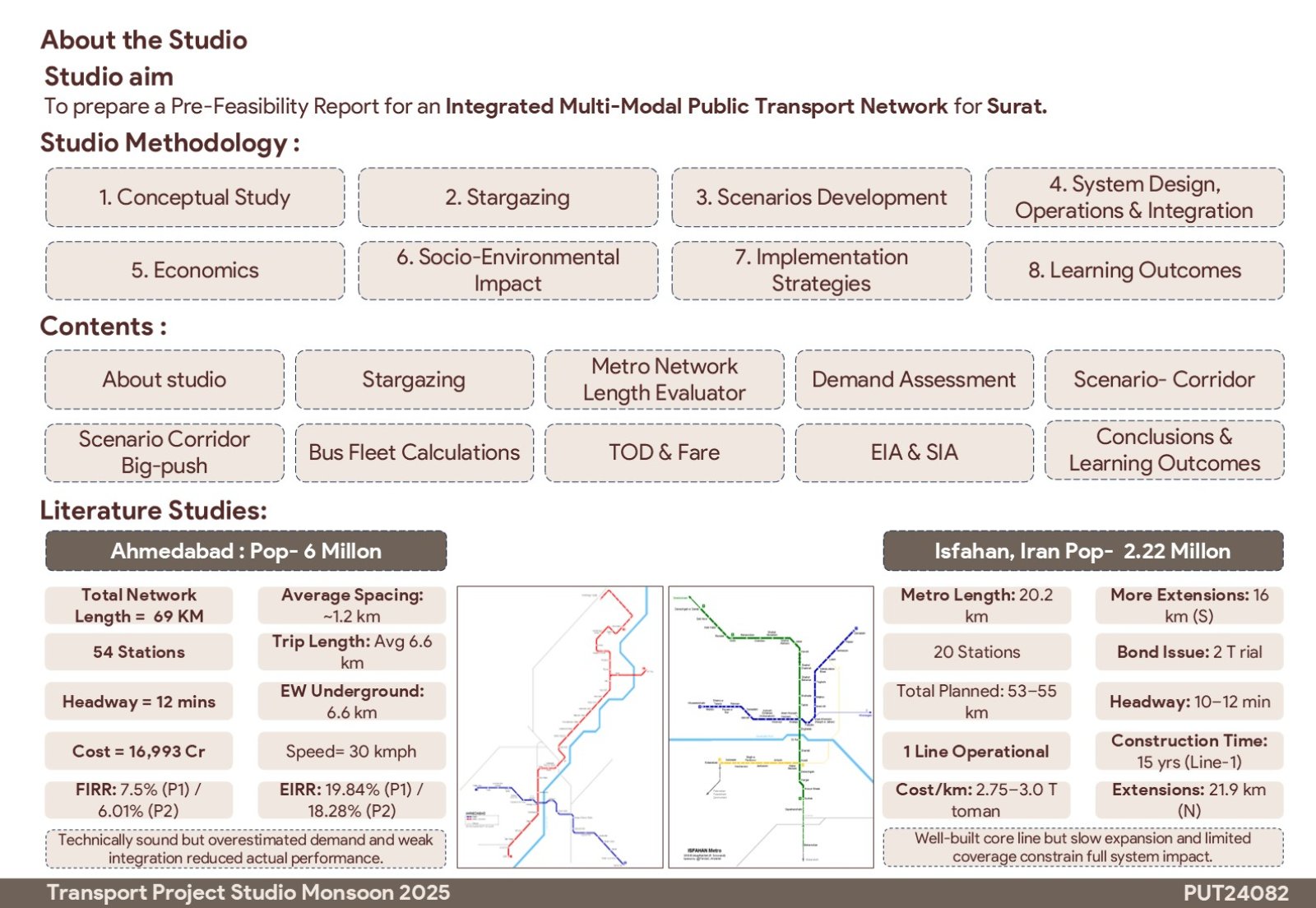
A comprehensive planning exercise structured around eight modules: conceptual foundations, future foresight, scenario development, system design, operations integration, economics, socio-environmental impact, and implementation strategies. The work spans multimodal planning—metro, BRTS, city bus, and non-motorized mobility—woven into a unified network vision for Surat. Literature studies from Ahmedabad and Isfahan offer lessons on demand accuracy, integration quality, and expansion pacing, informing decisions on network completeness and phasing. The studio combines modelling, design, policy, and evaluation to produce a robust pre-feasibility framework.

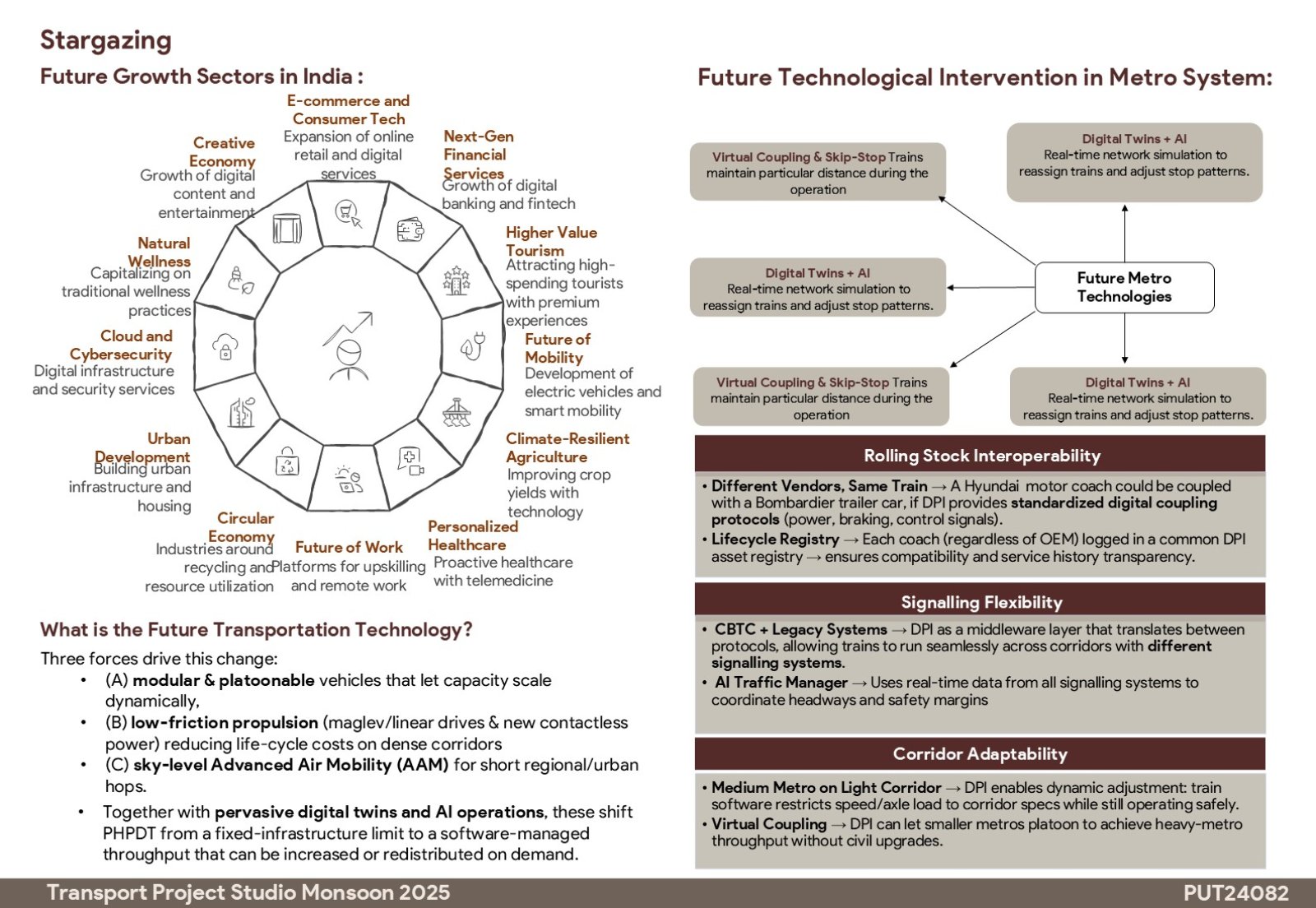
Future growth sectors—including e-commerce, fintech, urban development, creative economy, wellness, cybersecurity, and future mobility—shape long-term travel demand and workforce distribution. Emerging industries demand flexible, high-capacity, digitally integrated transport systems. Technological interventions redefine metro operations: Digital Twins enable real-time optimization; virtual coupling increases line capacity without physical upgrades; skip-stop algorithms reduce travel time; AI traffic managers enhance safety and efficiency. Interoperable rolling stock and signalling create a vendor-neutral environment, ensuring long-term adaptability. The vision anticipates a shift from hard-coded infrastructure to software-driven, scalable mobility systems aligned with Surat’s future economic trajectory.

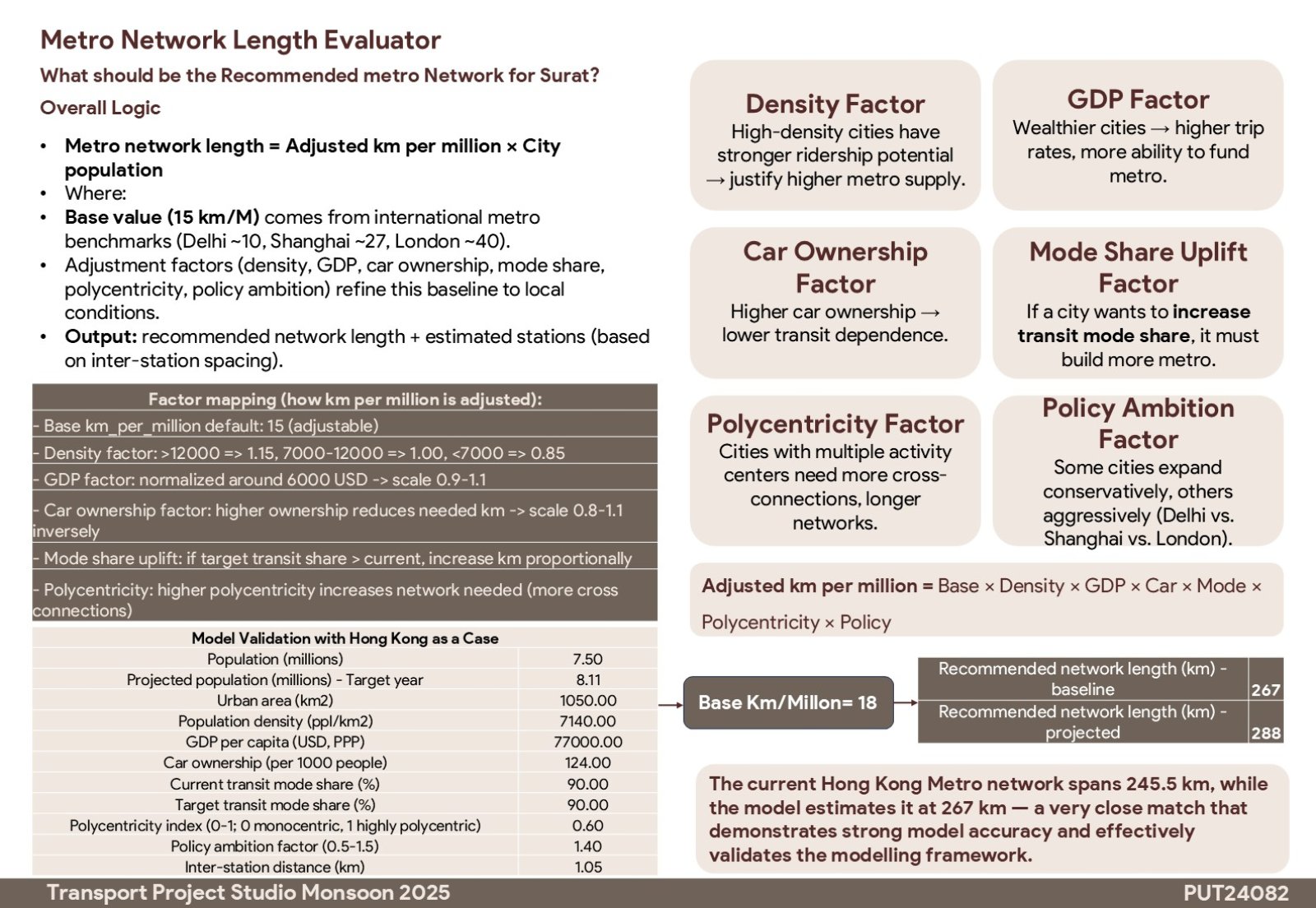
A data-driven framework used to estimate the ideal metro network size for Surat by adjusting global benchmarks to local city conditions. The model begins with a baseline of 15 km per million population and refines it using six factors: density, GDP, car ownership, modal share ambition, polycentricity, and policy attitude. Each factor adjusts the required km per million upwards or downwards to reflect demand potential and system productivity. A validation using Hong Kong demonstrates strong model accuracy, estimating a 267 km network against the actual 245.5 km. The final adjusted value of 18 km per million guides the recommended metro length and station count for Surat. This method ensures that network planning aligns with future growth, travel behaviour, and the city’s long-term ambition for sustainable mobility.

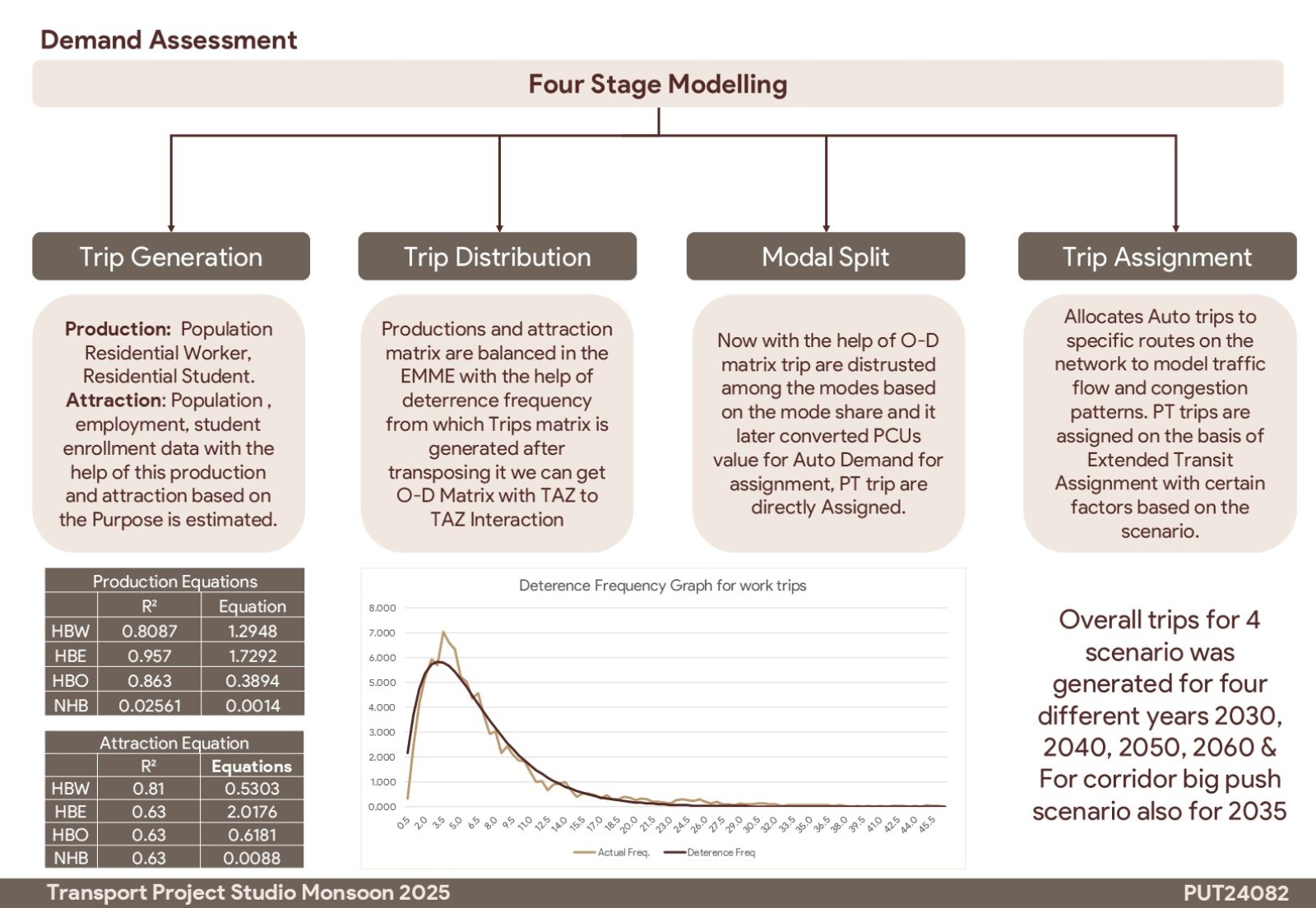
A four-stage travel modelling framework used to generate future demand for 2030, 2040, 2050, and 2060 across all scenarios. Trip Generation estimates productions and attractions based on population, employment, and student distribution. Trip Distribution balances these interactions using deterrence frequency curves, creating a realistic O-D matrix. Modal Split assigns trips across public transport and auto modes using scenario-specific mode shares. Trip Assignment allocates flows across the multimodal network, incorporating congestion, route choice, and extended transit parameters. The model outputs PPHPD loads, trip lengths, and spatial demand patterns that define corridor viability and network sizing. The approach ensures demand forecasts that align with demographic change and multimodal integration.

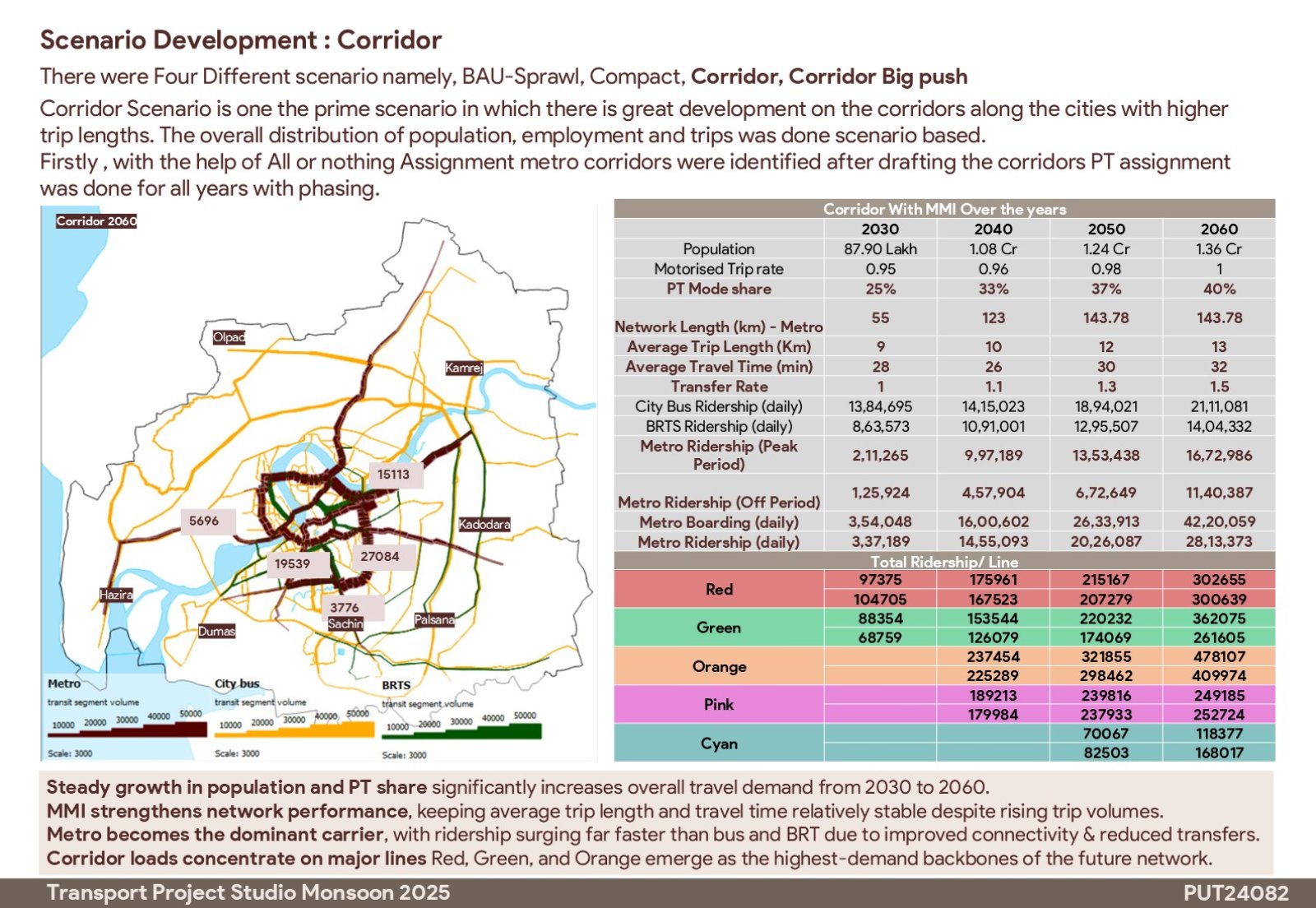
The Corridor Scenario focuses on channeling growth along high-connectivity transit corridors, resulting in strong demand concentration and efficient movement patterns. As population and PT share rise, the metro network expands from 55 km to 144 km by 2060, improving trip lengths and travel times. Metro ridership grows rapidly, surpassing buses and BRTS due to improved accessibility and lower transfer friction through multimodal integration. High-demand clusters emerge on the Red, Green, and Orange lines, defining the strongest structural spines of future mobility. The scenario demonstrates how transit-oriented development and phased network expansion can generate a resilient and well-balanced system with high operational productivity.

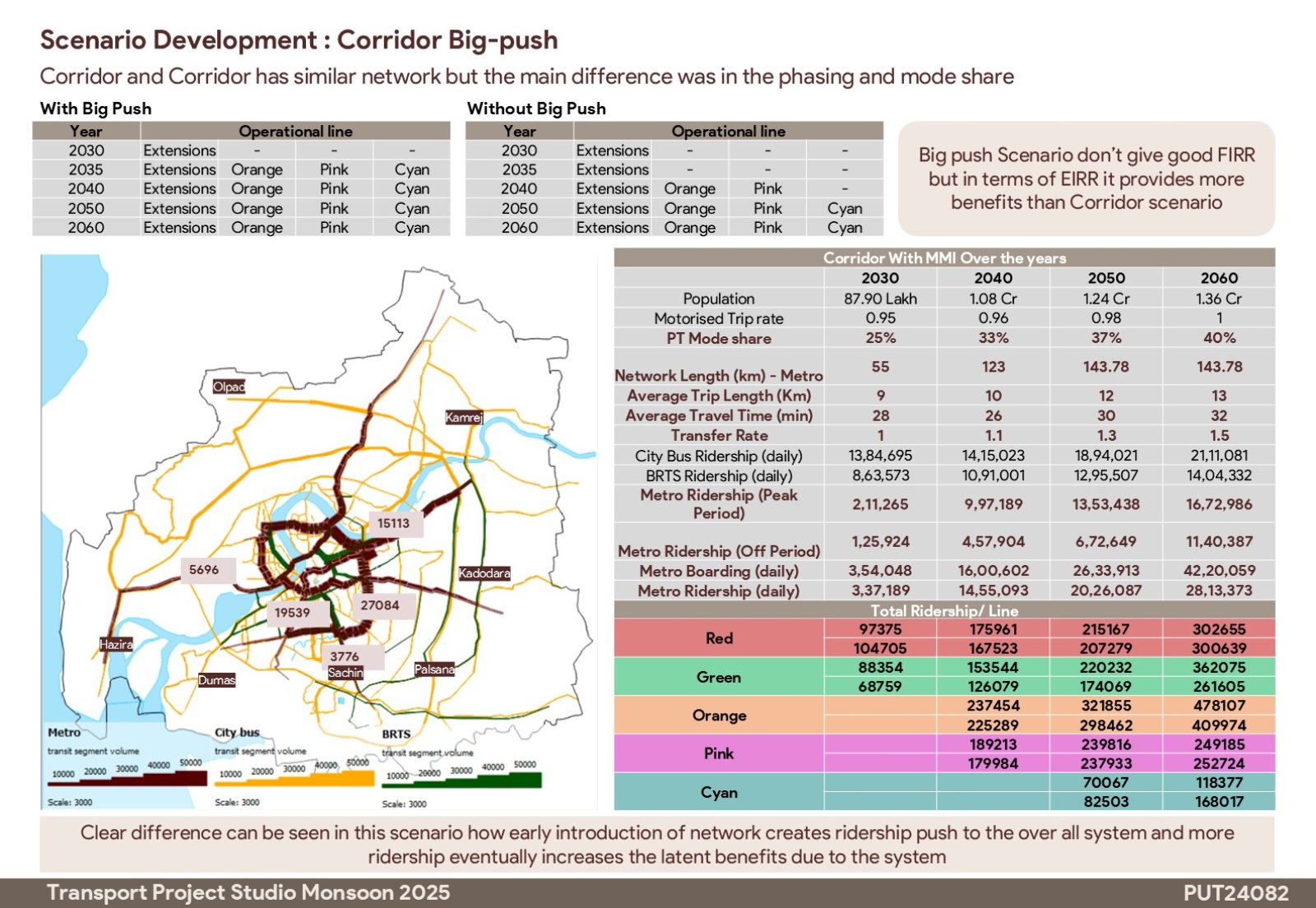
Early network completion accelerates ridership, strengthens corridor loads, and enhances long-term system performance. The Big Push approach prioritizes opening all major metro extensions by 2035 instead of phasing them over decades. This creates a substantial “ridership uplift,” tapping into latent demand and establishing public transport habits earlier. Despite lower FIRR due to upfront investment, EIRR is significantly higher because of broader social, economic, and environmental benefits. The network records stronger demand on key corridors, balanced ridership distribution, and higher boarding efficiency. The comparison reinforces that network sequencing—not city growth—is the decisive factor in long-term metro viability.

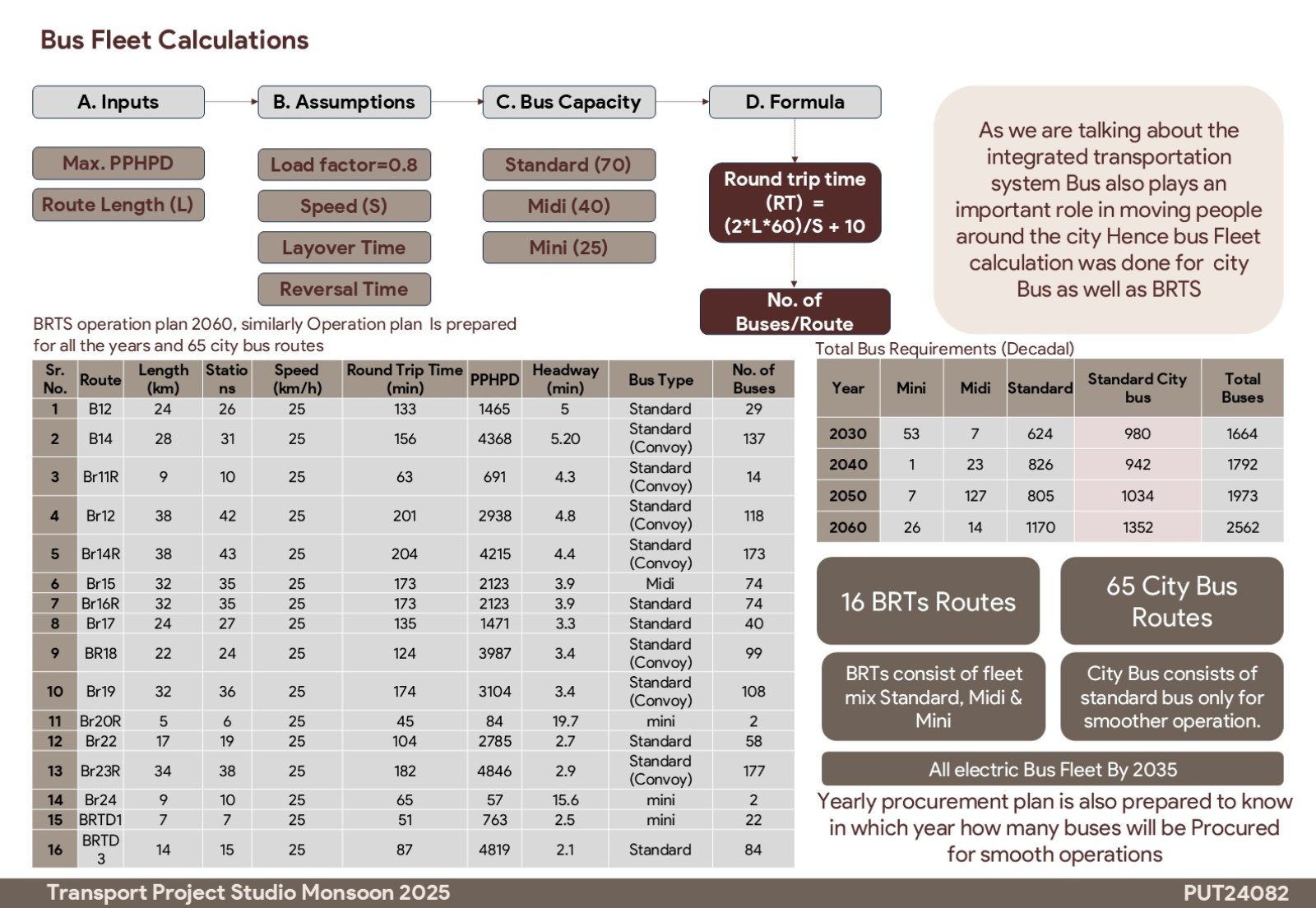
Fleet planning integrates corridor characteristics, service frequency, and operational assumptions to calculate bus requirements for both BRTS and City Bus systems. Round-trip time is derived from route length, speed, and layover, determining the number of buses needed to maintain the required headway. The model incorporates standard, midi, and mini buses based on PPHPD demand across 16 BRTS routes and 65 city bus routes. Total bus requirements increase from 1,664 in 2030 to 2,562 in 2060, reflecting growing demand. The strategy includes full electrification by 2035 and structured procurement cycles for smoother operations. The fleet design ensures high-frequency service, strong feeder connectivity, and an integrated, efficient multimodal network.

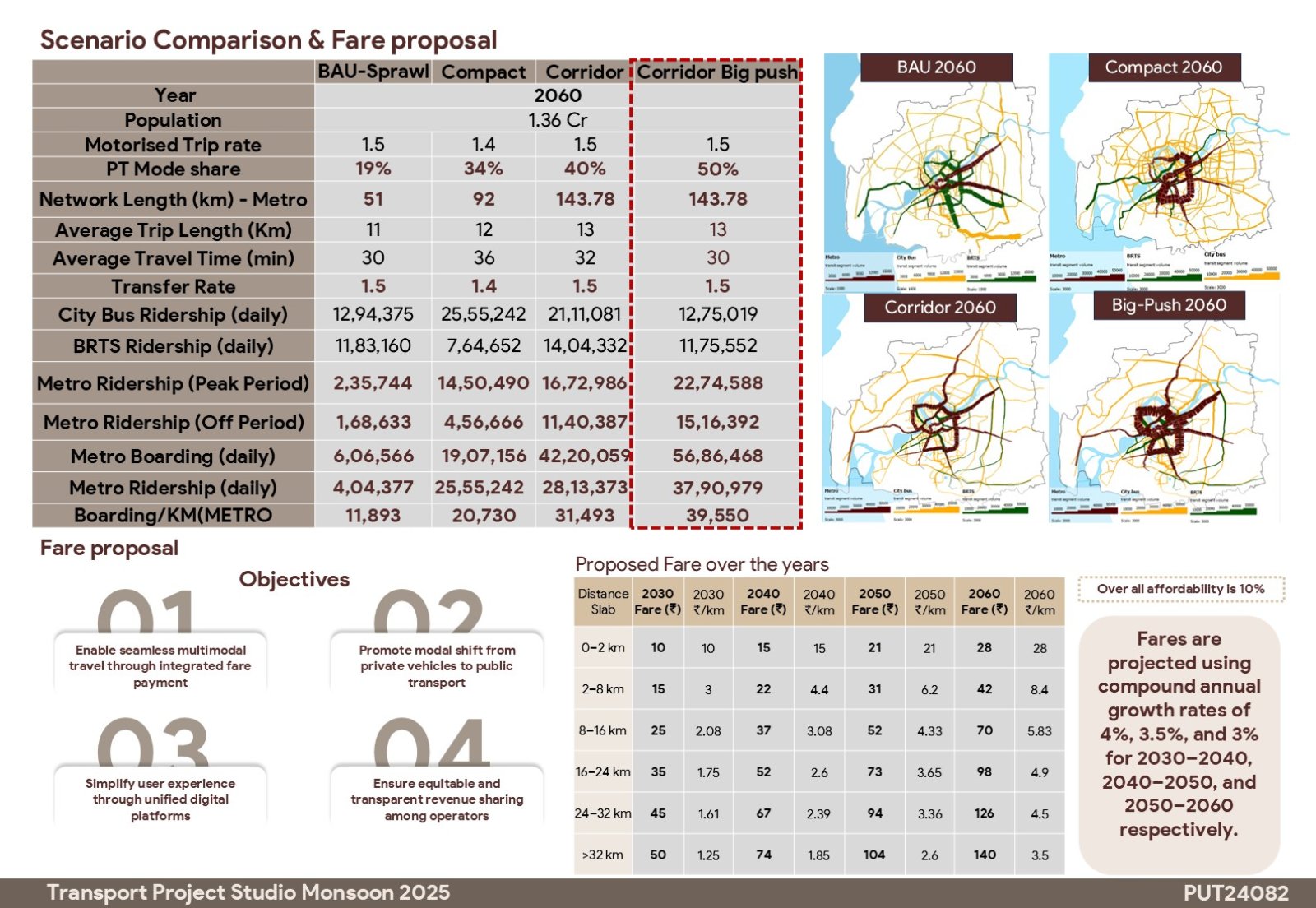
Scenario comparison highlights how land-use patterns shape transport performance. BAU remains low-performing due to sprawl, while Compact improves mode share through densification. Corridor and Big Push outperform both, offering higher ridership, better boarding/km, and stronger multimodal efficiency. Big Push reaches a 50% PT mode share, with exceptional metro productivity. The fare strategy proposes a distance-based, inflation-adjusted framework ensuring affordability and financial sustainability. Key objectives include seamless multimodal travel, modal shift encouragement, simplified user experience, and transparent revenue sharing. Fares grow gradually while retaining the 10% affordability threshold, balancing accessibility with system viability.

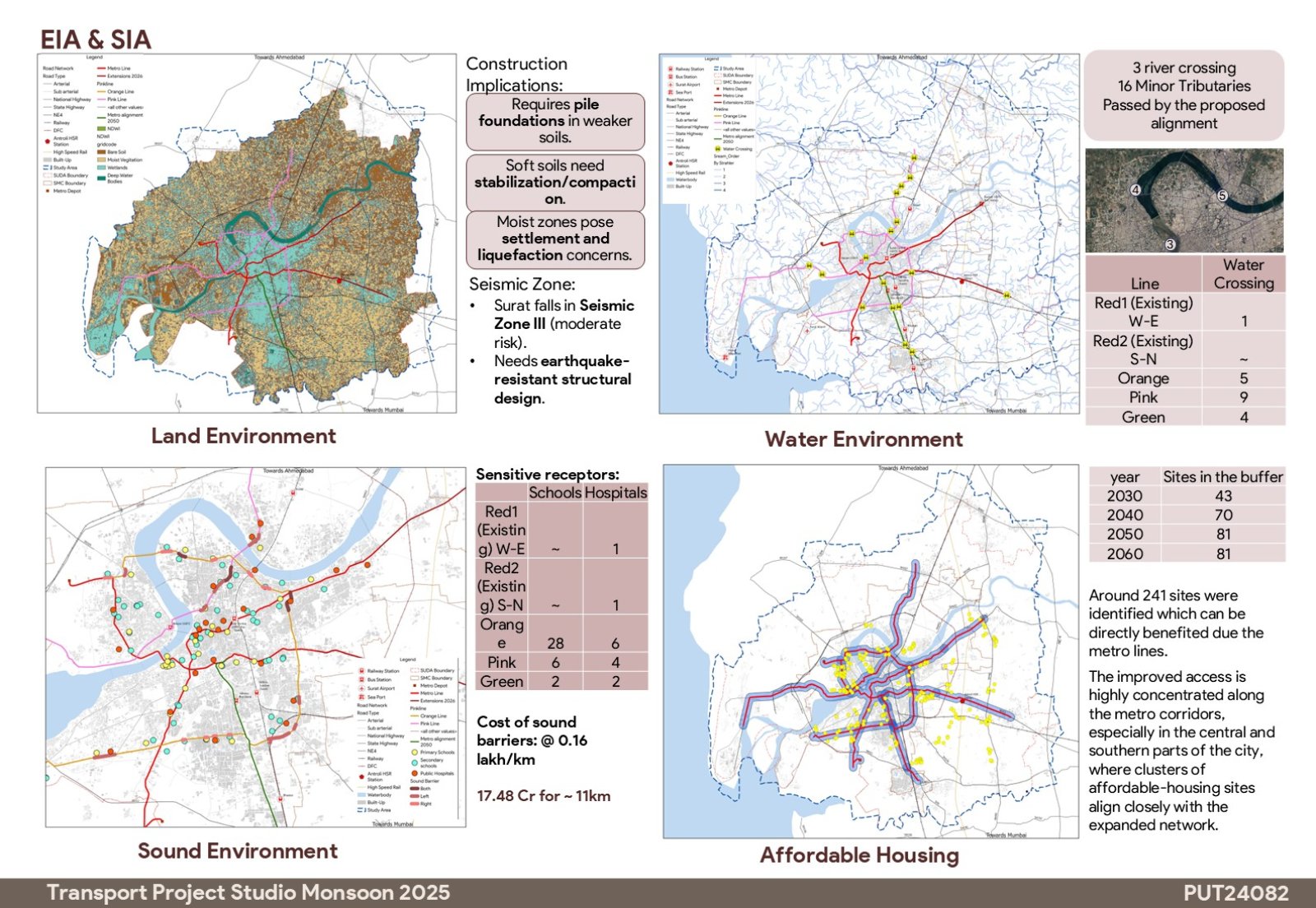
Environmental and social evaluations identify constraints and opportunities across geology, hydrology, land use, noise exposure, and vulnerable populations. Construction considerations respond to soft soils, moisture zones, and seismic risk through pile foundations and stabilization. Hydrological mapping captures river and canal crossings, ensuring alignment design does not disrupt natural flows. Sensitive receptors such as schools and hospitals require targeted mitigation including noise barriers and traffic management during construction. Affordable housing analysis shows increased accessibility along metro corridors, benefiting low-income communities. The assessment confirms that most impacts are manageable with appropriate engineering and policy interventions, while long-term benefits in mobility, equity, and environmental quality remain substantial.

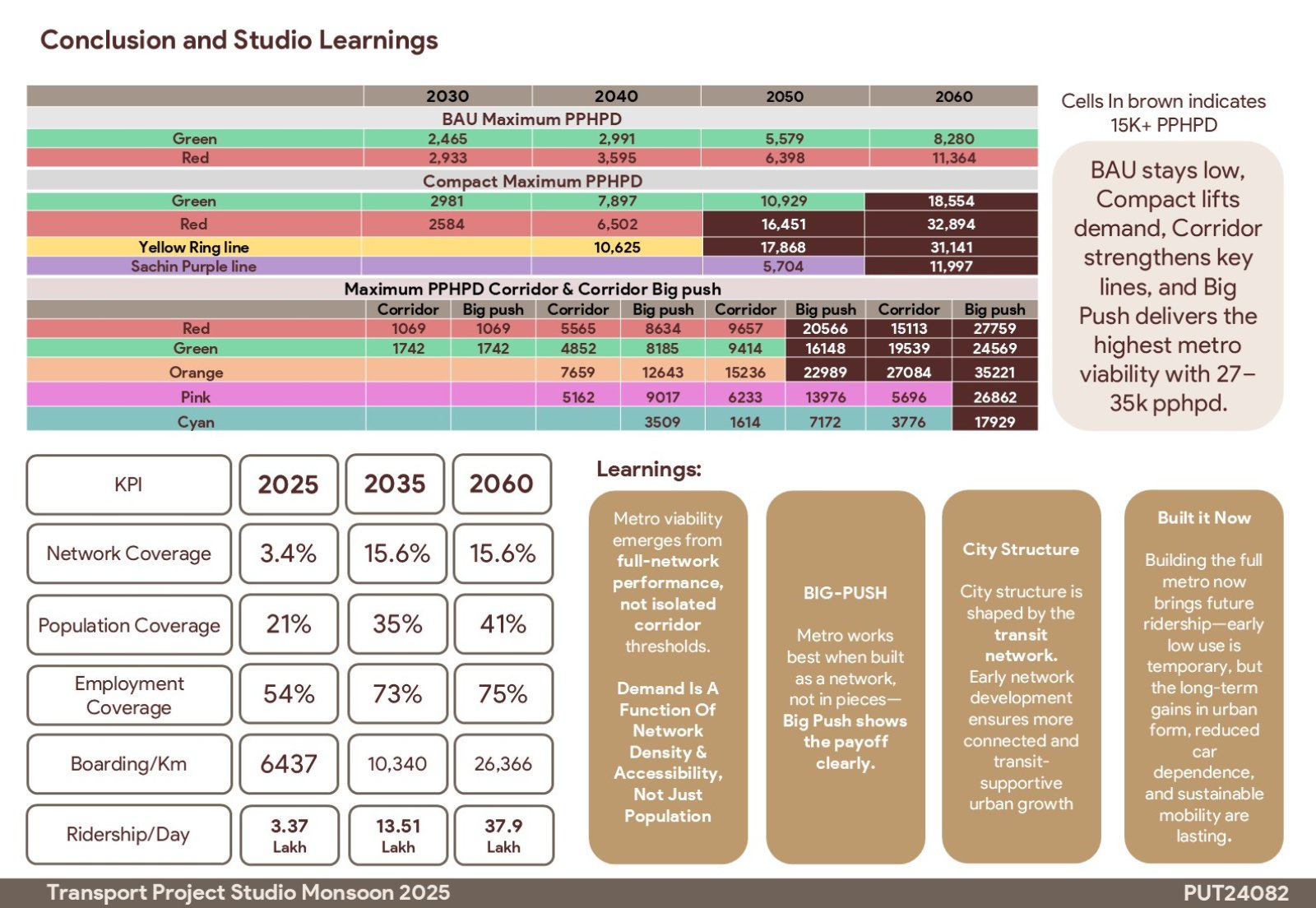
Performance indicators highlight substantial network efficiency gains under Corridor and Big Push scenarios. PPHPD levels, employment coverage, population reach, and boarding/km rise dramatically as the network matures from 2025 to 2060. Key learnings emphasize that metro viability depends on full-network performance, not isolated corridor demand. Early implementation strengthens ridership behaviour and shapes a more connected city structure. Big Push reveals the strongest returns, demonstrating how complete networks outperform phased approaches. Overall, the most sustainable outcome emerges from building early, integrating modes, and aligning city development with transit investment.