• Home
  • FD
  • CD4002
  • Dhaara: A Kinetic Origami Façade for Elevated Platform

Puspika Ghosh

CD4002

Dhaara: A Kinetic Origami Façade for Elevated Platform

Dhaara is a kinetic origami façade for semi-open spaces, such as terraces, verandahs and elevated platforms, that must remain open. Its case study is an elevated metro platform in Ahmedabad, where the breeze passes above passengers waiting in still, hot air. Each module is a rigid waterbomb fold of ten facets, driven by one linear actuator. The façade responds to outdoor wind speed for human comfort: fully open in calm conditions, closing as wind rises, and shut in strong wind or rain. Wind (CFD) and thermal comfort (UTCI) simulations show 1.35 m/s at occupant height, against 0.24 m/s behind louvers.
Report Content

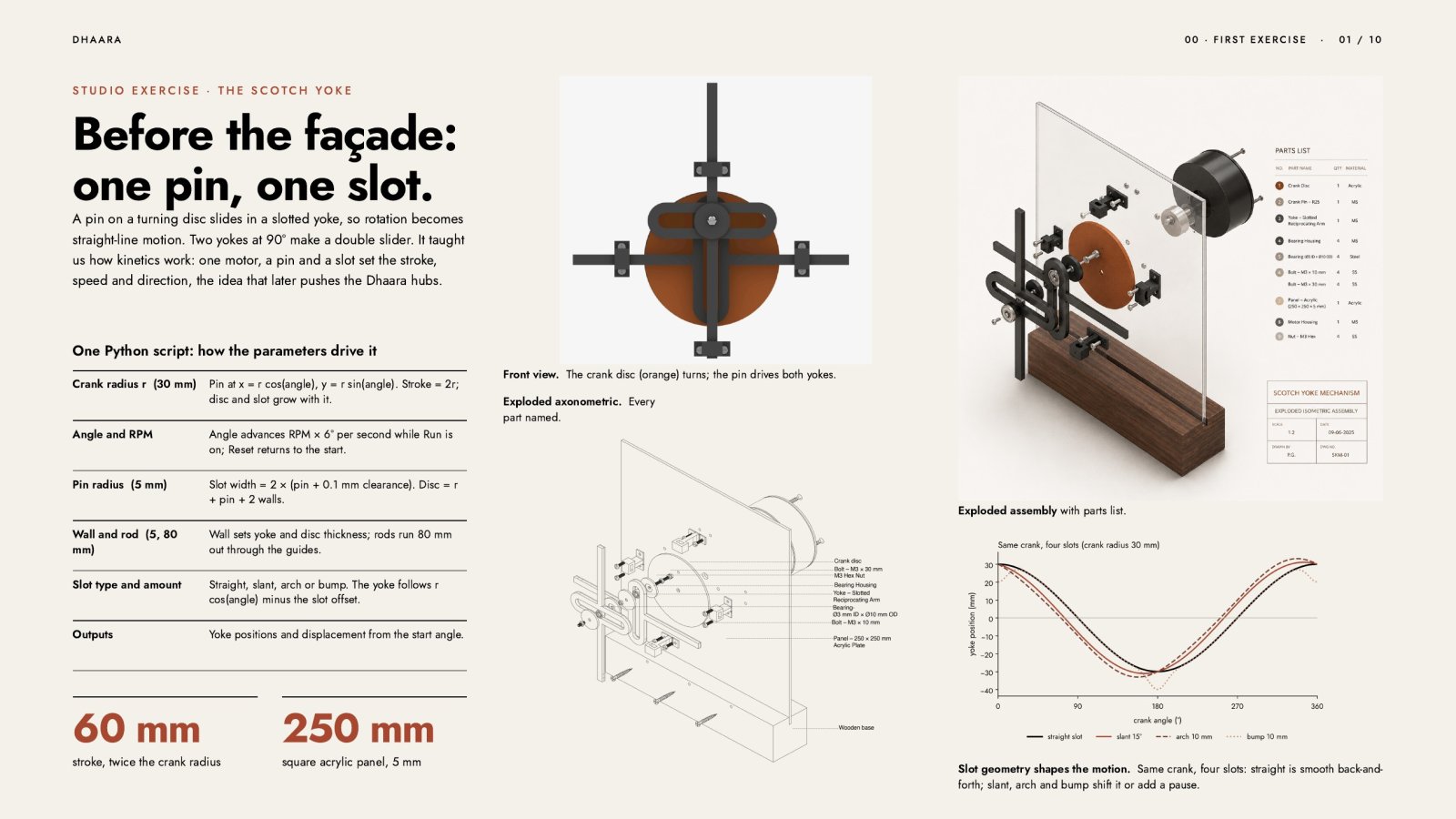
First studio exercise: a scotch yoke. A pin on a rotating crank disc slides inside a slotted yoke, converting rotation into linear motion; two yokes at 90° form a double slider. The mechanism was modelled parametrically with a Python script in Grasshopper, where crank radius, pin radius, wall thickness, rod length and slot shape drive the geometry and motion. The exercise established how a single motor, a pin and a slot control stroke, speed and direction.

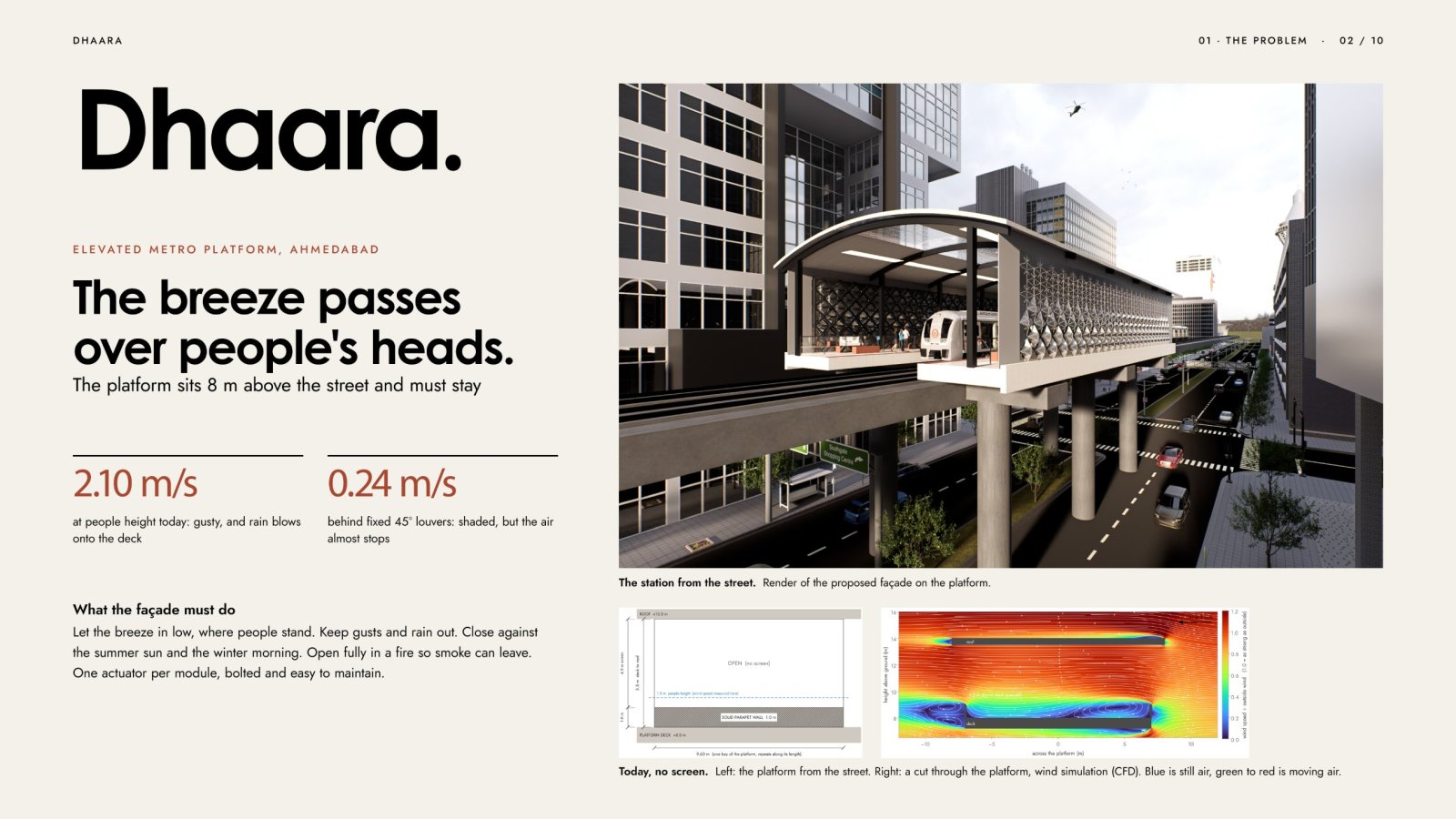
The problem The case study: an elevated metro platform in Ahmedabad, 8 m above the street. It must stay open, yet the breeze passes over passengers' heads while they wait in still, hot air. CFD shows 2.10 m/s of gusty wind at people height on the open deck, while conventional 45° louvers reduce it to 0.24 m/s, leaving the air almost still.

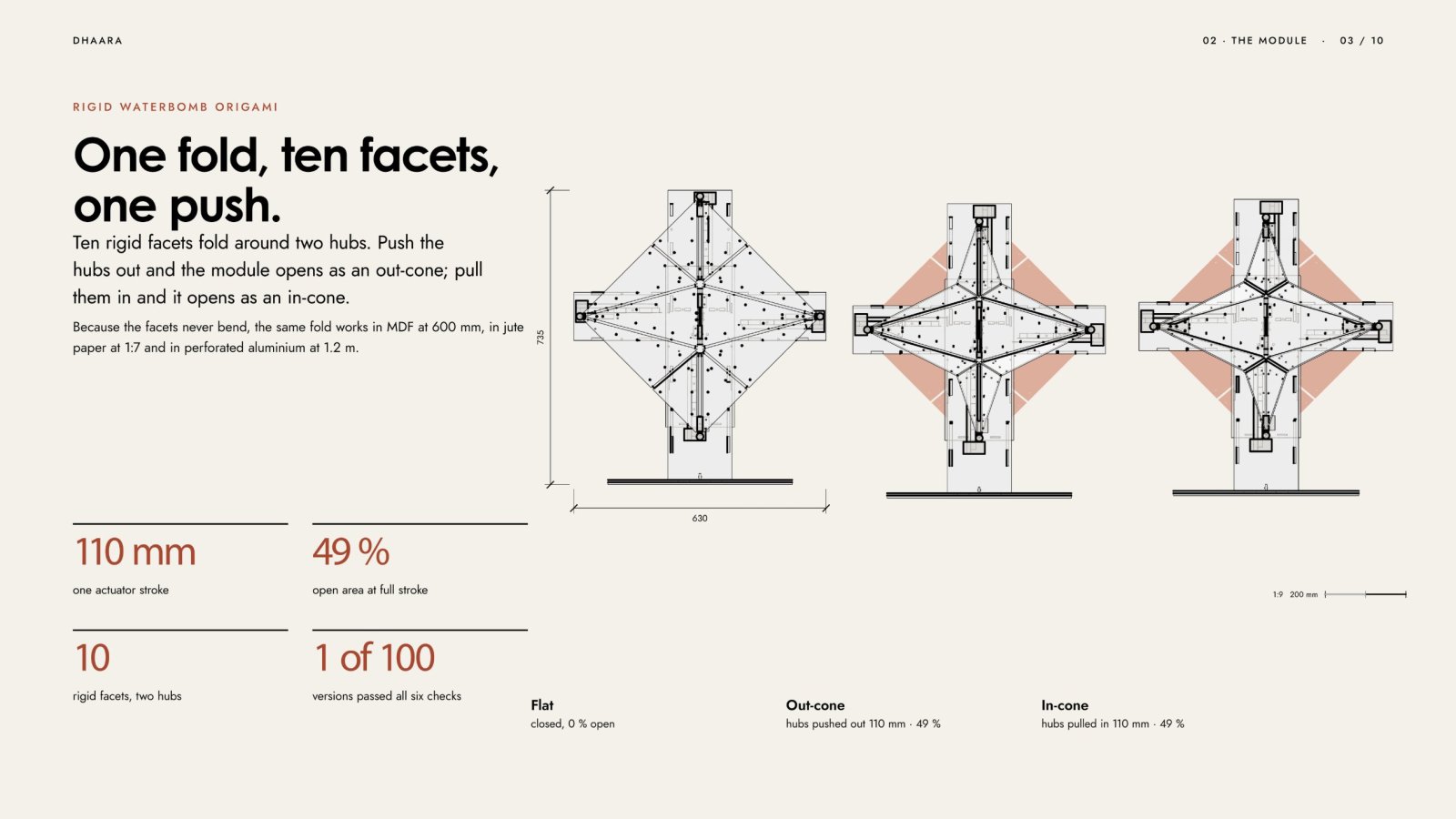
The module The module is a rigid waterbomb origami fold: ten rigid facets hinged around two hubs. Pushing the hubs out opens it as an out-cone; pulling them in opens it as an in-cone. A single 110 mm actuator stroke gives 49 % open area. Because the facets never bend, the same fold works in MDF at 600 mm, jute paper at 1:7 and perforated aluminium at 1.2 m.

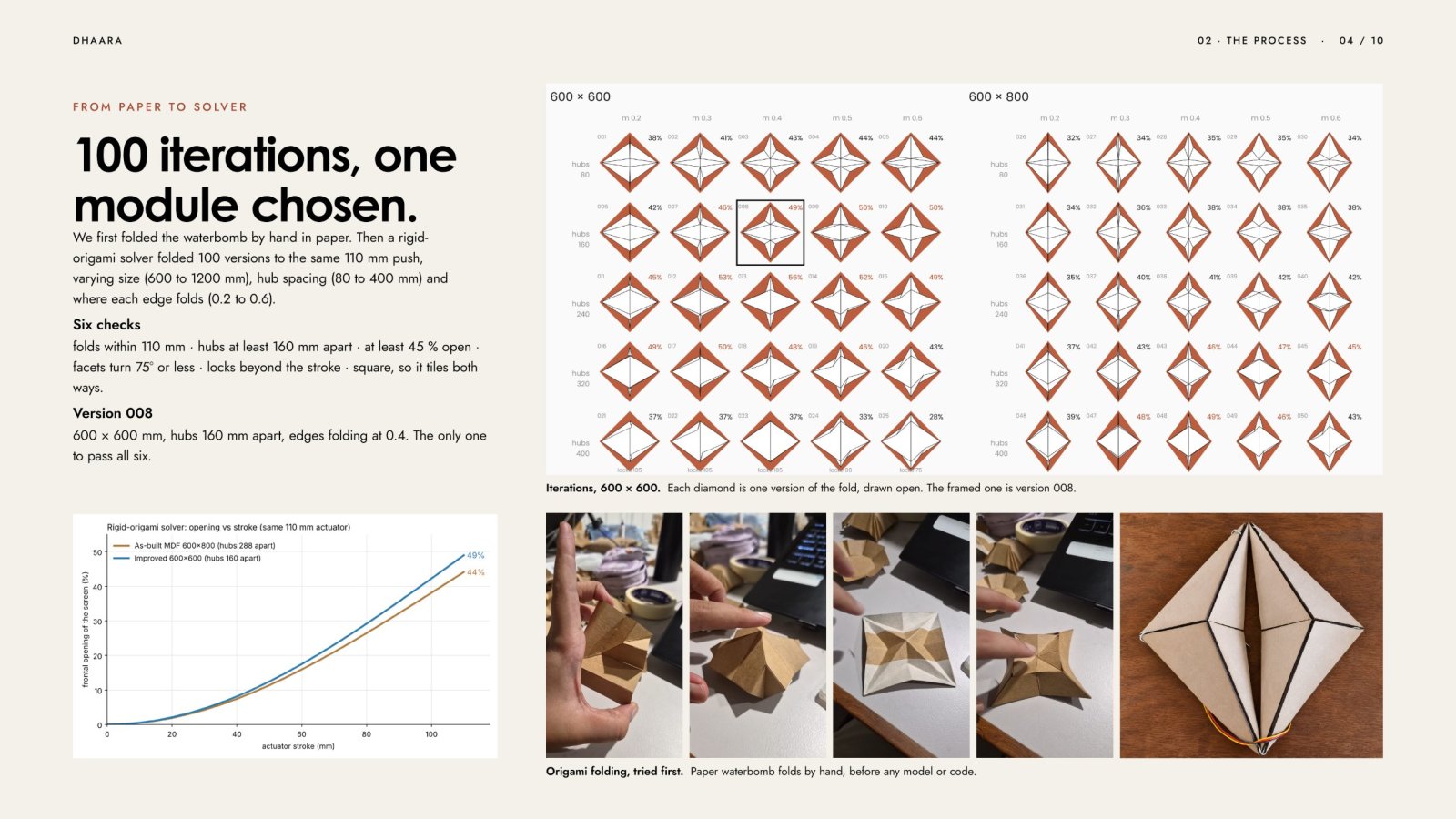
Process The fold was first tested by hand in paper, then a rigid-origami solver generated 100 versions, varying module size, hub spacing and fold position. Each was checked against six criteria: folding within 110 mm, hub clearance, at least 45 % open area, facet angle, locking beyond the stroke and tiling. Version 008 (600 × 600 mm, hubs 160 mm apart) was the only one to pass all six.

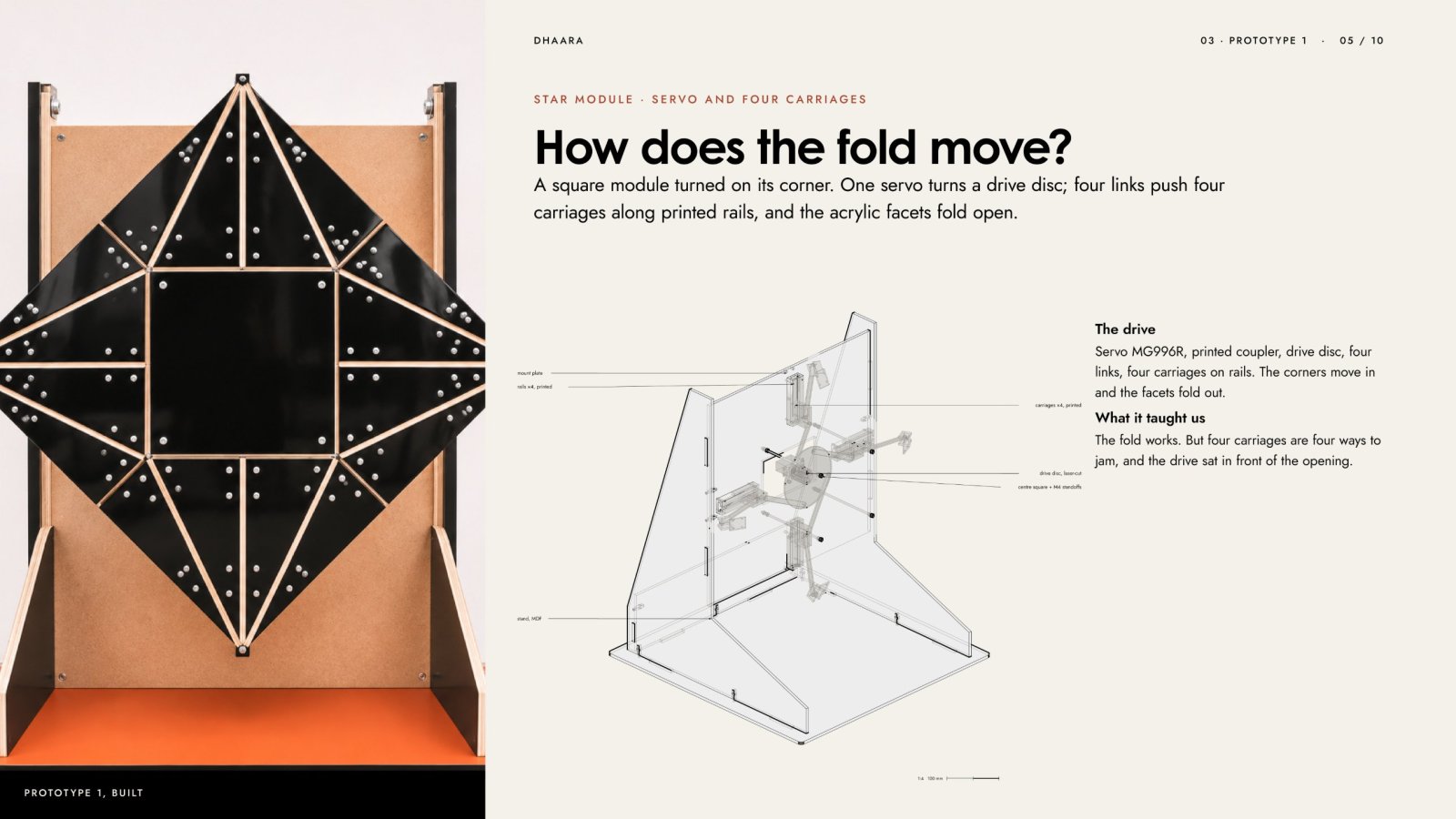
Prototype 1 Prototype 1, star module: one servo turns a drive disc, and four links push four carriages along printed rails to fold the acrylic facets open. It proved the fold works, but four carriages meant four points of failure, and the drive sat in front of the opening, blocking airflow.

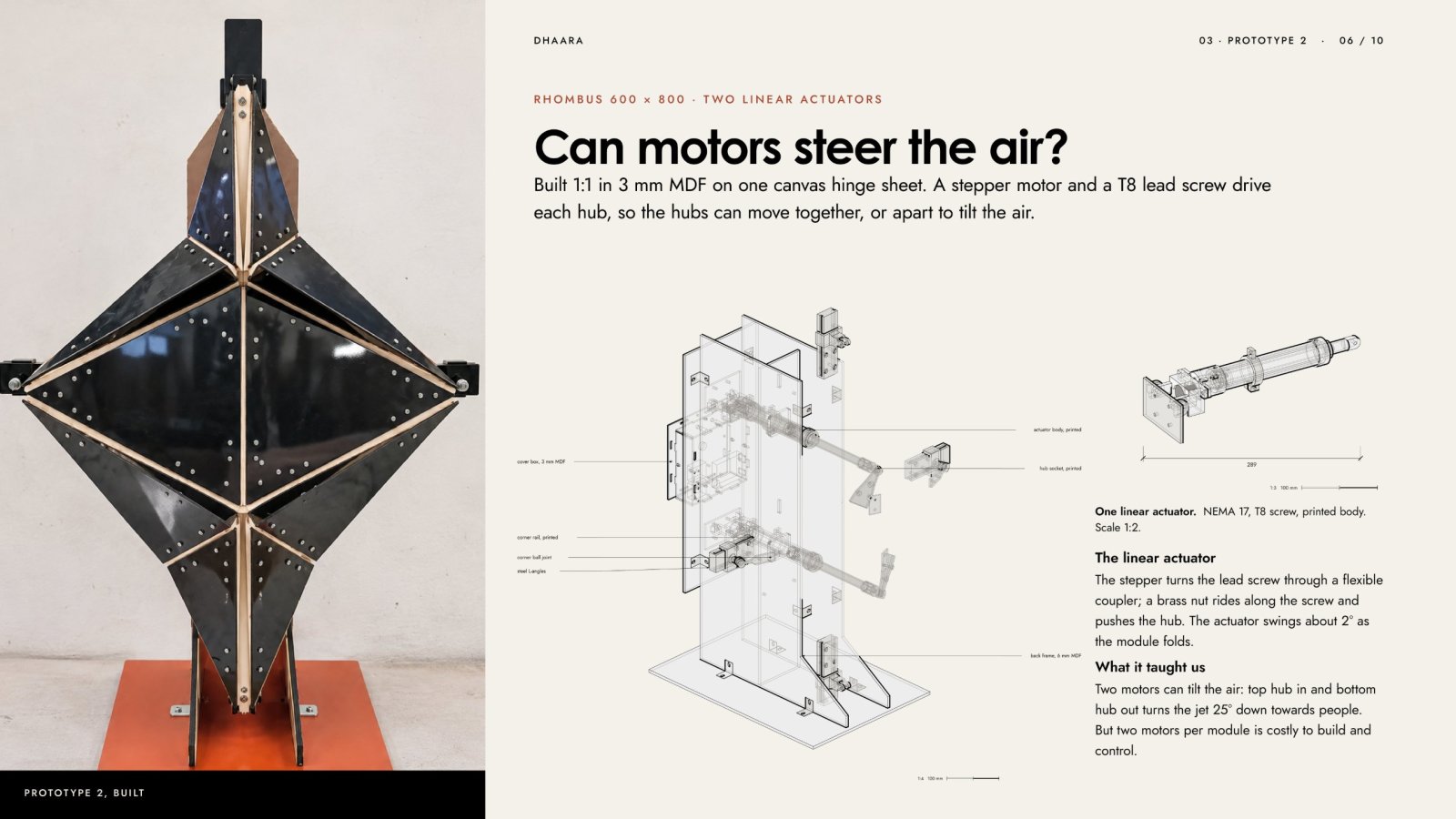
Prototype 2 Prototype 2, 600 × 800 rhombus: built at 1:1 in 3 mm MDF on a single canvas hinge sheet. Two linear actuators, each a stepper motor driving a T8 lead screw, move the hubs independently, so the module can tilt the airflow; top hub in and bottom hub out turns the jet 25° down towards people. Two motors per module, however, proved costly to build and control.

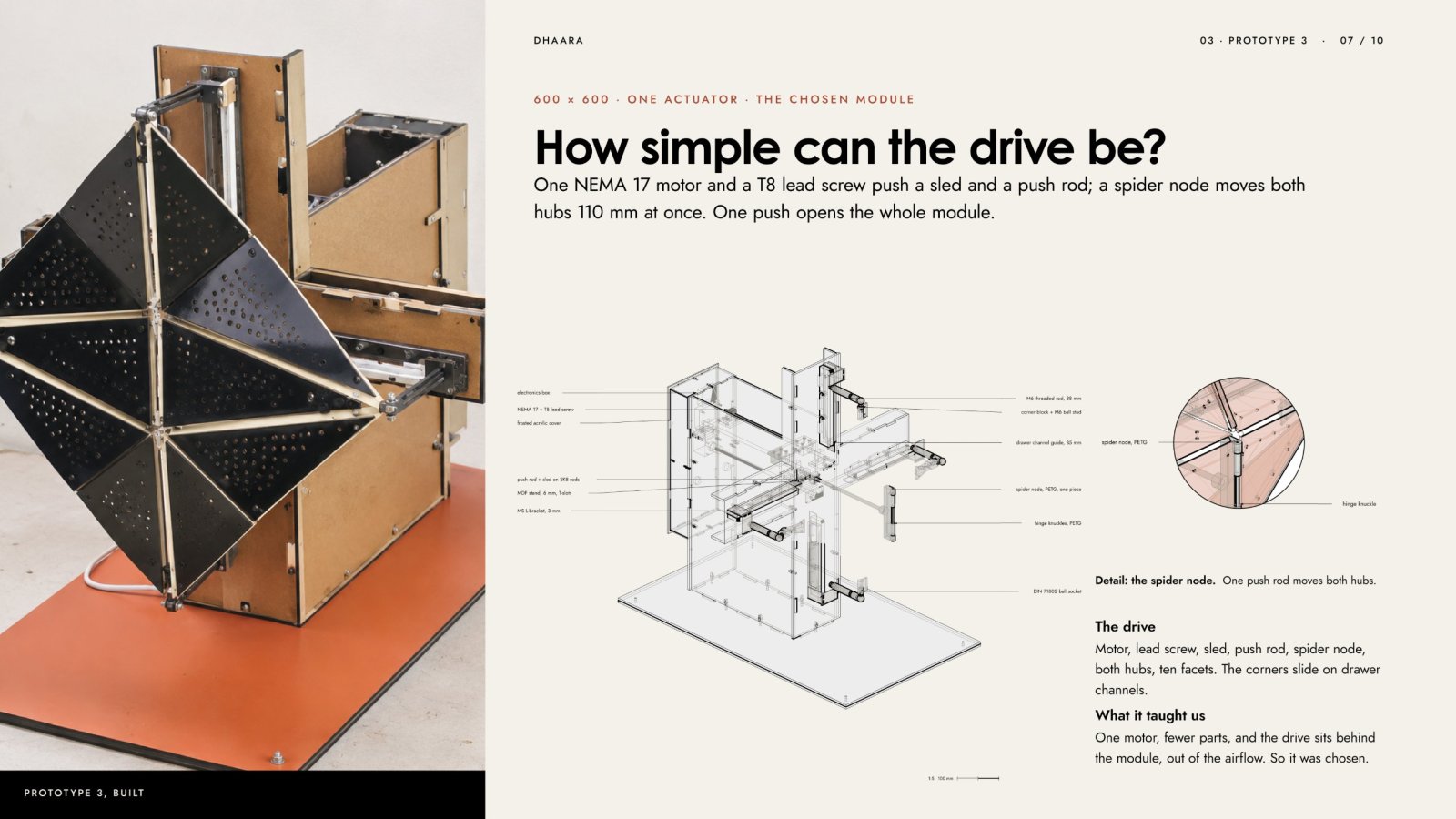
· Prototype 3 Prototype 3, the chosen module: one NEMA 17 motor and a T8 lead screw drive a sled and push rod, and a printed spider node moves both hubs 110 mm at once. One push opens the whole module. With fewer parts, a single motor and the drive placed behind the module, out of the airflow, it became the final system.

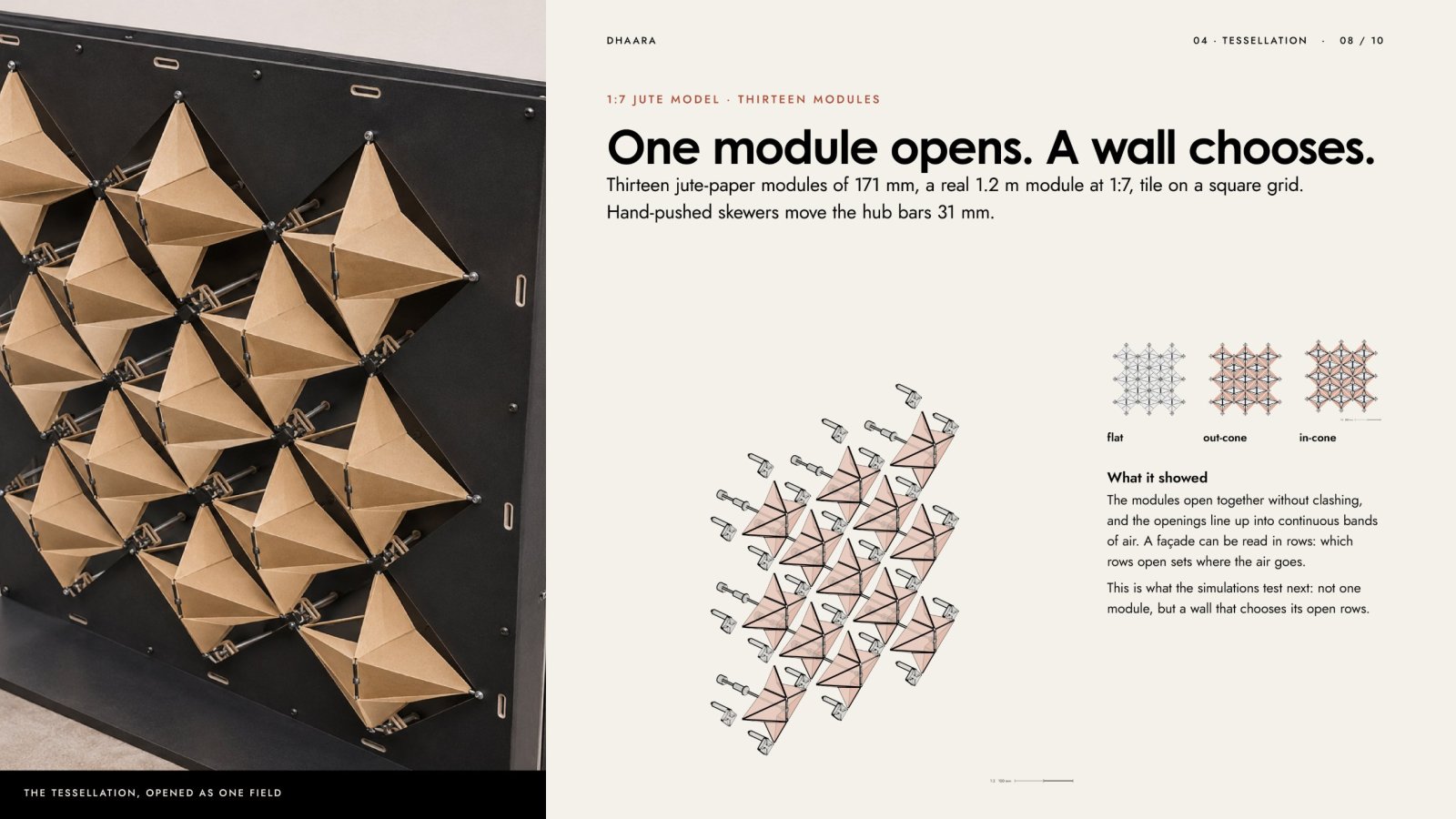
Tessellation A 1:7 jute-paper tessellation of thirteen modules on a square grid, each representing a 1.2 m façade module, operated by hand-pushed skewers. The modules open together without clashing, and their openings align into continuous bands of air, showing that a façade can be controlled row by row to direct where the air goes.

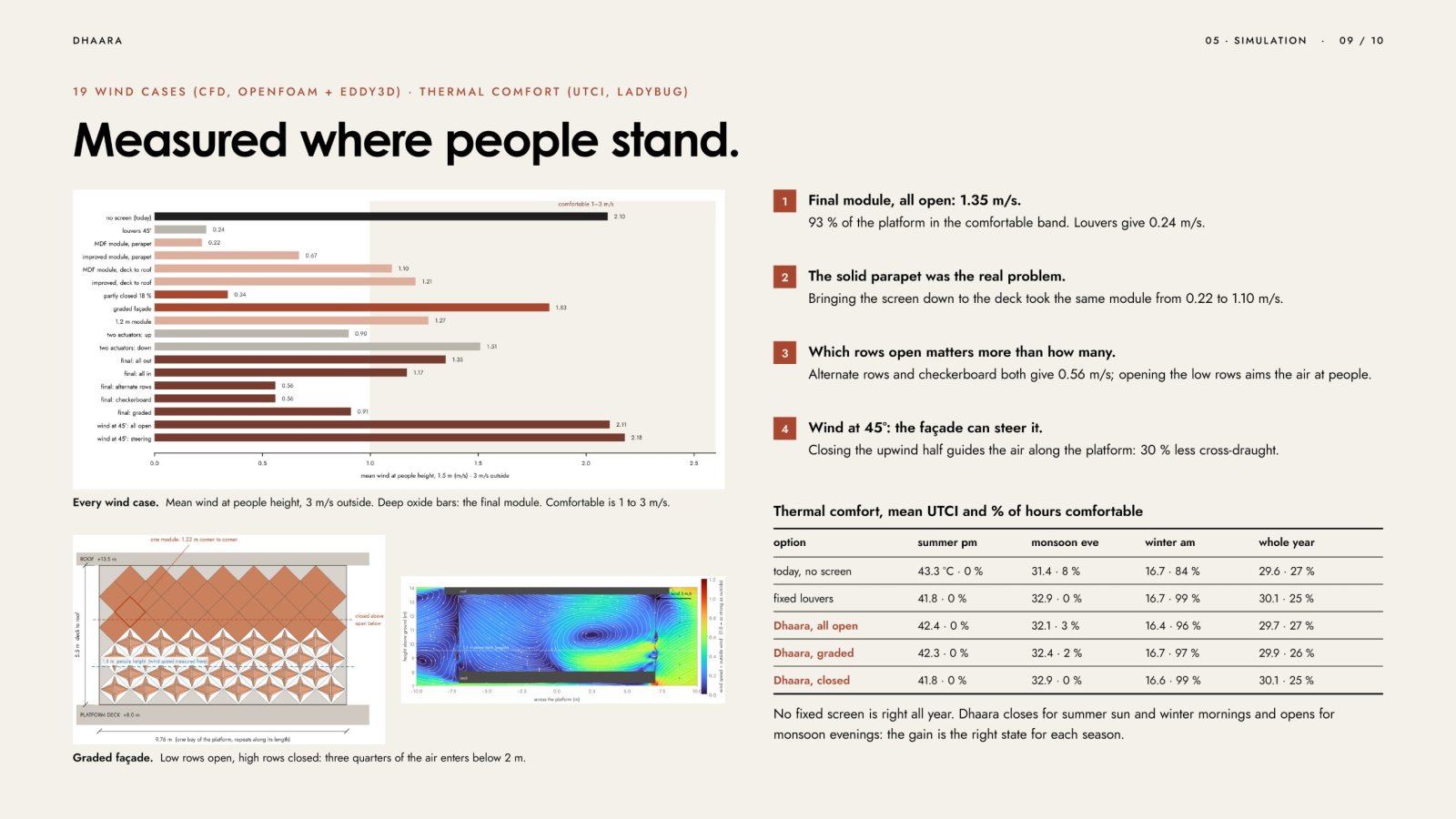
Simulation summary Wind (CFD, OpenFOAM with Eddy3D) and thermal comfort (UTCI, Ladybug) simulations, measured at 1.5 m where people stand. With all modules open, the final module delivers 1.35 m/s, keeping 93 % of the platform in the comfortable 1 to 3 m/s band, against 0.24 m/s behind louvers. No fixed screen suits every season; the kinetic façade opens for monsoon evenings and closes for summer sun, winter mornings, strong wind and rain.
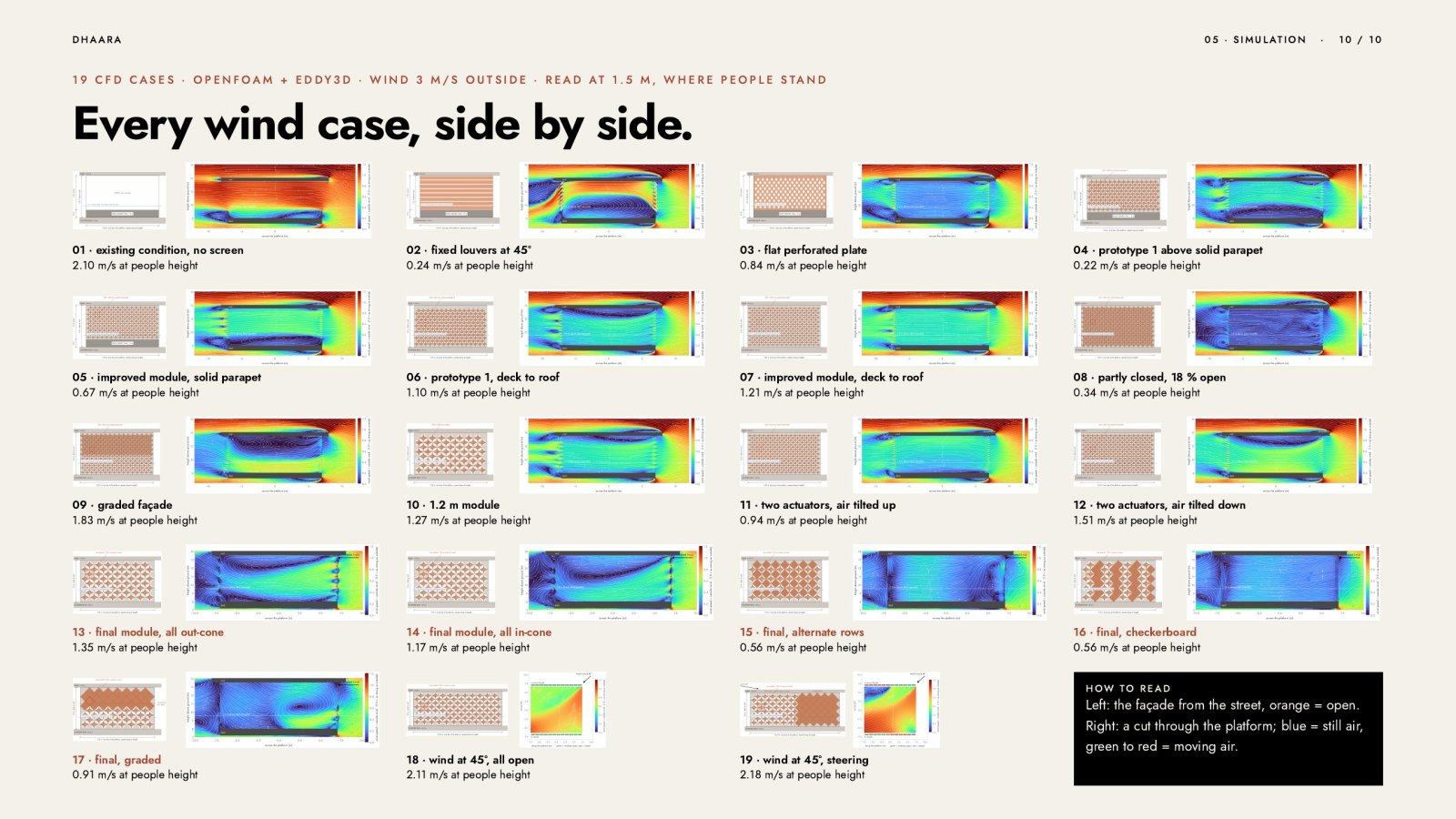
Every wind case All 19 CFD wind cases compared side by side, with 3 m/s wind outside. Each pairs the façade elevation (orange = open) with a section through the platform (blue = still air, green to red = moving air), and gives the average wind speed at people height. The cases trace the design from the existing open platform and louvers, through each prototype, to the final module's opening patterns and its ability to steer wind arriving at 45°.

Project Video