Christa Ann Billy

UM4005

Municipal Finance and Capital Investment

What enables a city to transform its economic ambitions into reality? Beyond industries, businesses and infrastructure, it is the financial capacity of its institutions to invest, deliver and sustain growth.
The Ahmedabad-Gandhinagar City Region (ACR) is anchored by two municipal corporations, AMC and GMC, whose fiscal resources shape the region’s ability to support urban development. This study examines their revenue structures, capital investments, grants and borrowing, benchmarking their performance against cities such as Pune and Chennai. 
It further explores the foundations required to envision ACR as a globally competitive city region by 2047 through an assessment of seven key indicators, the study identifies existing gaps and develop strategic recommendations  translating its global-city aspirations into actionable priorities

Report Content

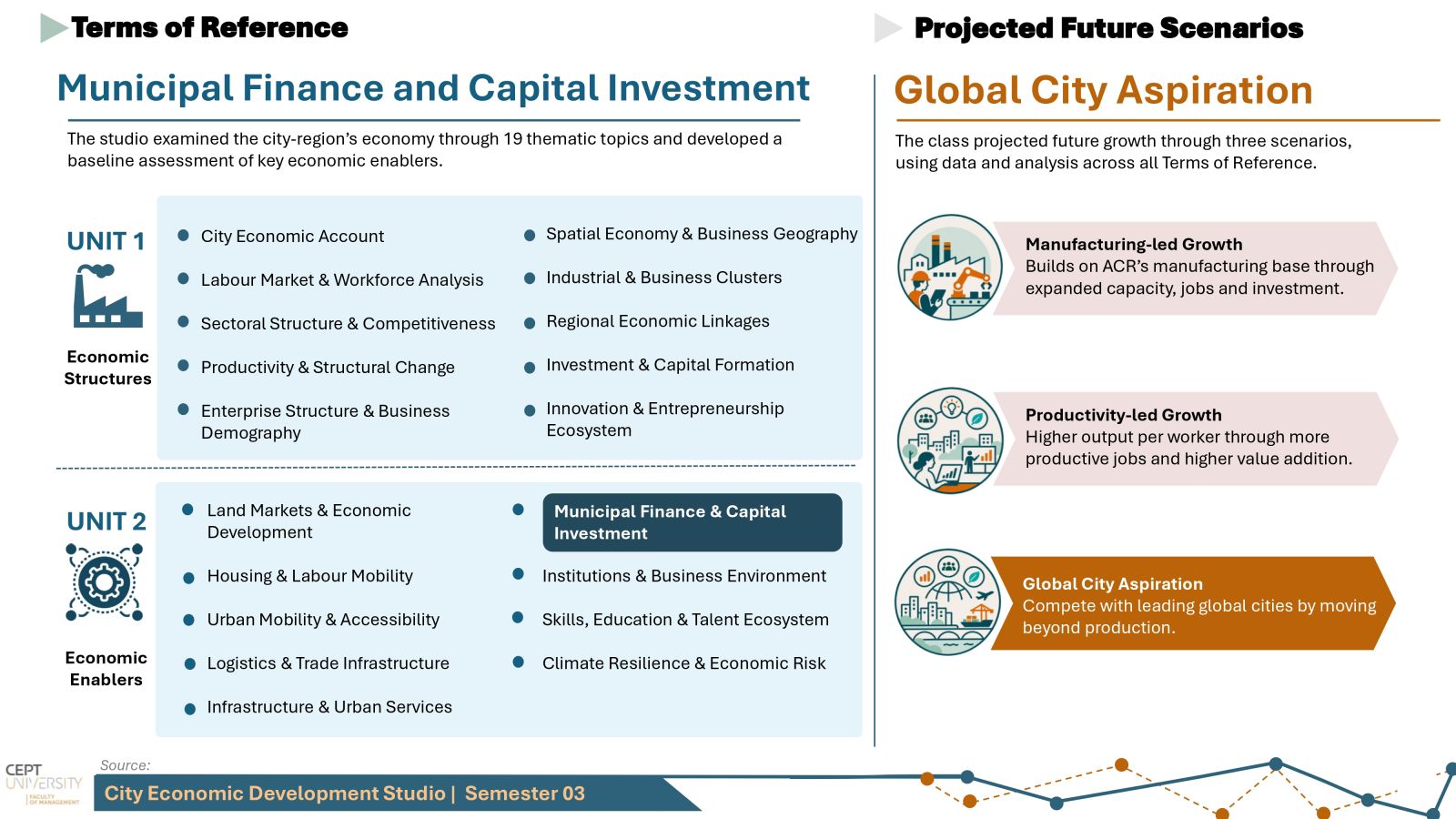
The studio studied the city region's economy through 19 thematic topics in two units, Economic Structures and Economic Enablers, and Municipal Finance and Capital Investment is one of the enablers. These findings feed three future scenarios: manufacturing led growth, productivity led growth and a global city aspiration.

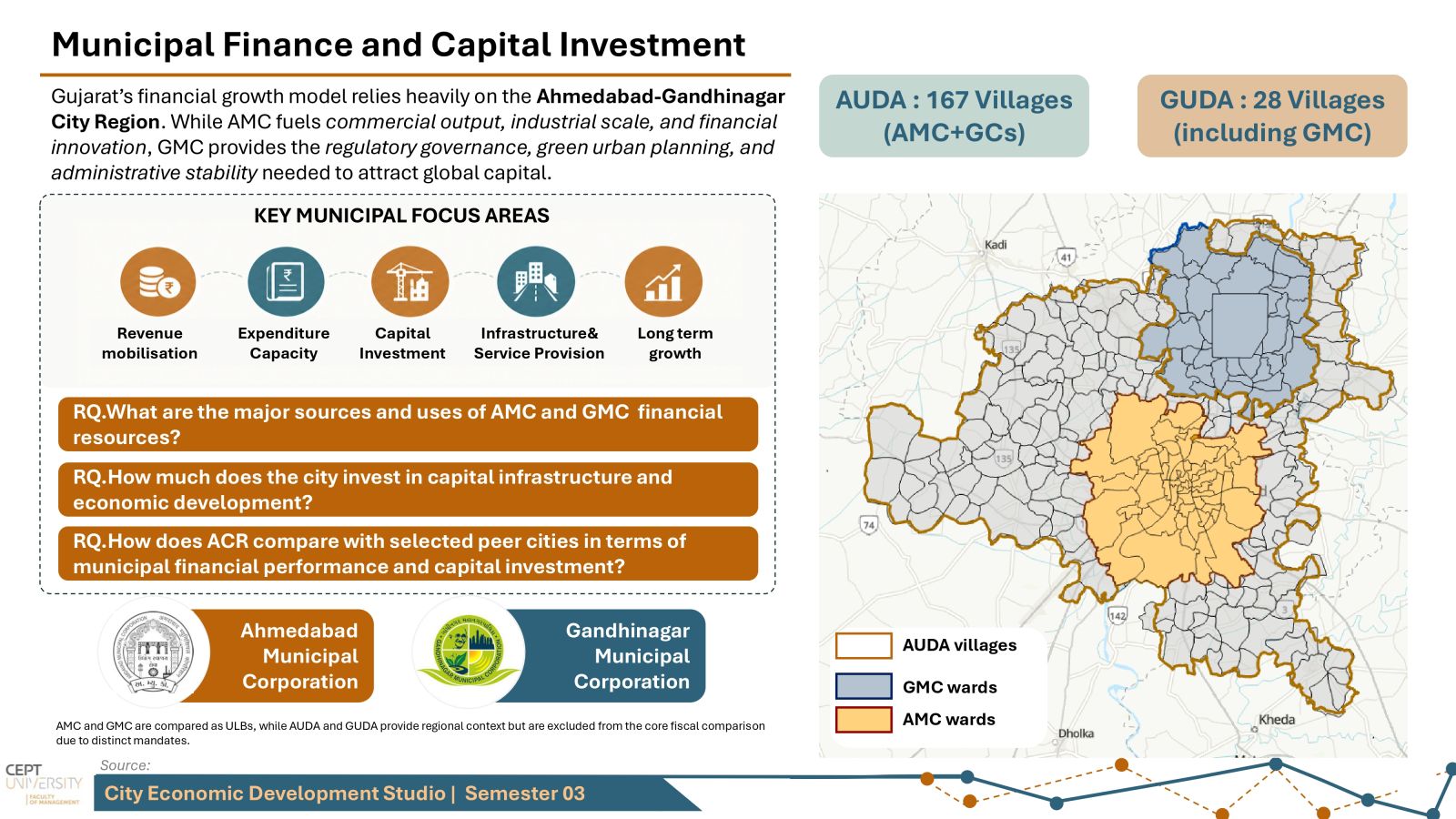
Municipal Finance and Capital Investment Gujarat's growth relies on the Ahmedabad Gandhinagar City Region, where AMC drives commercial and industrial output and GMC provides stable governance and planned development. AMC and GMC are compared as urban local bodies across five areas, from revenue mobilisation to long term growth, while AUDA and GUDA are kept only as regional context.

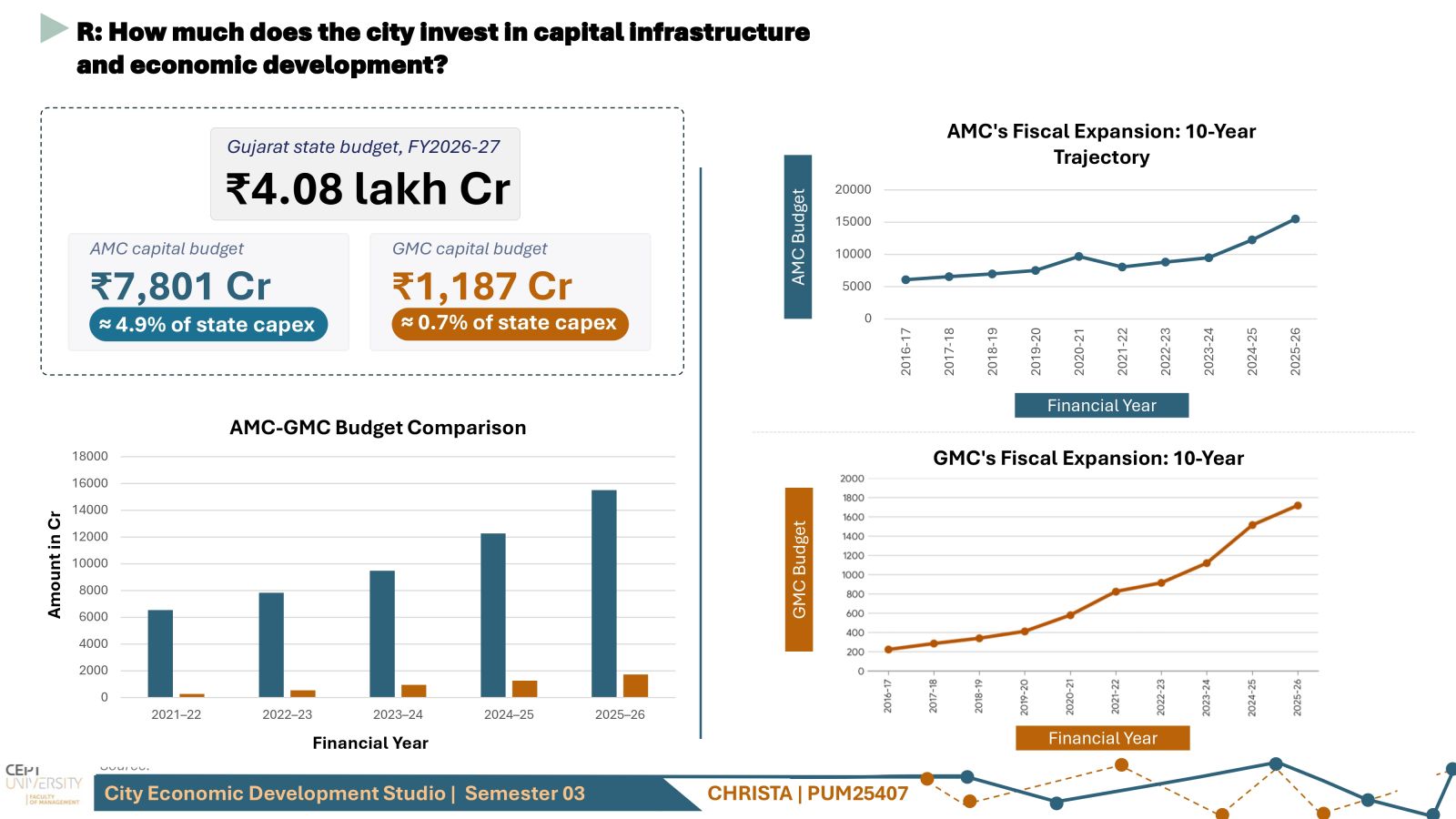
Capital Investment Against Gujarat's ?4.08 lakh Cr budget for FY2026?27, AMC's capital budget of ?7,801 Cr is about 4.9% of state capex, and GMC's ?1,187 Cr is about 0.7%. Ten year trends show both budgets growing steadily, with AMC working at a far larger scale than GMC.

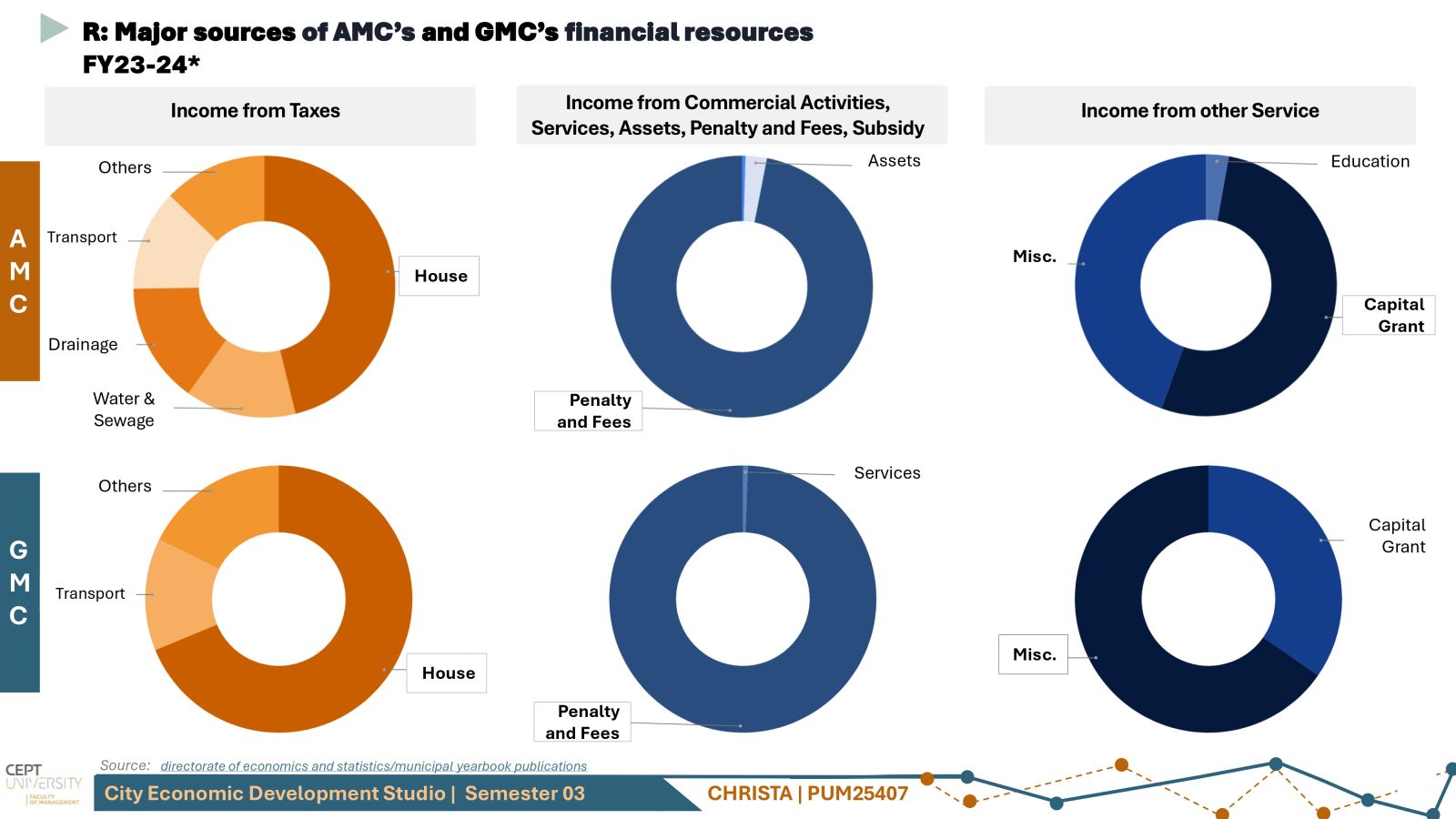
Sources of Financial Resources (FY23?24) Both corporations rely mainly on taxes, especially house tax, along with income from commercial activities, services, fees, penalties and capital grants. AMC's revenue base is spread more widely across transport, drainage, water and sewage, while GMC depends more on a narrower set of sources.

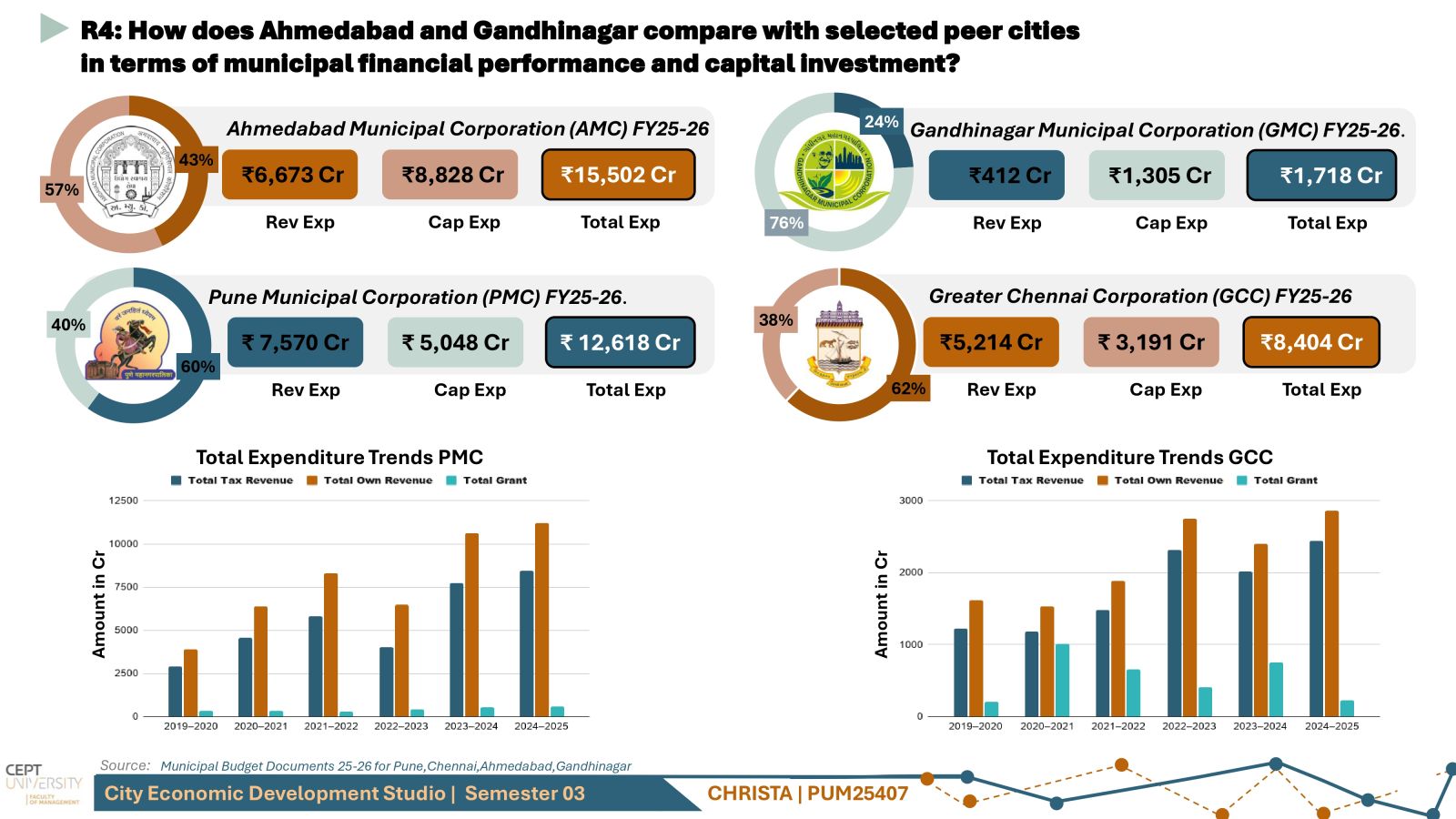
Peer City Comparison (FY25?26) AMC spends ?15,502 Cr in total, and 57% of that is capital expenditure, a higher capital share than Pune (40%) or Chennai (38%). GMC puts 76% of its ?1,718 Cr into capital works, which shows both ACR bodies are focused on building assets more than on routine spending.

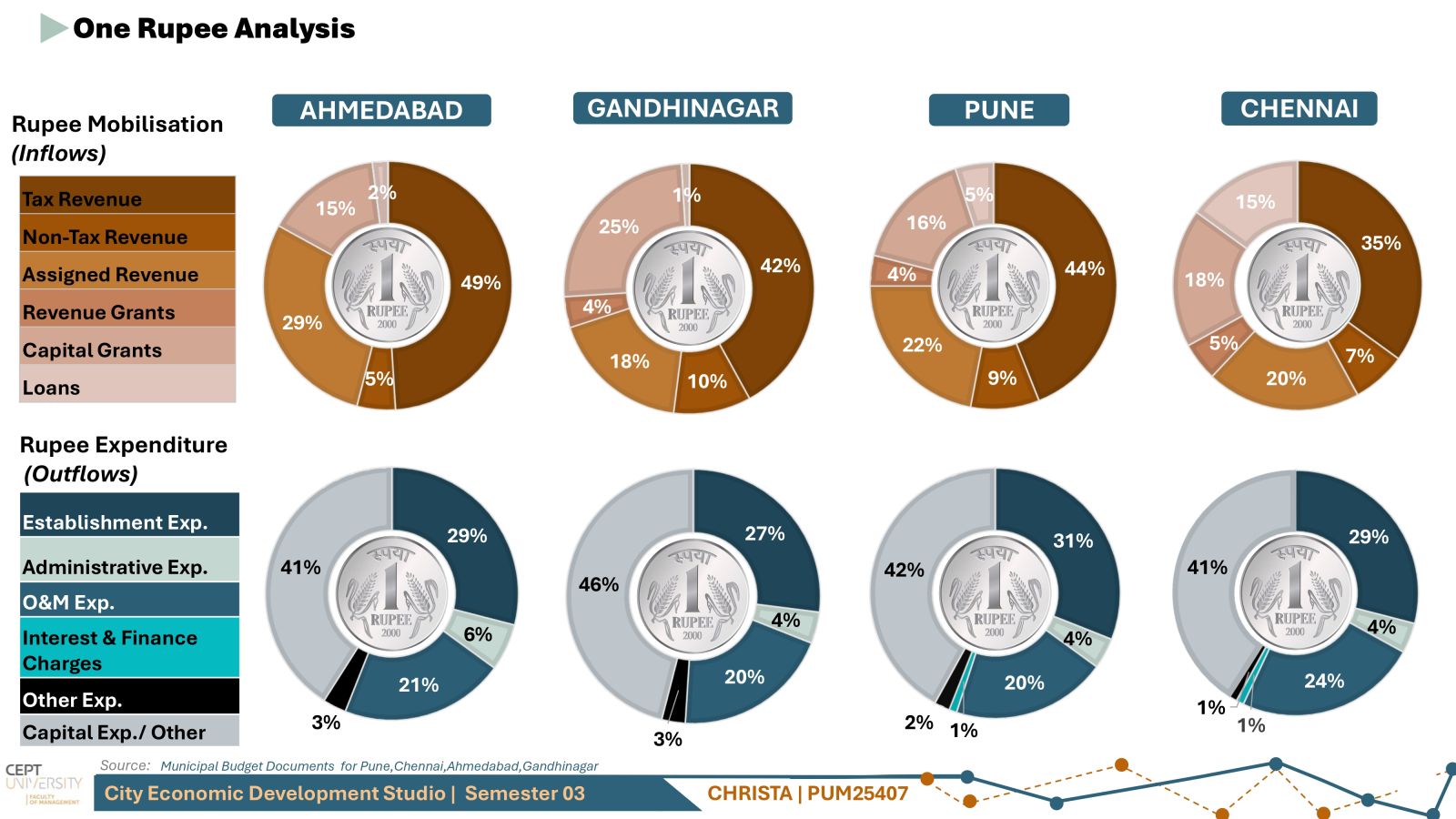
One Rupee Analysis This slide breaks down every rupee each city receives into taxes, non tax revenue, assigned revenue, grants and loans, and every rupee it spends into establishment, operations, interest and capital costs. It shows how the four cities differ in reliance on their own revenue and in borrowing, with Chennai the most dependent on loans.

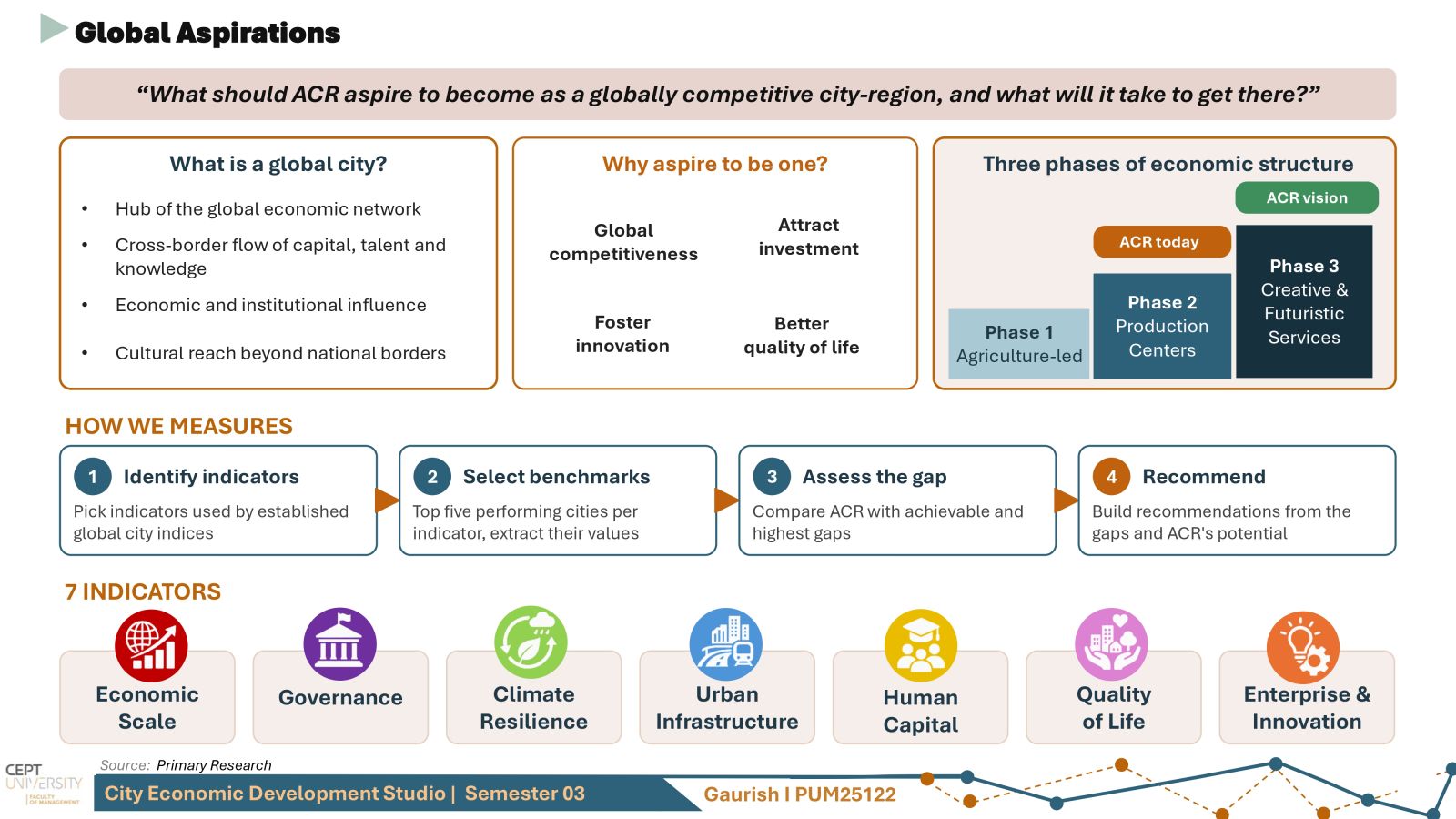
A global city is a hub for flows of capital, talent and knowledge, and ACR wants to move from production centre to creative, service led economy. The gap is measured through seven indicators, benchmarking ACR against the top five global cities for each and building recommendations from the gaps. Post midsem of assessment of studio outputs in 3 basic scenarios and here envisioning ACR to that of a global city.

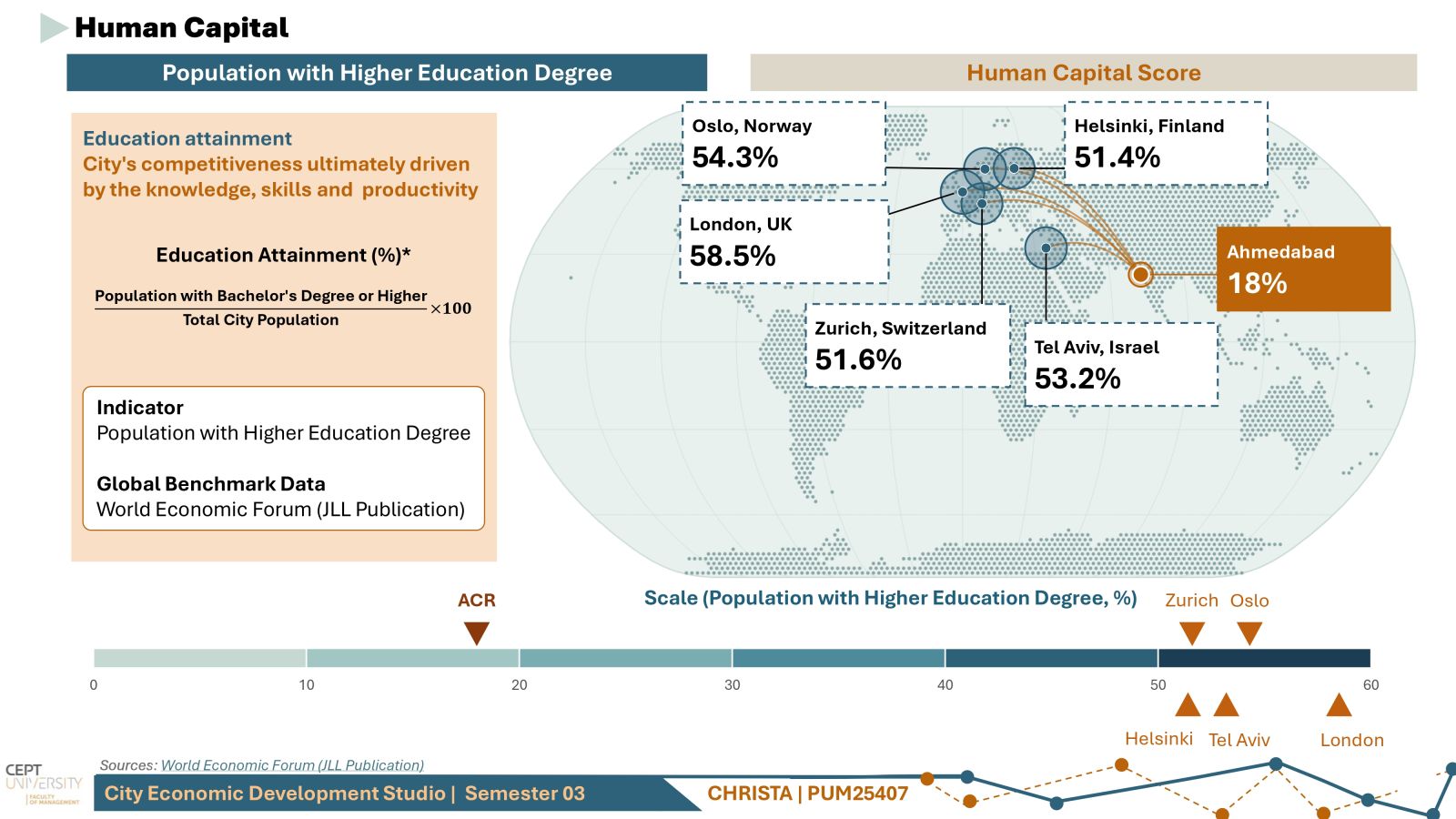
Indicator Human Capital: Education Attainment Only 18% of ACR's population has a higher education degree, compared with more than 50% in London, Oslo, Zurich, Tel Aviv and Helsinki. Because competitiveness comes down to knowledge and skills, this is one of ACR's most important gaps.

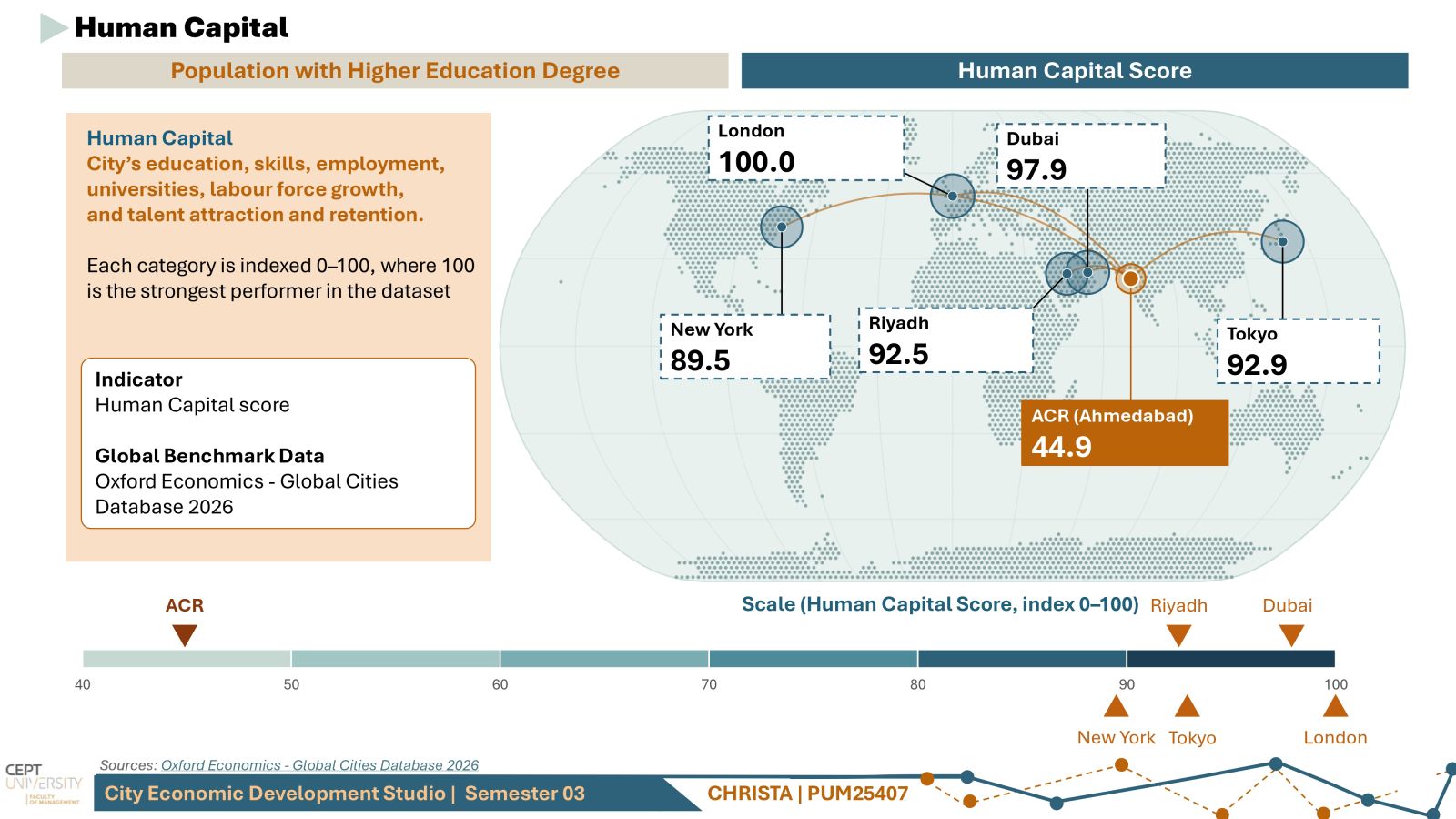
Human Capital Score On the Oxford Economics Global Cities index, ACR scores 44.9 out of 100, against 100 for London, 97.9 for Dubai and around 90 for Tokyo, Riyadh and New York. The score covers education, skills, universities and talent retention, so the gap goes well beyond degrees.

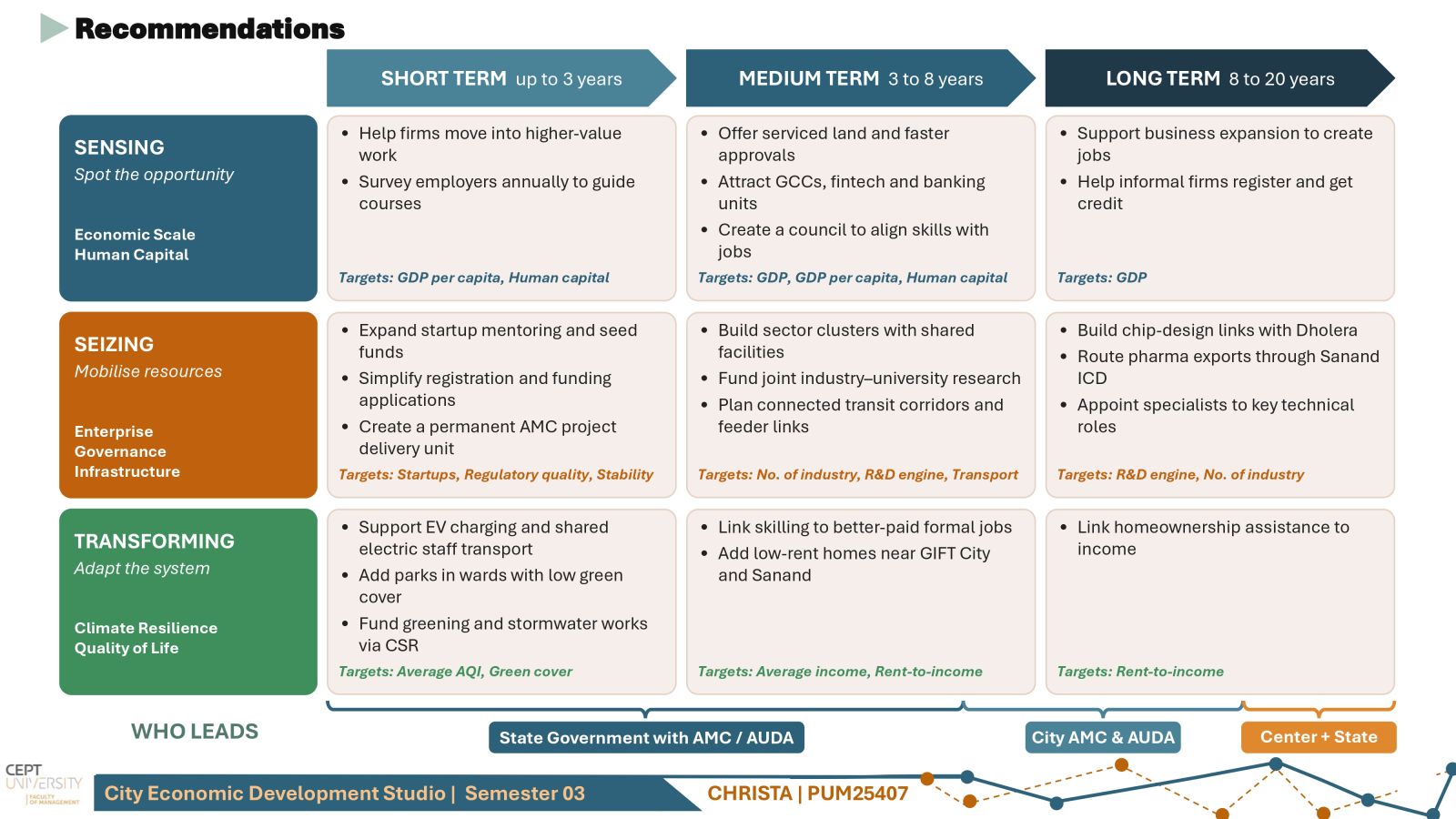
Recommendation framework for global scenario Short, medium and long term actions are grouped into Sensing, Seizing and Transforming, covering skills councils, attracting GCCs and fintech, startup funds, transit corridors, links with Dholera and Sanand, and affordable housing. Each action has measurable targets, and responsibility is shared between the State, AMC, AUDA and the Centre.

Project Video