Feeuna Alam

RE4000

The Number Before the Drawing

The studio taught finance as a practice. One project carried it: Aravanta Crest, 297 units on a 6,329 square metre plot at Shilaj, taken from site and market through a joint development agreement into pricing, funding and a full feasibility model. We built the cost sheet, the cash curve and the return, then defended it at a jury. What I took away is that a project is a set of assumptions producing a number, that the Year 1 low point rather than the total cost sizes the ask, and that a model can be perfectly built and still be wrong.  

Report Content

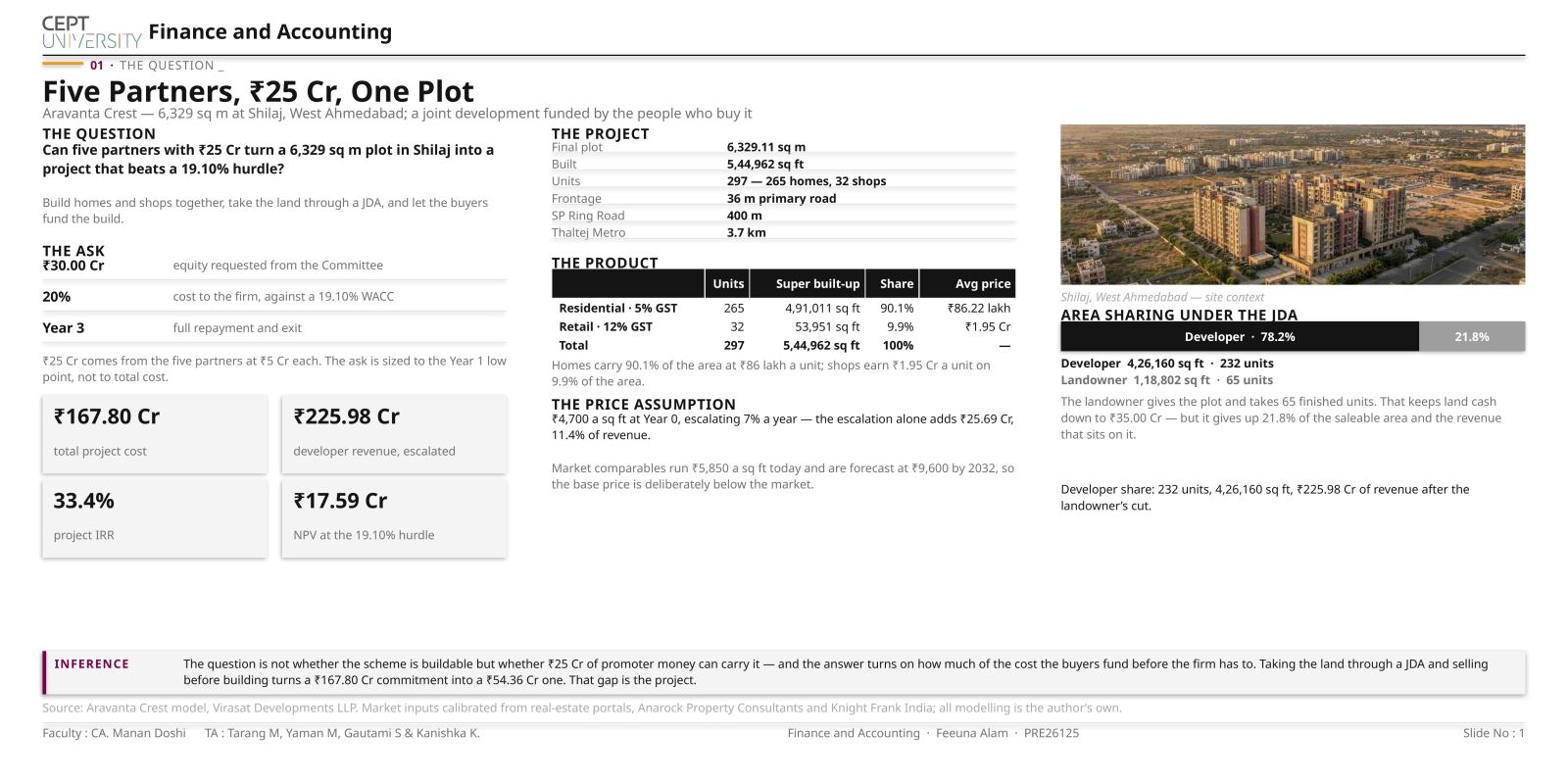
THE QUESTION Can five partners with ?25 crore turn a 6,329 square metre plot at Shilaj into a project that beats a 19.10% hurdle? The plot takes 297 units, 265 homes and 32 shops, across 5,44,962 square feet, with a 36 metre frontage and SP Ring Road 400 metres away. The product is priced at ?4,700 a square foot at Year 0, escalating 7% a year, which adds ?25.69 crore and 11.4% to revenue. Market comparables run ?5,850 today and are forecast at ?9,600 by 2032, so the base price sits deliberately below the market. The area-sharing JDA gives the landowner 21.8% of the saleable area and 65 finished units, leaving the developer 232 units and ?225.98 crore of revenue. The ask is ?30 crore of Committee equity at 20%, against ?25 crore of promoter money, with full repayment and exit in Year 3. Total cost ?167.80 crore, revenue ?225.98 crore, IRR 33.4%, NPV ?17.59 crore.

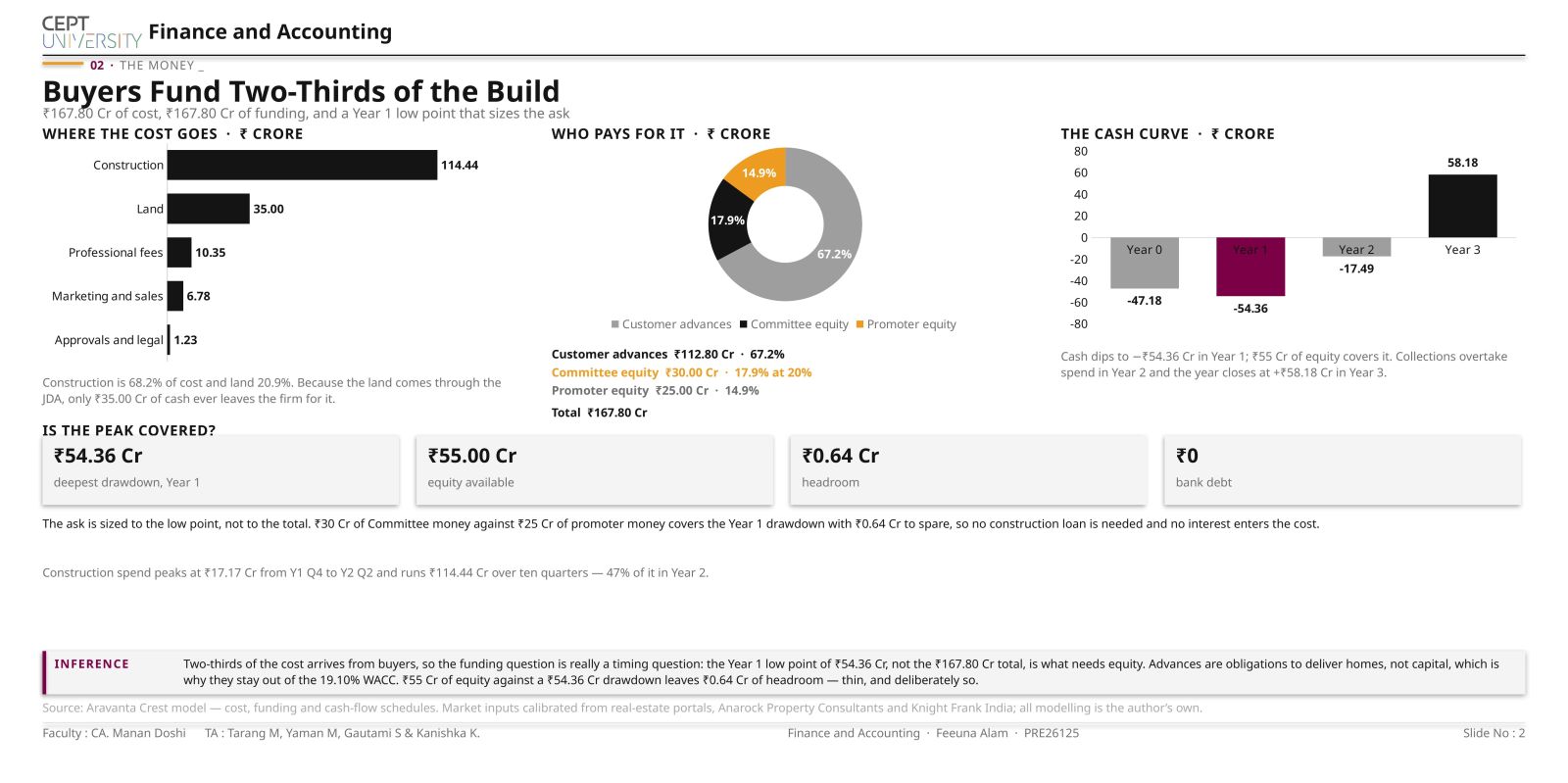
THE MONEY Two-thirds of the cost arrives from buyers, so the funding question is really a timing question. Construction is ?114.44 crore of the ?167.80 crore, land ?35.00 crore, professional fees ?10.35 crore, marketing and sales ?6.78 crore, approvals ?1.23 crore. Customer advances cover 67.2%, or ?112.80 crore; Committee equity 17.9% at 20%; promoter equity 14.9%. The cash curve dips to ?47.18 crore in Year 0 and ?54.36 crore in Year 1, narrows to ?17.49 crore in Year 2 and closes at positive ?58.18 crore in Year 3. Against that ?54.36 crore low point there is ?55.00 crore of equity, leaving ?0.64 crore of headroom and no bank debt at all. Advances are obligations to deliver homes rather than capital, which is why they stay outside the 19.10% WACC.

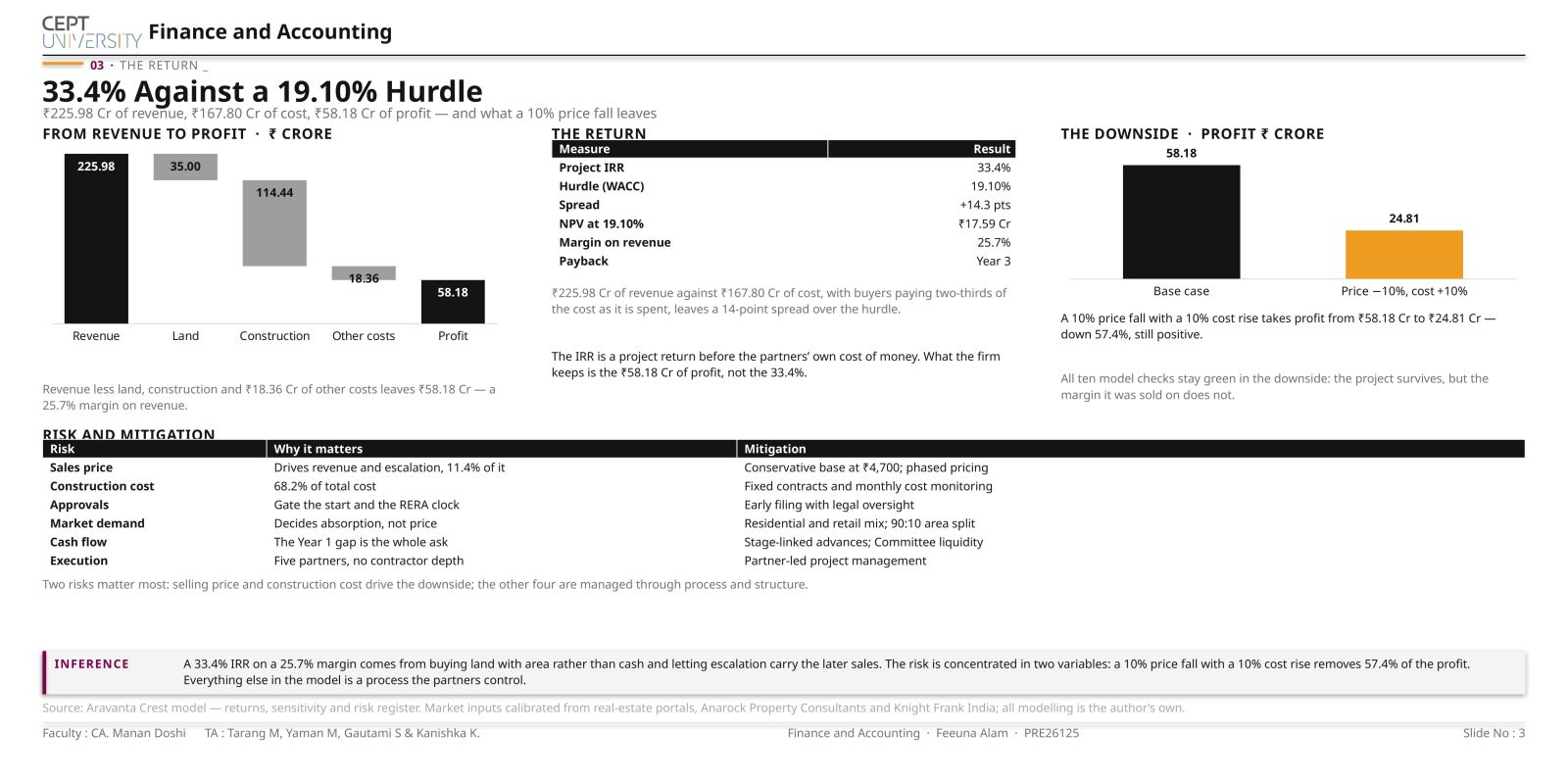
THE RETURN ?225.98 crore of revenue against ?167.80 crore of cost leaves ?58.18 crore, a 25.7% margin, a 33.4% project IRR, ?17.59 crore of NPV at the 19.10% hurdle and a 14.3 point spread, with payback in Year 3. The downside is tested rather than assumed: a 10% price fall with a 10% cost rise takes profit to ?24.81 crore, down 57.4%, still positive. Six risks are set against six mitigations, from a conservative ?4,700 base and phased pricing against sales price, to fixed contracts and monthly cost monitoring against construction cost. Two of them matter most, because selling price and construction cost drive the whole downside; the other four are managed through process and structure.

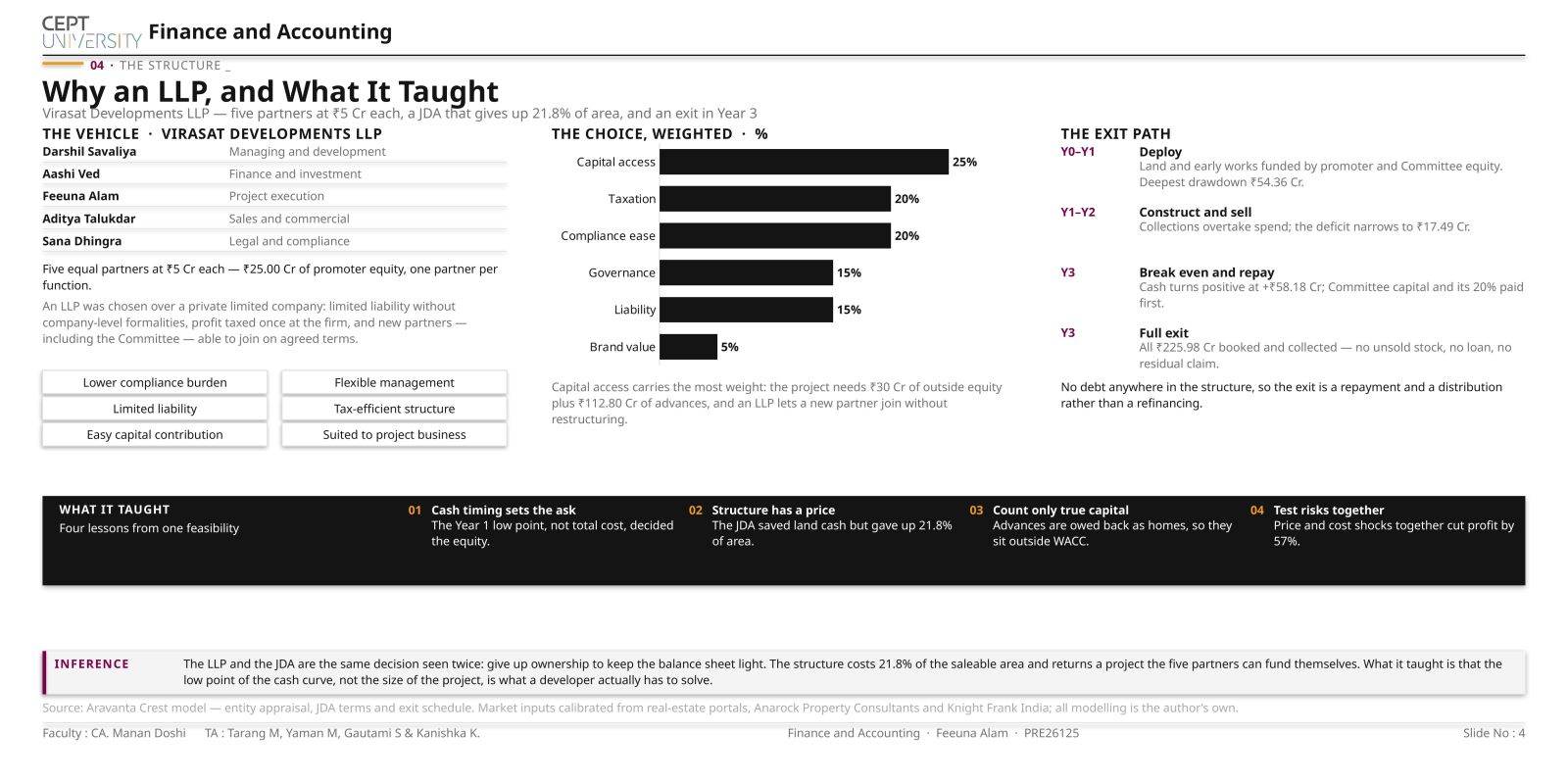
THE STRUCTURE Virasat Developments LLP, five partners at ?5 crore each, one partner per function: managing and development, finance and investment, project execution, sales and commercial, legal and compliance. The choice was weighted and the weights are on the page: capital access 25%, taxation 20%, compliance ease 20%, governance 15%, liability 15%, brand value 5%. Capital access carries it, because the project needs ?30 crore of outside equity plus ?112.80 crore of advances, and an LLP lets a new partner join on agreed terms. The exit path runs deploy in Year 0 to 1, construct and sell to Year 2, break even and repay the Committee capital and its 20% first in Year 3, then full exit with all ?225.98 crore booked and collected, no unsold stock, no loan and no residual claim.