Divyank Sharma

UI4001

A GVP management framework for Ahmedabad

Despite routine sanitation efforts, recurring waste accumulation remains a challenge in Ahmedabad. Drawing on AMC’s complaint records and field assessments of 191 Garbage Vulnerable Points (GVPs), this report identifies the distinct conditions responsible for waste accumulation across residential, commercial and public spaces. It proposes a site-specific management framework that integrates data-driven diagnosis, targeted interventions and clearly defined institutional responsibilities, enabling AMC to move beyond reactive cleaning towards preventing the recurrence of GVPs.
Report Content

Introduces the Infrastructure Project Studio and its focus on Ahmedabad’s urban infrastructure. It outlines the city’s solid waste management challenges, highlighting gaps in waste collection, processing, resource recovery and institutional coordination. The project focuses on developing practical interventions to strengthen the city's waste management system.

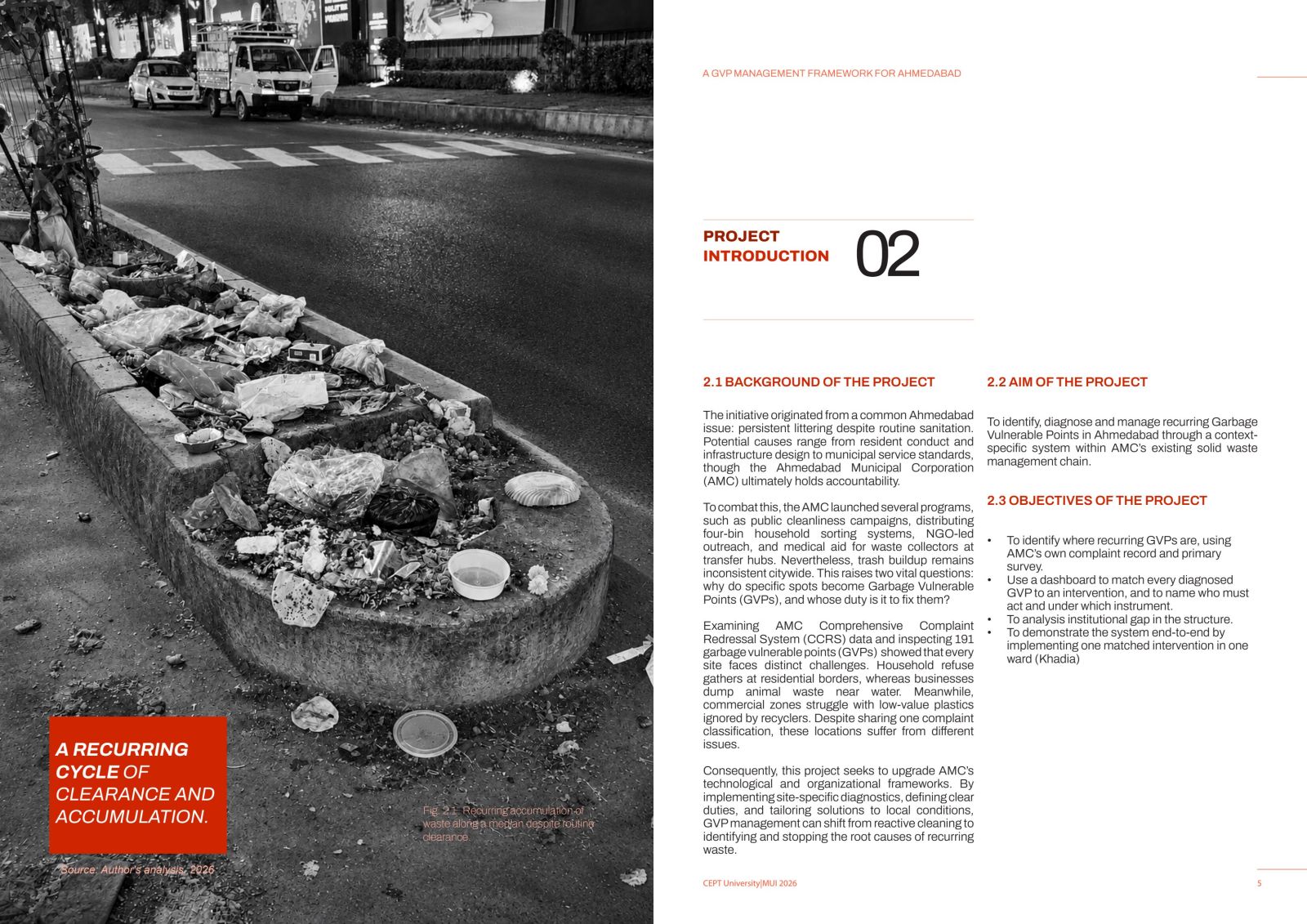
Introduces the recurring problem of waste accumulation at specific locations across Ahmedabad, despite regular municipal cleaning efforts. It explains the project’s aim to identify and diagnose Garbage Vulnerable Points (GVPs), understand why waste keeps returning, and develop site-specific interventions with clear institutional responsibilities.

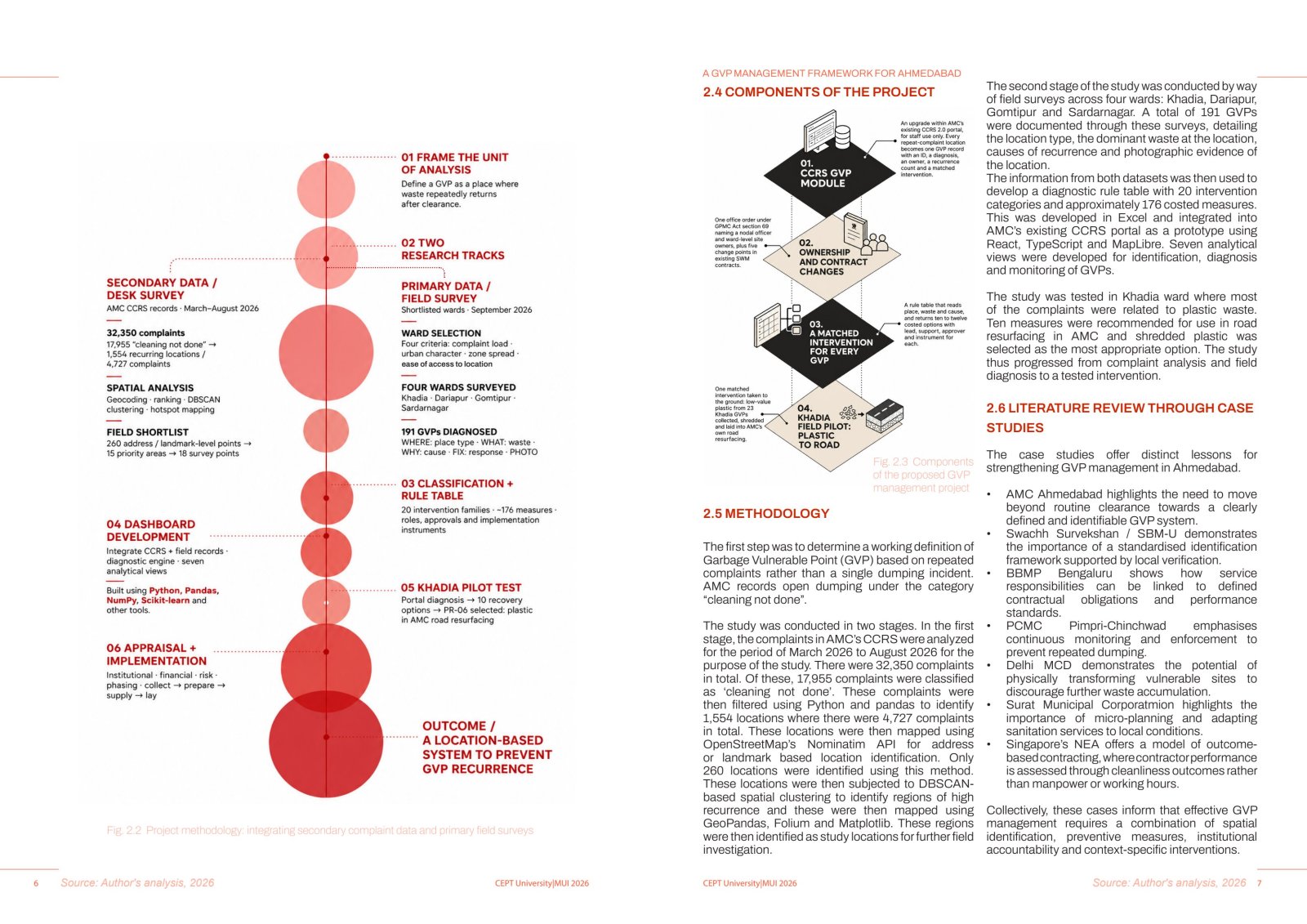
Builds on the project’s objectives by explaining how recurring GVPs were identified and studied. The research combines AMC complaint data from March–August 2026 with field surveys of 191 GVPs across four wards. These findings inform a diagnostic framework, a digital management dashboard and a pilot intervention in Khadia. Case studies further help establish the need for location-specific solutions, preventive measures and clearer institutional accountability.

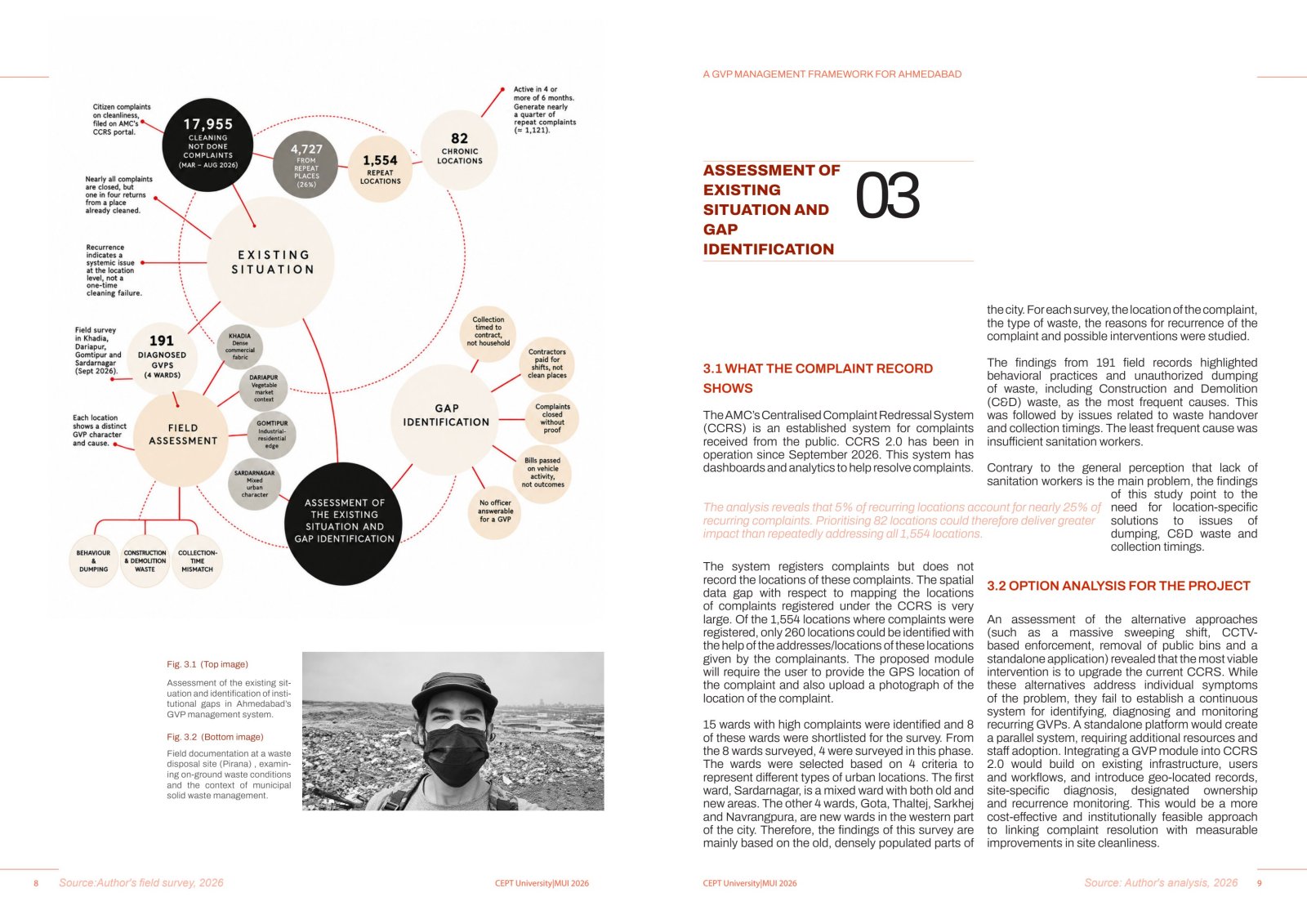
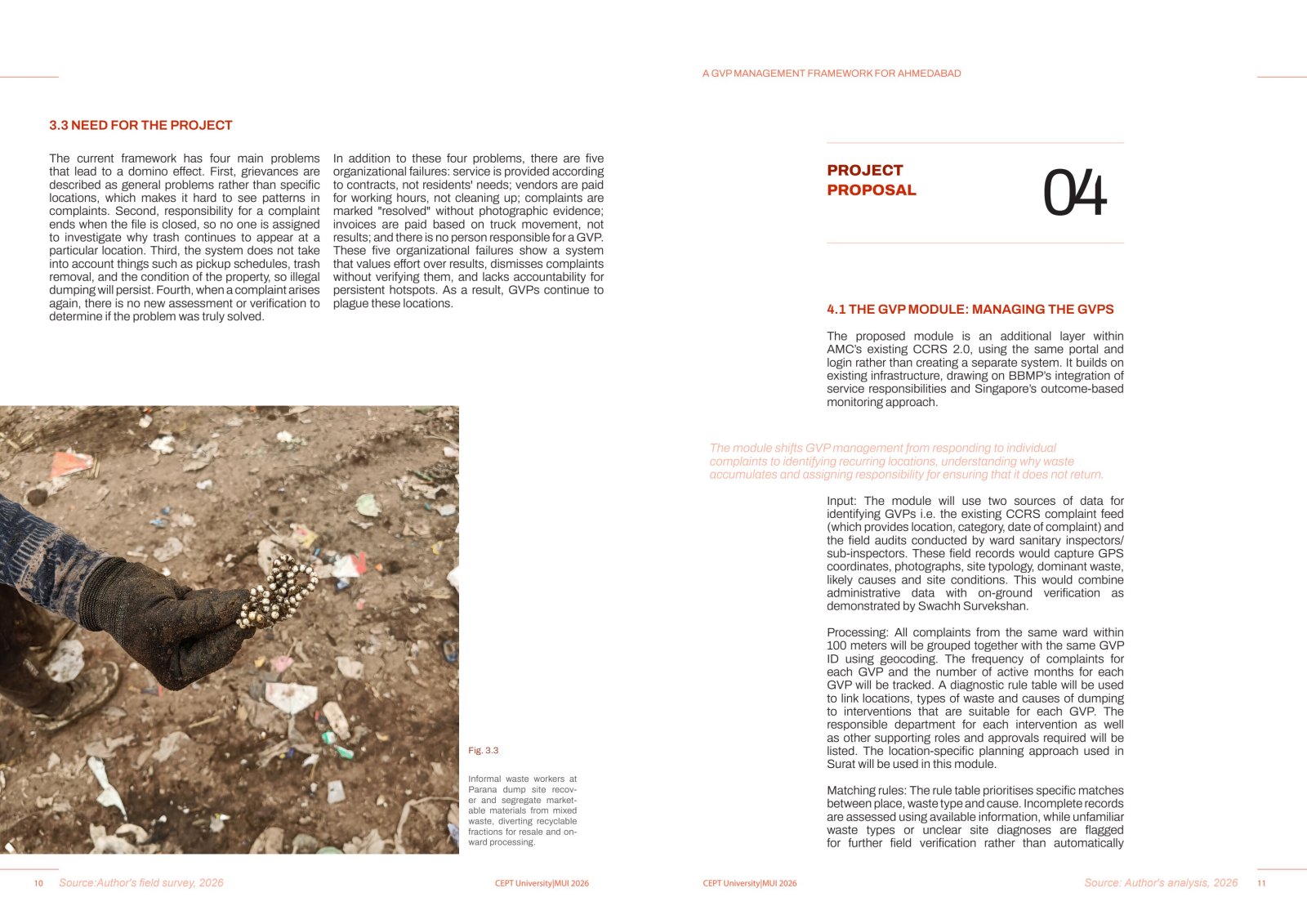
Examines AMC’s complaint records to understand the scale and recurrence of waste accumulation across Ahmedabad. The analysis identifies 1,554 repeat complaint locations, including 82 chronic locations, while field assessments reveal that each GVP has distinct causes. It also highlights gaps in the existing complaint system and establishes the need for a more integrated, location-specific approach to identifying, diagnosing and managing recurring waste.

Identifies the institutional and operational gaps that allow waste accumulation to persist despite routine cleaning. The report proposes an integrated GVP management module within AMC’s existing CCRS 2.0 system. By combining complaint records with field-level data, the module aims to identify recurring locations, diagnose their causes, recommend suitable interventions and assign clear responsibility for action.

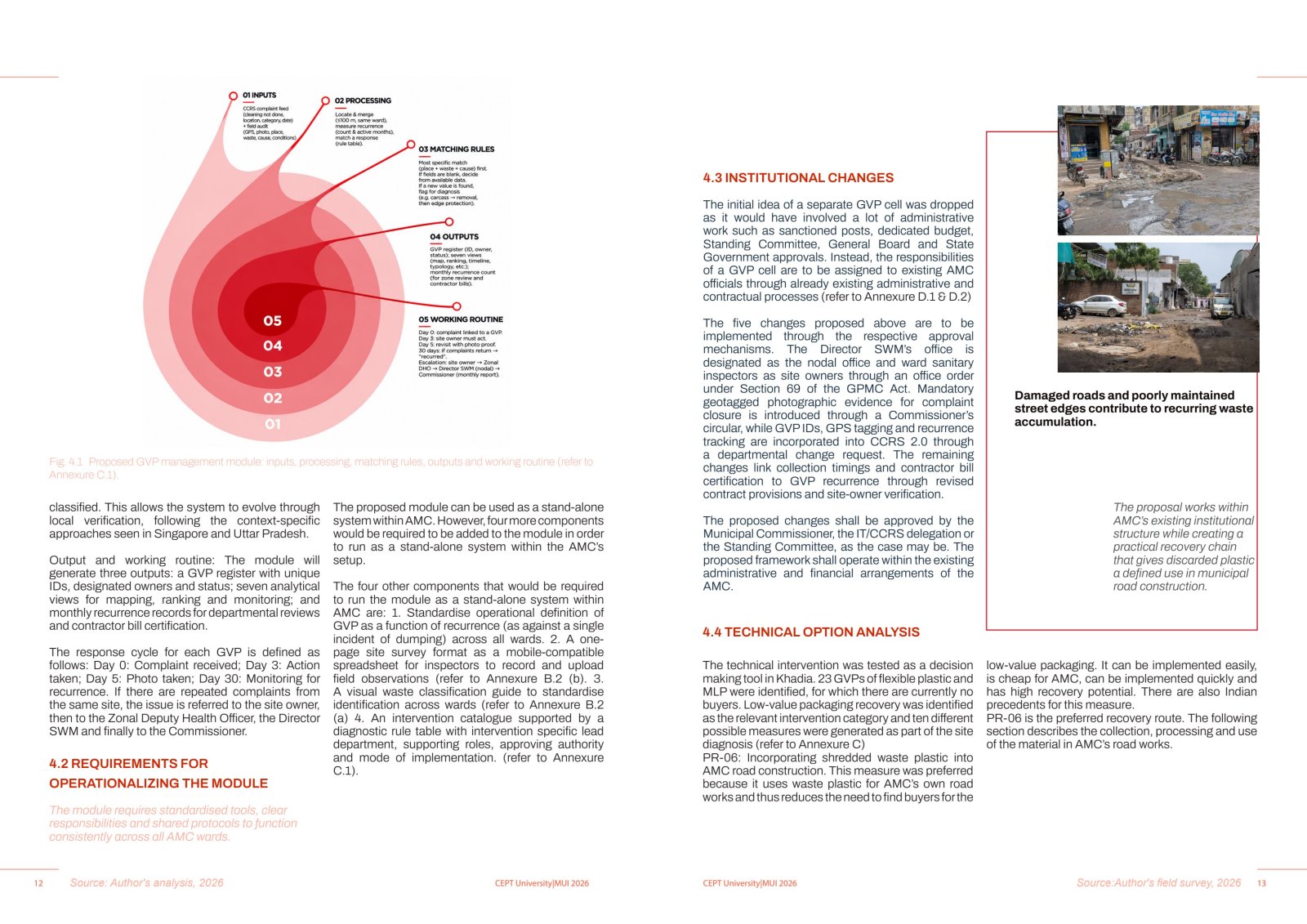
Explains how the proposed GVP module will function through a structured process of data collection, diagnosis, intervention matching and monitoring. It outlines the tools and requirements needed for implementation, along with institutional changes to establish clear responsibilities within AMC. The page also introduces the Khadia pilot, where shredded plastic is proposed for road construction as a practical recovery solution for low-value plastic waste.

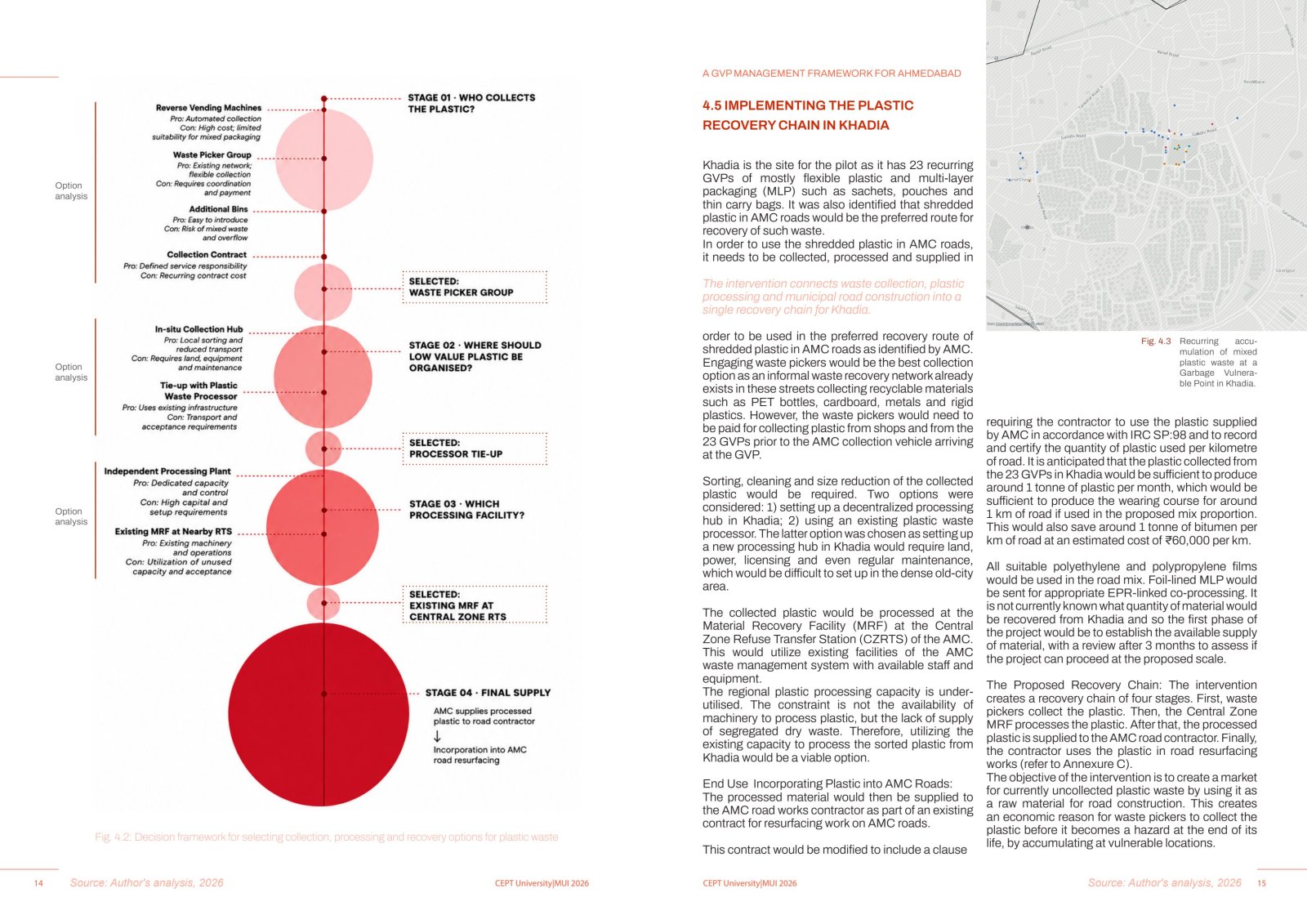
Develops the proposed Khadia pilot by establishing a recovery chain for low-value plastic waste. It evaluates collection, processing and end-use options, selecting waste-picker groups for collection, an existing MRF at the Central Zone RTS for processing, and AMC road construction for material recovery. The proposal connects informal waste collection with municipal infrastructure to divert plastic from recurring GVPs and put it to productive use in road resurfacing.

Presents the estimated costs and funding strategy for implementing the proposed GVP management pilot. It identifies existing AMC budget provisions that could support the intervention without creating a new budget head. The page also examines potential implementation risks, including material availability, coordination, data accuracy and contractor compliance, and outlines measures to address them.

Outlines a four-phase implementation plan for the Khadia pilot, moving from institutional preparation and resource mobilisation to plastic collection, processing, road resurfacing and city-wide expansion. Each phase includes review points to assess material availability, operational readiness and project outcomes before proceeding. The approach allows AMC to test the intervention at a ward level, evaluate its effectiveness and gradually extend the framework to other parts of Ahmedabad.

Evaluates how the proposed Khadia pilot will be monitored using AMC’s existing performance indicators and complaint records. It outlines how changes in waste accumulation, plastic recovery and road quality will be assessed before considering expansion to other wards. The project concludes with an integrated approach to GVP management built around location-specific diagnosis, clear responsibility, targeted interventions and continuous monitoring. One place, one owner, one record until the GVP stops coming back.

Project Video