Uttaran Bhunia

UI4001

Every BODY Goes

“Every BODY Goes” is a pilot to develop an inclusive, universally accessible public toilet for Ahmedabad through four levers design, regulation, institutional and operation & maintenance. It pairs a low-cost “retrofit, don’t rebuild” strategy with the regulatory, contracting and governance reforms needed to make inclusion enforceable and permanent to align with SDG goals and the Court mandates.
Report Content

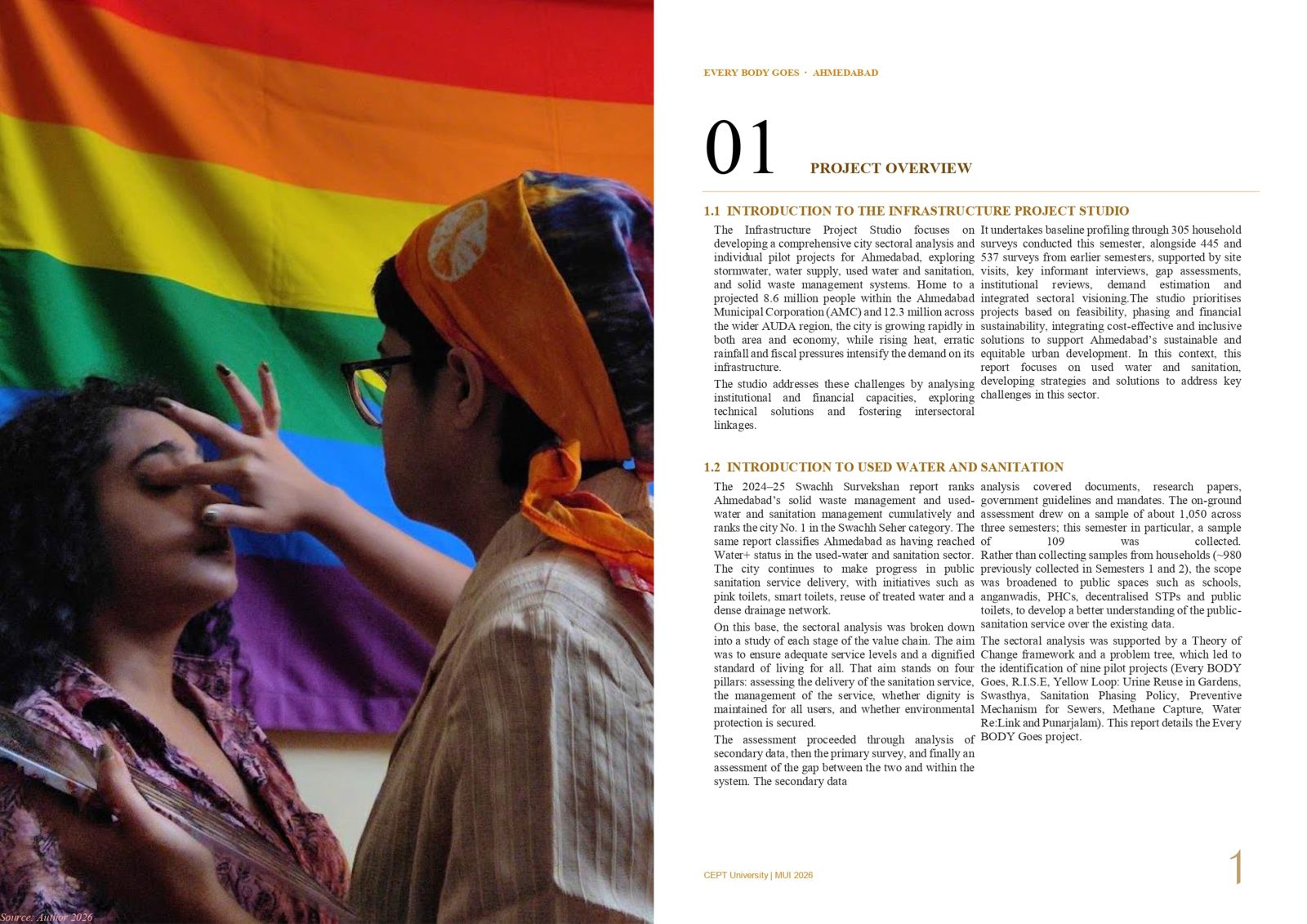
Introduces the Infrastructure Project Studio and the used-water/sanitation sector for Ahmedabad; places "Every BODY Goes" as one of nine pilots emerging from the studio's Theory of Change and problem tree.

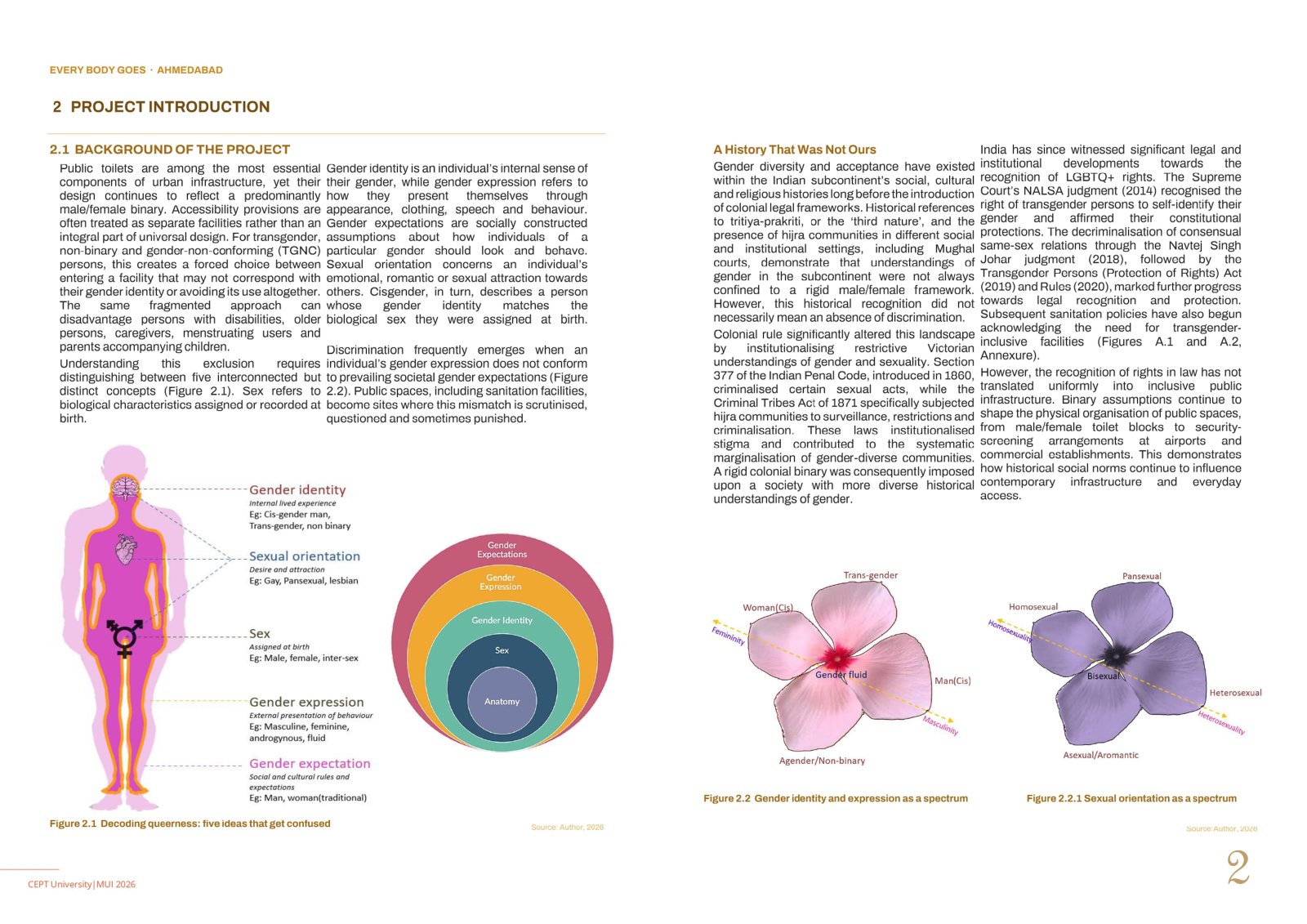
Explains why public toilets exclude TGNC users and decodes the five confused concepts (sex, gender identity, expression, orientation, expectation); traces the colonial-era origins of the binary and India's legal recognition since.

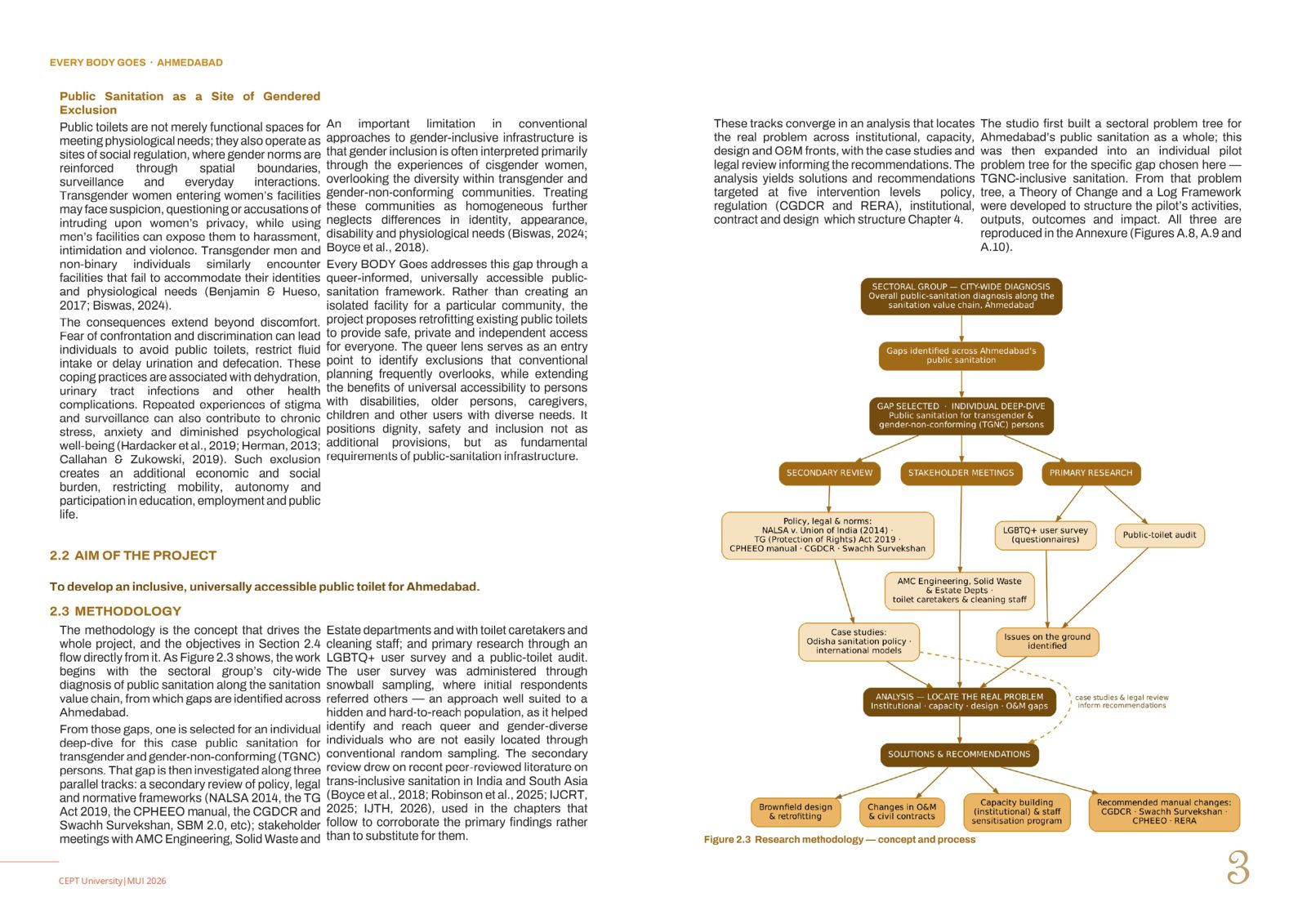
Frames public sanitation as a site of gendered exclusion with health costs; states the aim (an inclusive, universally accessible toilet) and the three-track methodology, shown in the research-process flowchart.

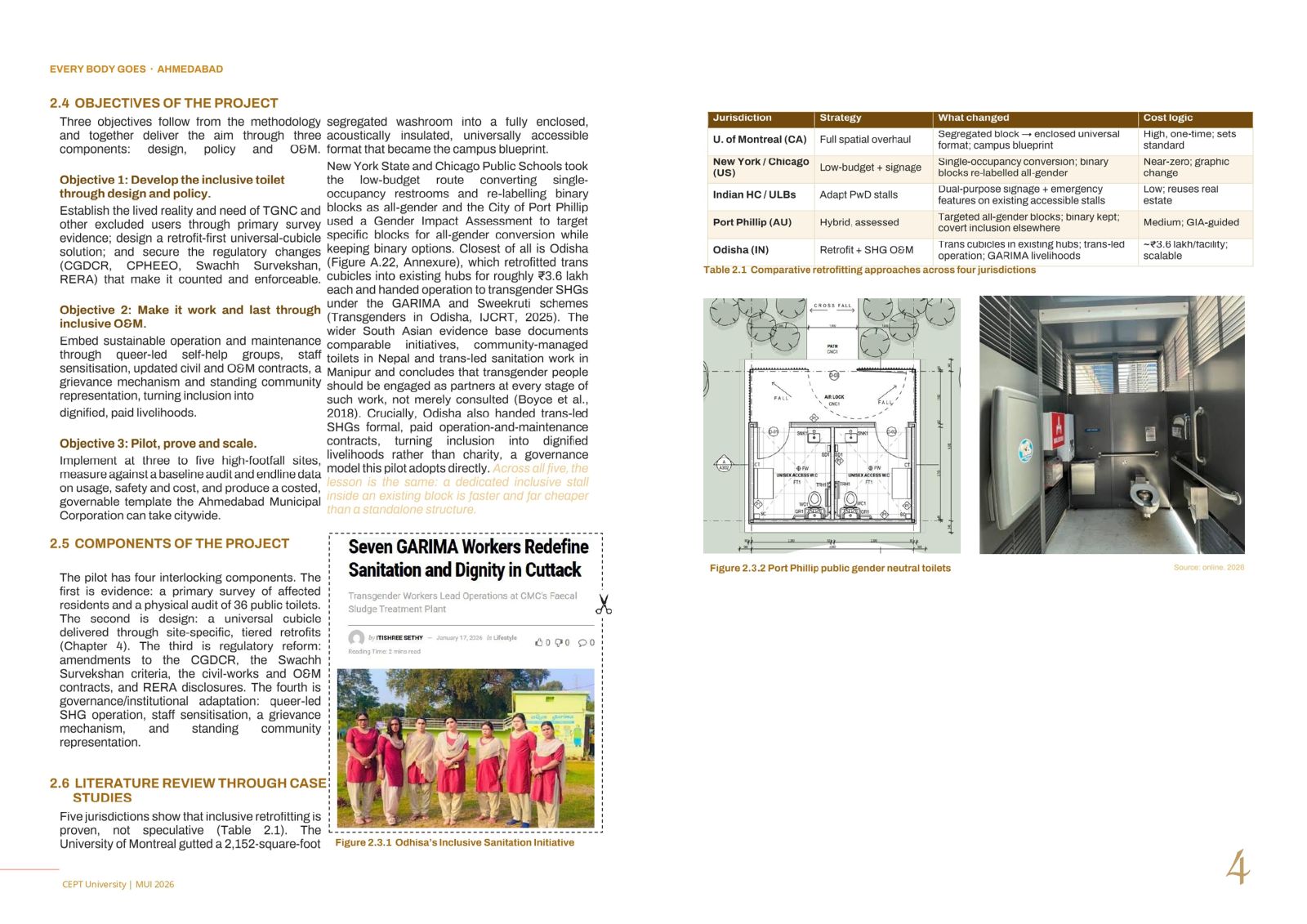
Sets out the three objectives (design+policy, O&M, pilot-and-scale) and four components; Table 2.1 compares five jurisdictions proving retrofit-first inclusion works, with Odisha as the closest model.

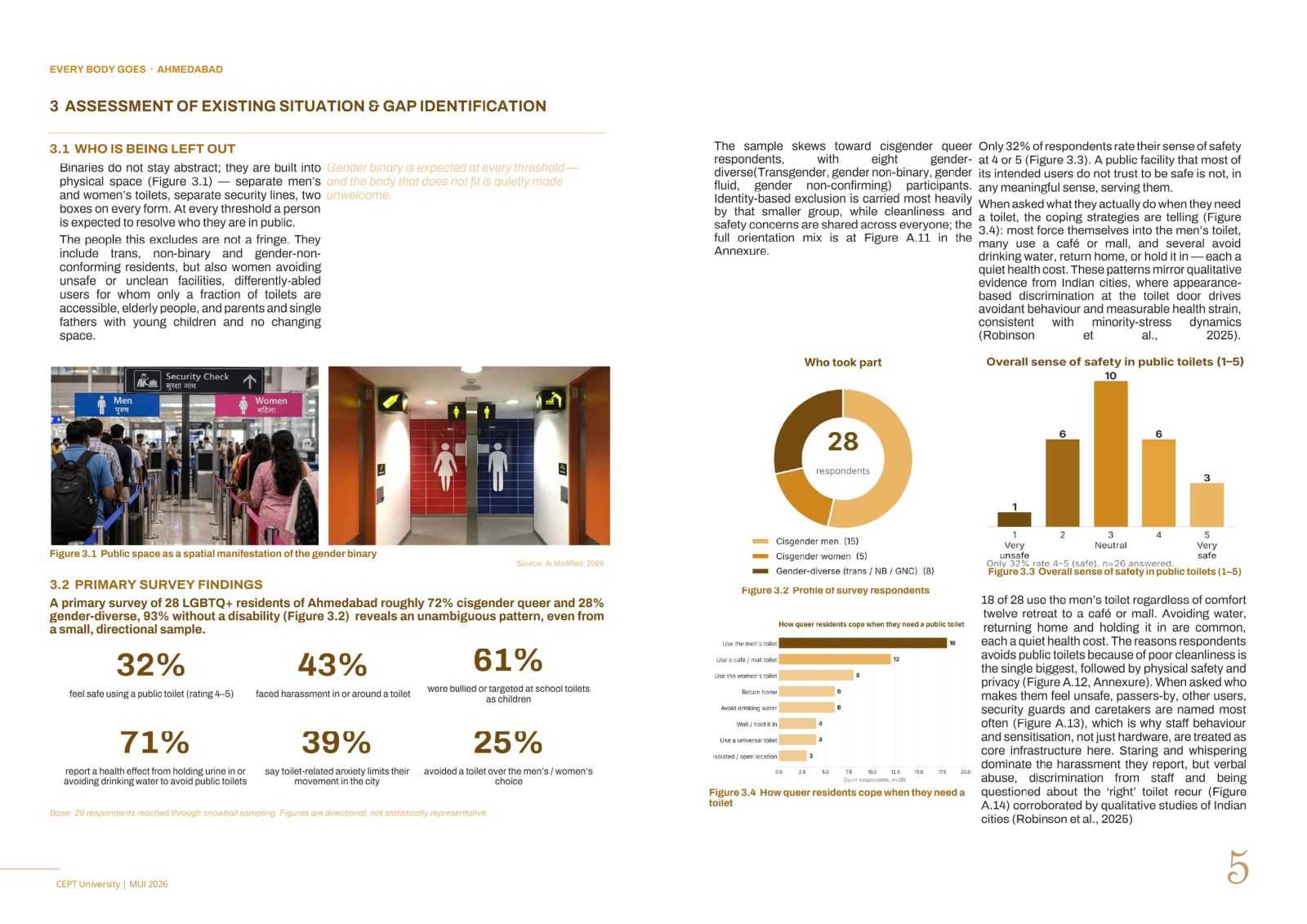
hows who is left out and the survey of 28 LGBTQ+ residents — 35% feel safe, 43% harassed, 61% bullied at school toilets — with respondent profile, safety and coping charts.

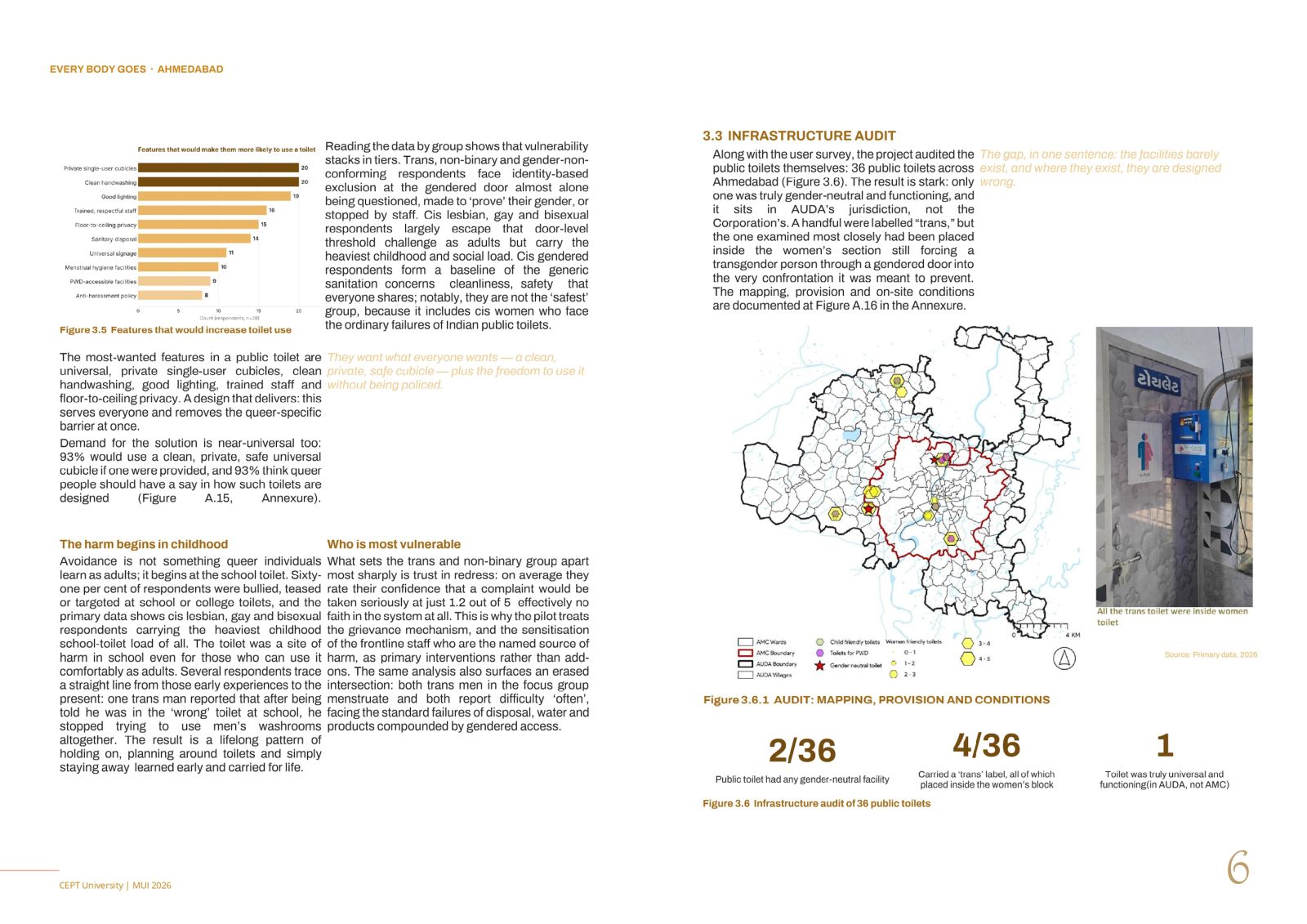
Reads findings by group (childhood harm, who's most vulnerable) and reports the 36-toilet audit: only 1 truly universal (in AUDA, not AMC), 2/36 gender-neutral, 4/36 "trans"-labelled inside women's blocks.

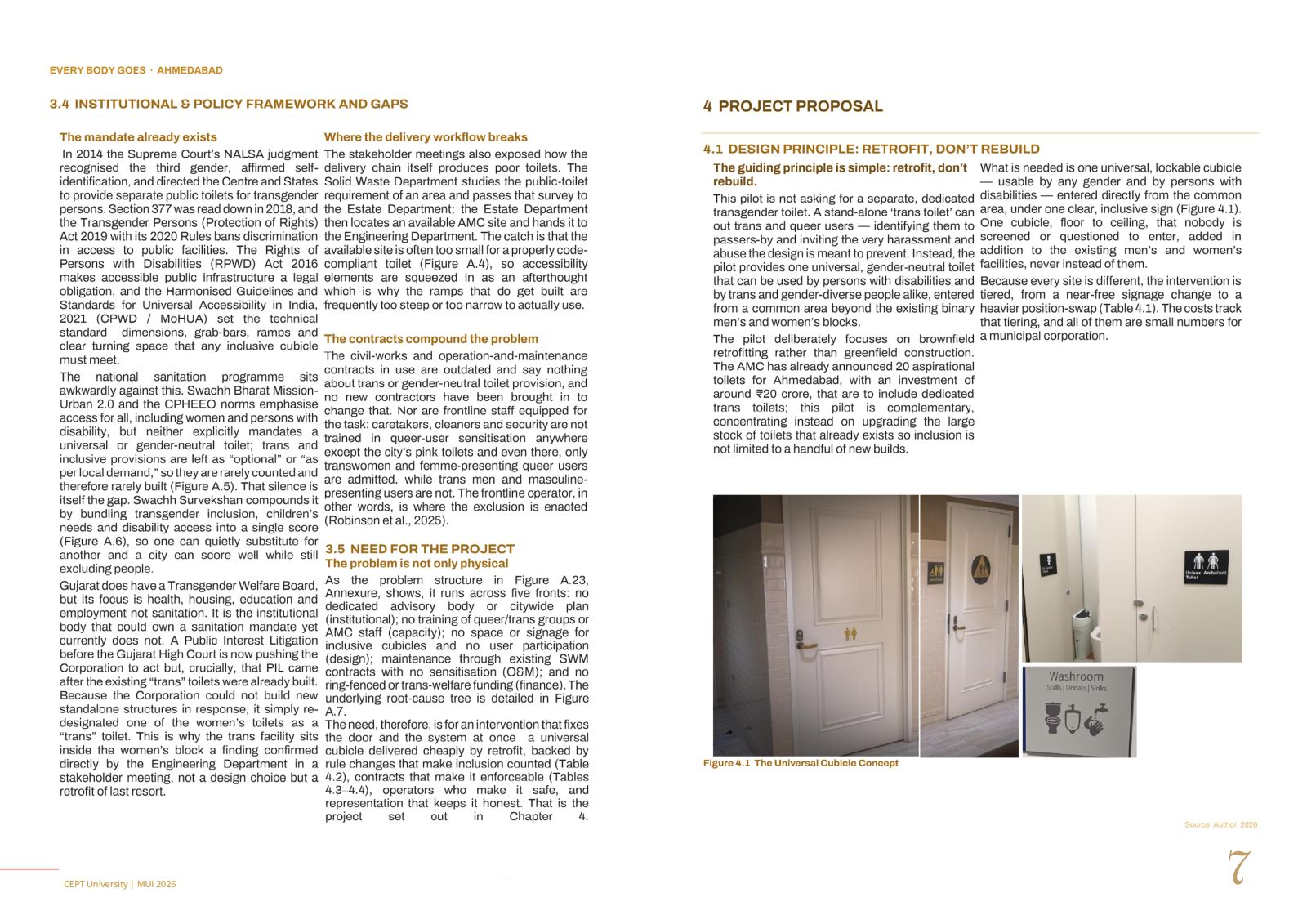
Maps the legal mandate vs. the broken delivery workflow and outdated contracts; opens the proposal with the "retrofit, don't rebuild" principle and the universal-cubicle concept.

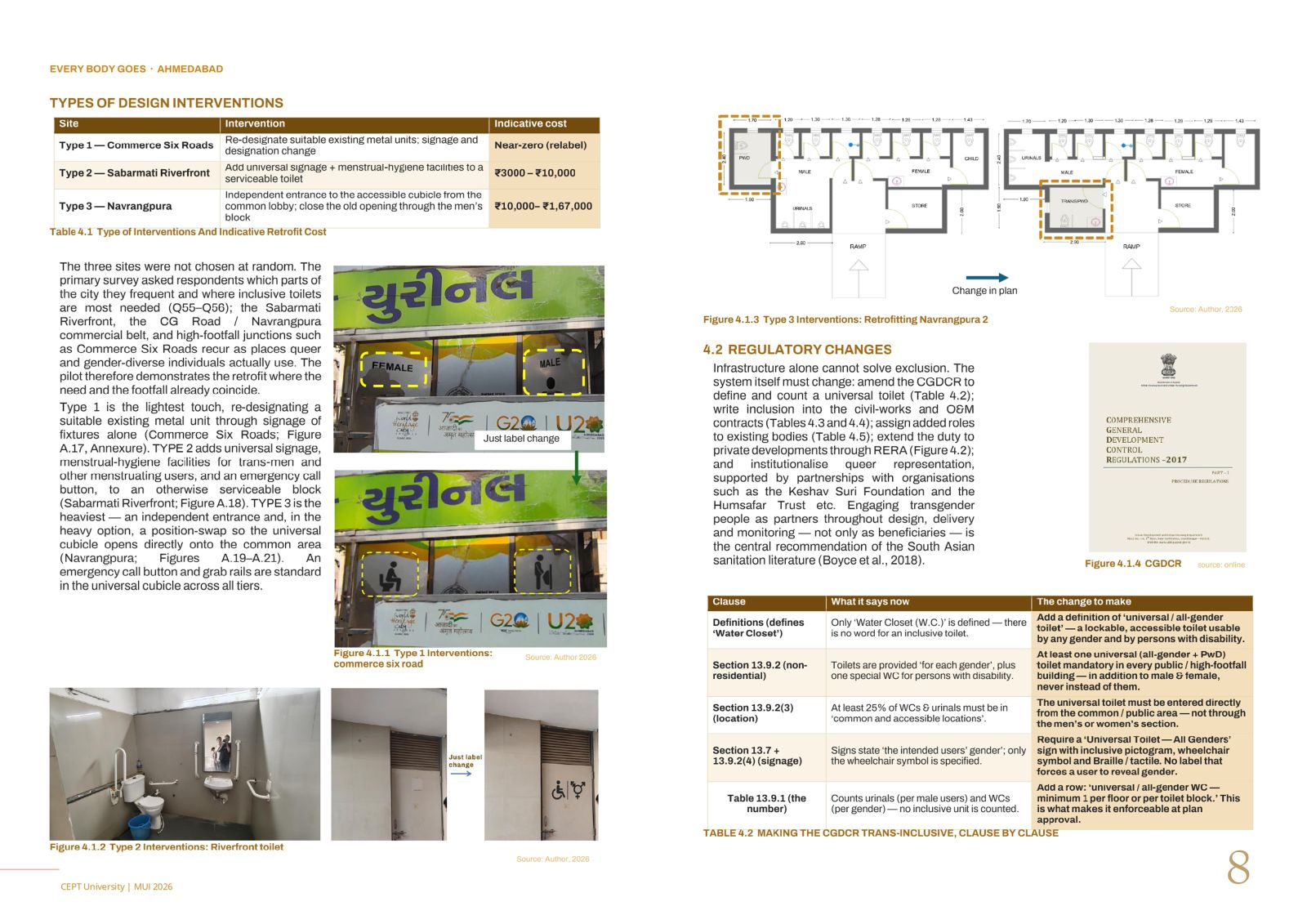
Table 4.1 gives the three retrofit types and costs (?0 to ?1.67 lakh); Table 4.2 lists the clause-by-clause CGDCR amendments to define and count a universal toilet.

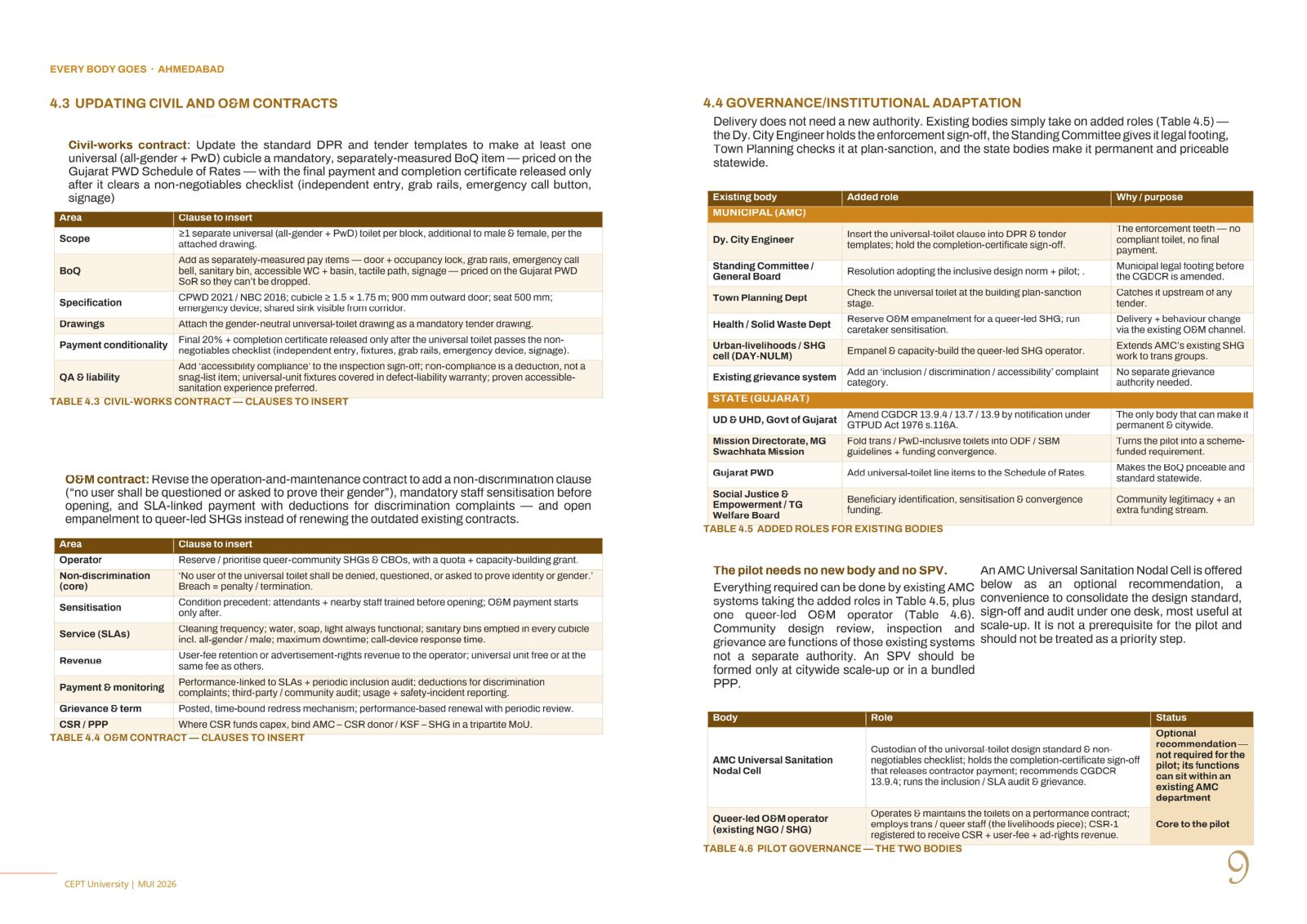
Civil-works and O&M contract clauses to insert (Tables 4.3–4.4) and added roles for existing AMC/state bodies (Table 4.5); notes the Nodal Cell is optional, needing no new body or SPV.

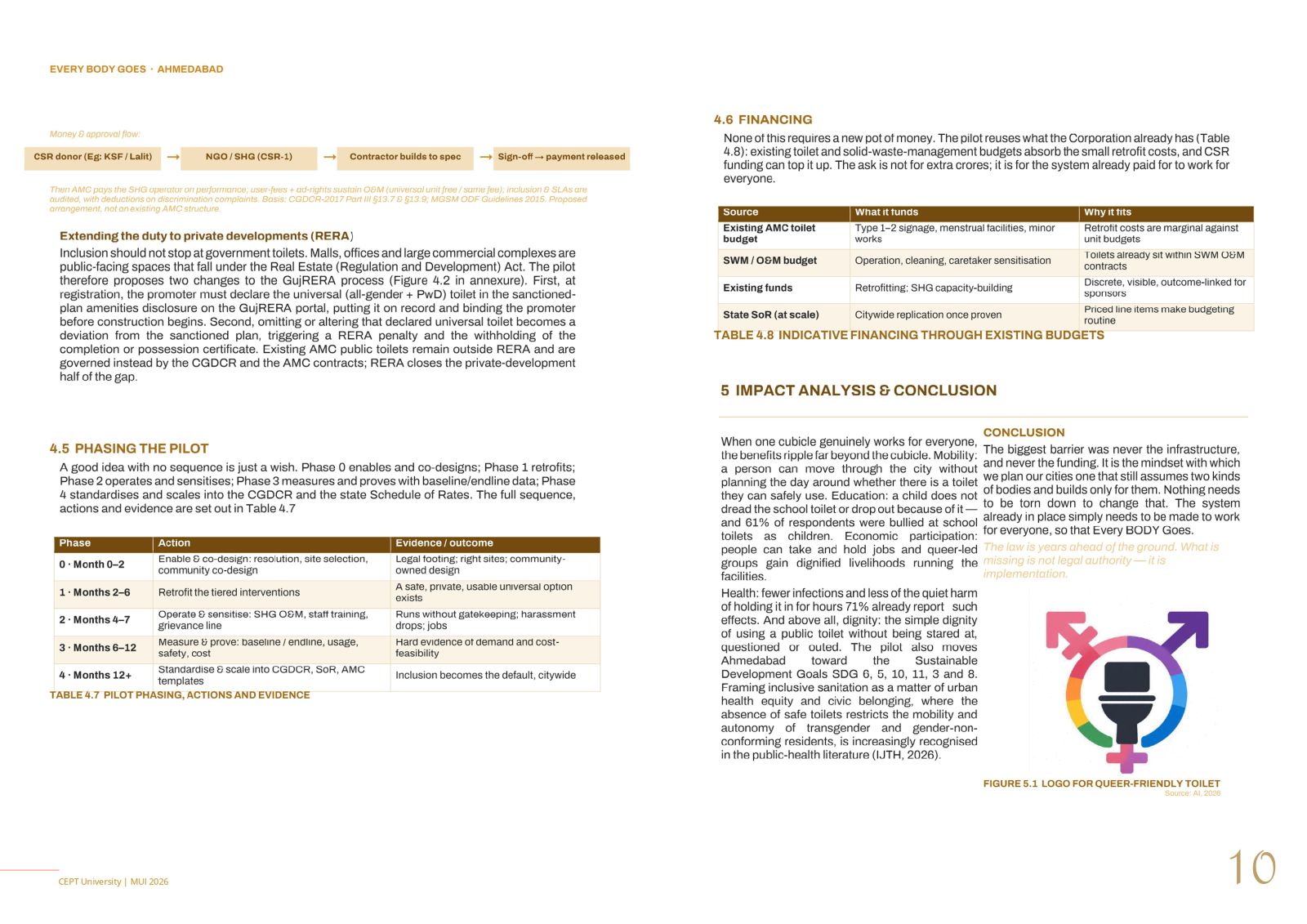
Extends the duty to private developments via RERA, phases the pilot over 12+ months (Table 4.7), finances it from existing budgets (Table 4.8), and concludes the barrier is mindset, not money.

Project Video