Your browser is out-of-date!
For a richer surfing experience on our website, please update your browser. Update my browser now!
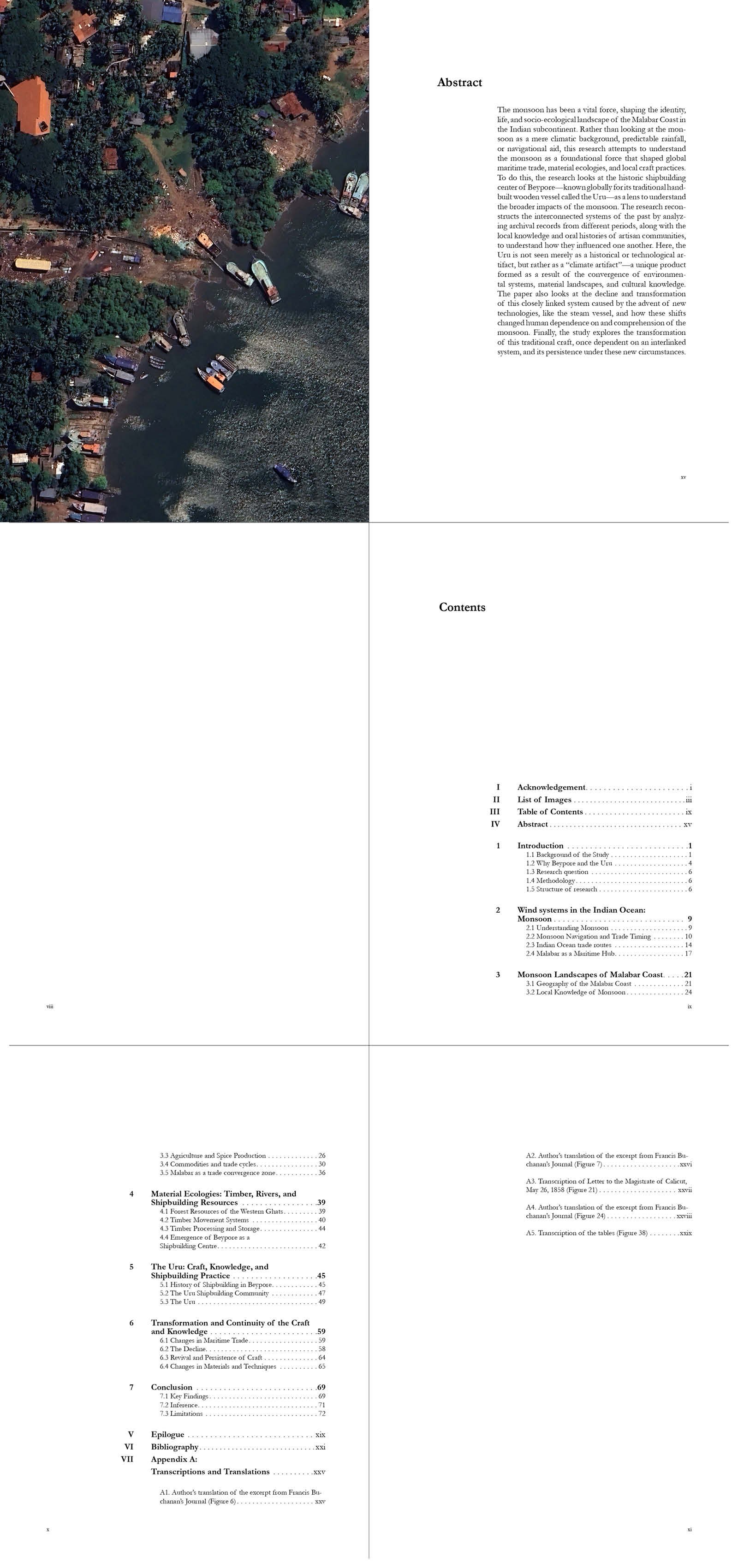
This research examines the interrelationship between environmental systems, maritime trade, and craft traditions along the Malabar Coast through the study of the Uru shipbuilding practices of Beypore. The study positions the monsoon not merely as a climatic phenomenon, but as a structuring force that historically shaped navigation, trade circulation, agricultural production, settlement patterns, and maritime livelihoods across the Indian Ocean world. The research traces how seasonal wind systems enabled long-distance maritime exchange, transforming the Malabar Coast into a major trade convergence zone connected to the Middle East, East Africa, and Southeast Asia. These trade networks stimulated the cultivation of export-oriented crops such as pepper and cardamom, while also generating demand for large ocean-going vessels capable of navigating the Arabian Sea. Within this broader environmental and economic framework, the study focuses on Beypore as a historically significant shipbuilding centre. It investigates how the ecological resources of the Western Ghats—particularly Nilambur teak and other indigenous timber species—combined with riverine transport systems like the Chaliyar River to support the development of the Uru industry. The research further explores the specialized labour systems of the Odayi and Khalasi communities, whose embodied and orally transmitted knowledge enabled the construction of these vessels without formalized drawings or written manuals. Rather than approaching the Uru solely as a traditional craft object, the study interprets it as a climatic and material artifact shaped by centuries of environmental adaptation, maritime exchange, and cumulative practical knowledge. Finally, the research examines the transformations brought by colonial intervention, steam navigation, forest regulations, and modern shipping systems, while also documenting the persistence and contemporary revival of the craft in altered economic and cultural contexts.