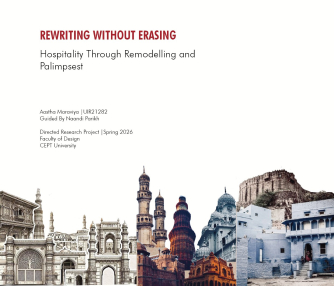
Rewriting Without Erasing: Hospitality Through Remodelling and Palimpsest
Buildings are understood as living entities that evolve, carrying memory, history, and
traces of change. The research looks at how heritage buildings, especially havelis,
are adapted into hospitality spaces through adaptive reuse. It treats these changes
as layered transformations, not just simple renovations. The study uses Remodelling
(Rodolfo Machado) to understand how intentional design interventions shape these
transformations. It also uses the idea of Palimpsest (Bailey’s classification) to explain how
different historical layers coexist within a building. Remodelling explains how changes
are made, while Palimpsest helps understand what those changes result in over time.
Together, these frameworks help analyse how architecture retains, modifies, and reveals
history through design.
The research looks at heritage havelis in Ahmedabad, Jodhpur, and Delhi that have been
converted into hotels, along with a few international examples for broader comparison.
It studies these projects through drawings, documentation, and spatial analysis to
understand how different interventions like insertion, intervention, and installation affect
the building. The focus is on how these changes influence the space, materials, and
overall user experience. A key finding is that adaptive reuse is not about freezing a
building in one time period, but about balancing and revealing multiple layers of history.
The most successful projects are those that highlight existing layers instead of hiding or
replacing them, allowing people to experience history through space itself. The study also
shows that different types of interventions create different palimpsest conditions, like true,
cumulative, and spatial. Each of these conditions offers a different way of understanding
and engaging with heritage spaces.
The findings in the research frame a connection between Remodelling and Palimpsest
cohesively to analyse architectural transformation. It places adaptive reuse as a thoughtful
and sensitive design approach and helps protect heritage buildings. Alongside buildings
are reinterpreted for today’s needs and ensure the buildings remain relevant and usable
in the future.