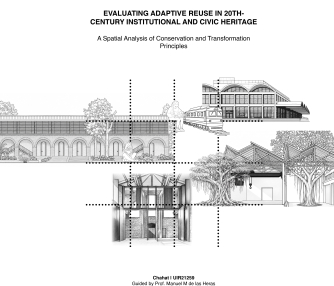
Evaluating Adaptive Reuse in 20th-Century Institutional and Civic Heritage A Spatial Analysis of Conservation and Transformation Principles
Adaptive reuse redefines the life of existing buildings by introducing new functions while retaining their historical essence.
This research investigates the dialogue between old and new materials, how their intersections express continuity, contrast,
and transformation within reused architectural spaces. Taking reference from Matadero Madrid, Casa de la Arquitectura, and
Centro Cultural Daoíz y Velarde in Madrid, the study explores how material transitions through texture, colour, structure, and
detail and mediate between the preserved and the inserted layers of architecture. The research aims to understand materials
not merely as construction elements but as narrative tools that embody memory, reveal time, and define atmosphere. By
analysing junctions, interfaces, and the tactile qualities of reused materials, the study identifies design strategies that allow
both the old and new to coexist in balance. Ultimately, it seeks to frame material transitions as a design language, one that
bridges heritage and modernity, enabling adaptive reuse to become a dialogue of time, craft, and identity.