Patel Ritu Prakashbhai

UM4050

PUM24302

My Direct Research Project examines the regularization process of unauthorized colonies in Ahmedabad, focusing on procedural inefficiencies, policy gaps, and ground-level challenges. The study analyzes the step-by-step framework of regularization in relation to GDCR provisions and urban governance mechanisms. Based on primary household surveys and secondary data, it evaluates key aspects such as infrastructure access, tenure security, and resident awareness. The research highlights conflicts between planning regulations and existing settlement patterns, along with limitations in implementation. It aims to propose practical, context-specific strategies to improve the effectiveness of regularization and ensure inclusive and sustainable integration of such settlements into the formal urban system.
Report Content

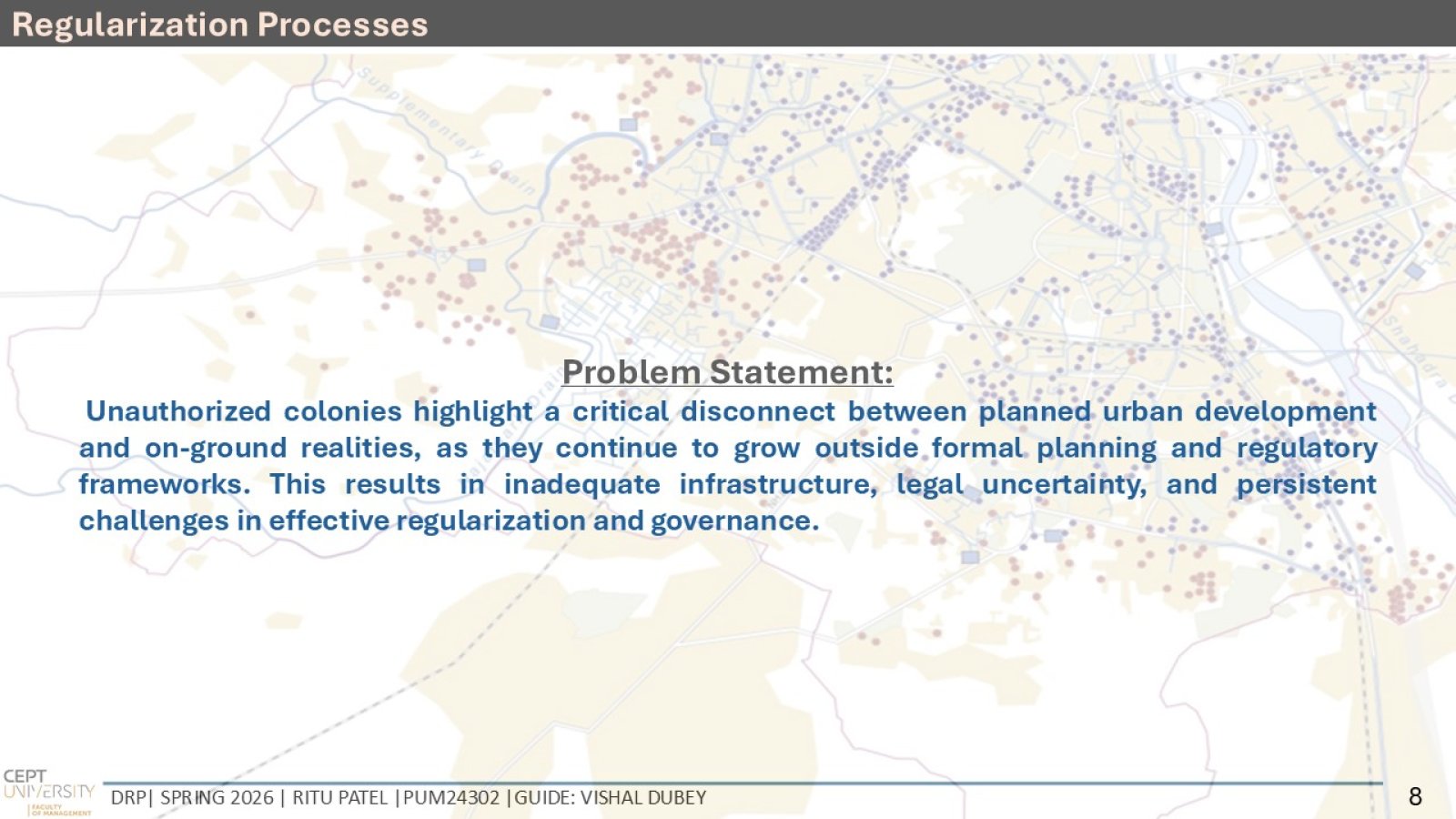
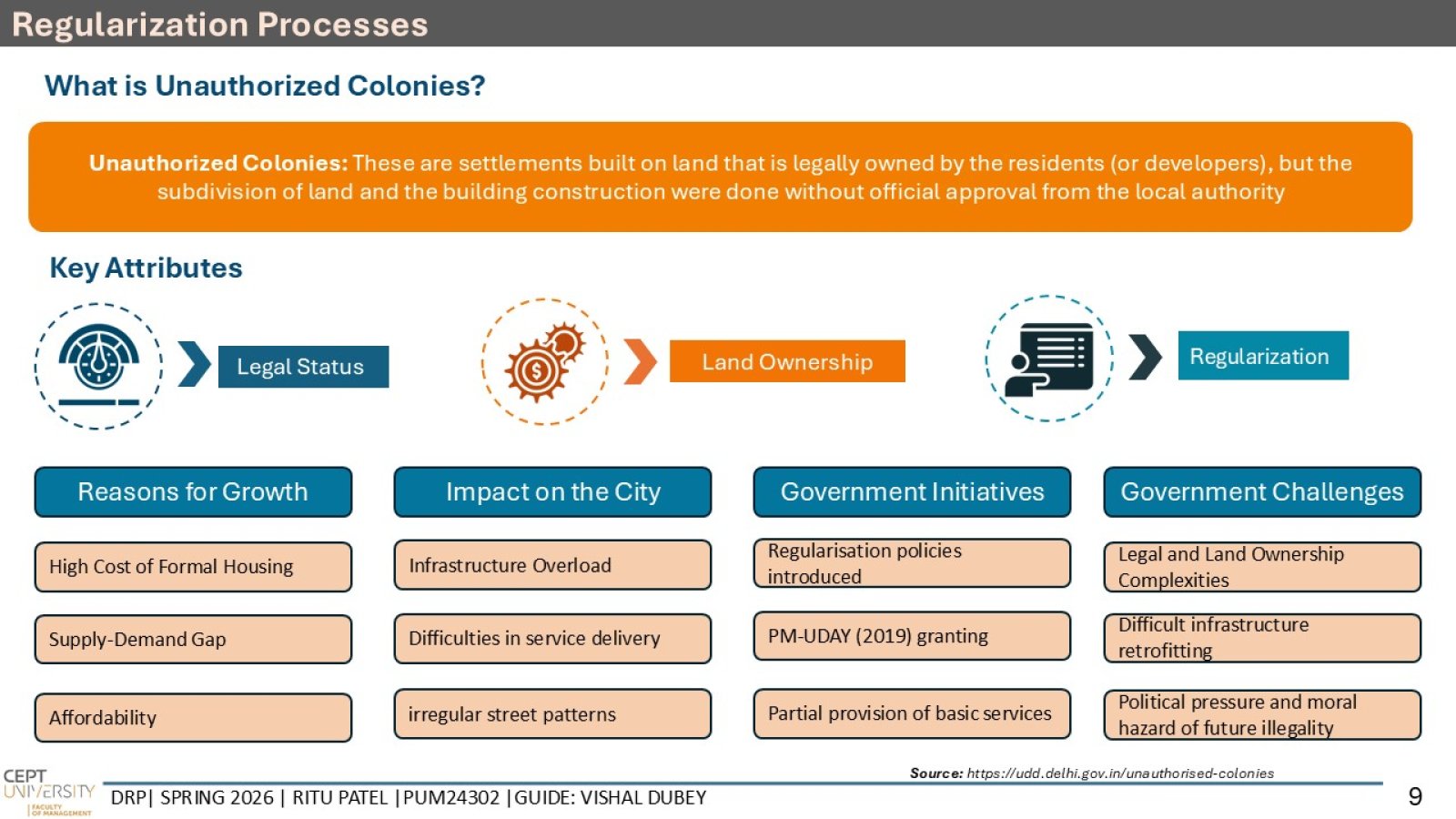
Unauthorized colonies reveal a significant disconnect between official urban planning and the reality of rapid, informal growth. This gap creates persistent governance challenges, leaving residents with inadequate infrastructure and long-term legal uncertainty.

These settlements are built on resident-owned land but lack official subdivision and construction approvals from local authorities. Their growth is primarily driven by a lack of affordable formal housing, resulting in infrastructure overload and complex regularization hurdles.

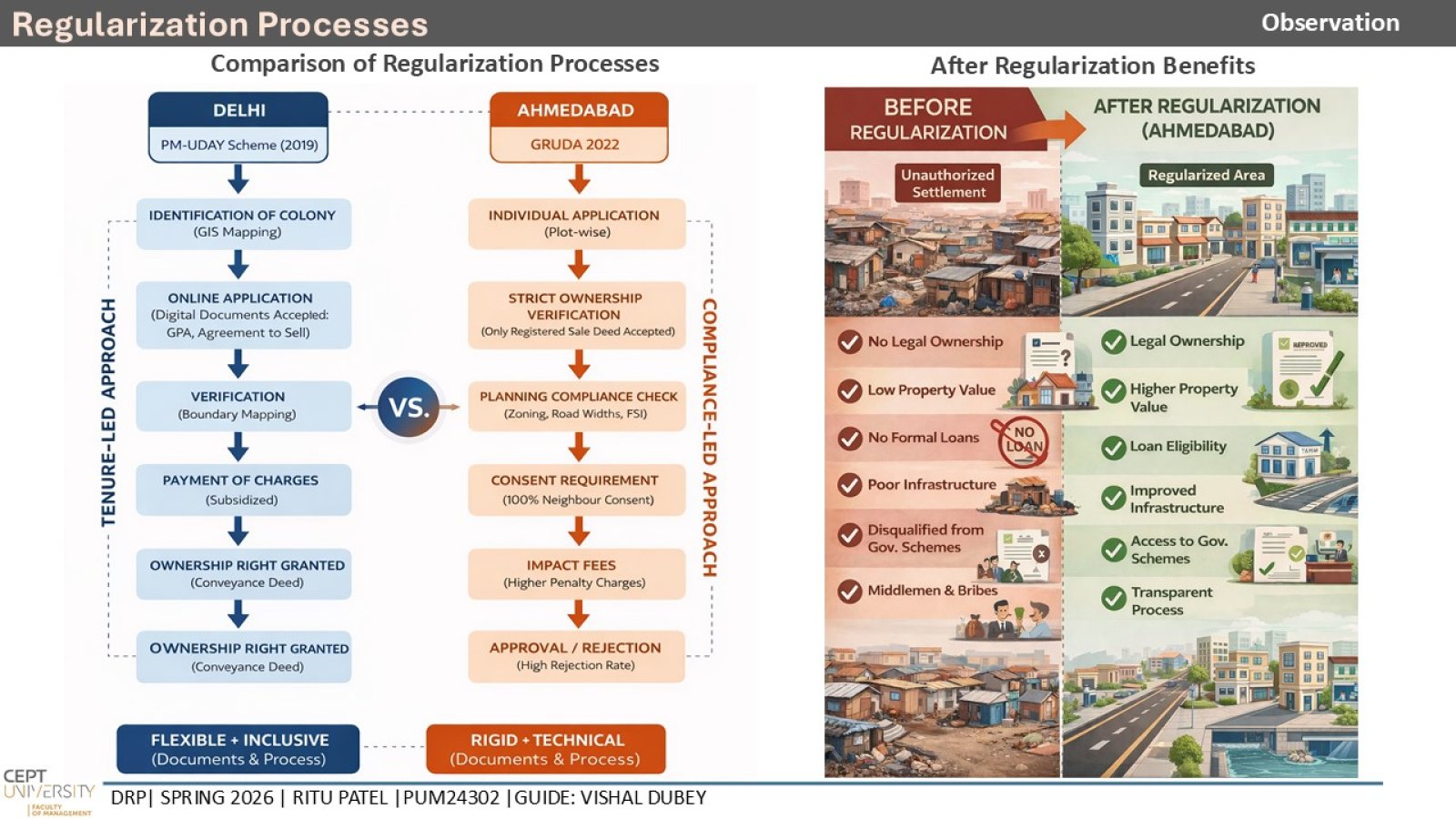
This slide compares Delhi’s flexible, tenure-led approach (PM-UDAY) against Ahmedabad’s rigid, compliance-led framework (GRUDA). While regularization offers benefits like increased property value and loan eligibility, Ahmedabad’s technical requirements often lead to higher rejection rates.

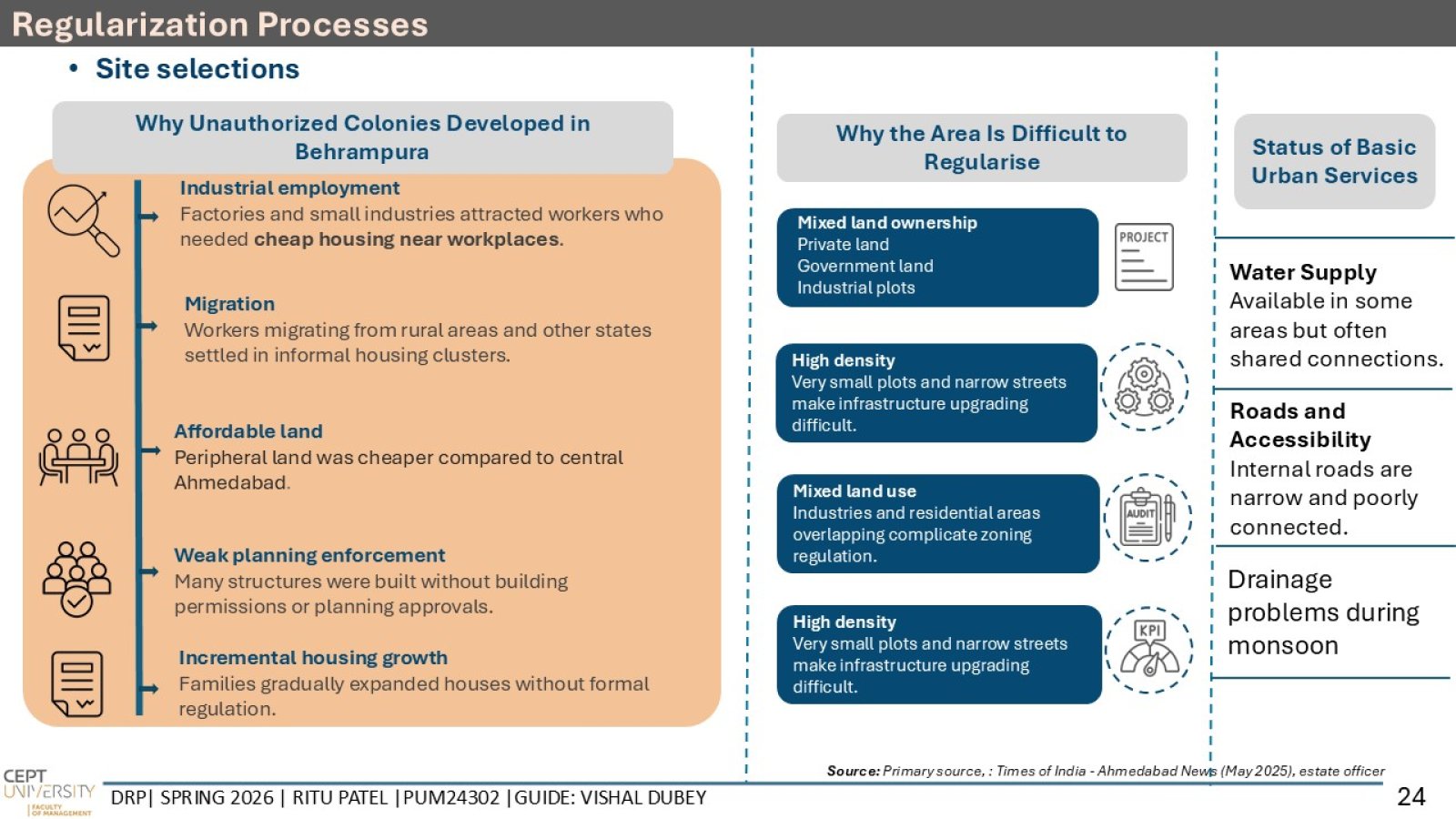
Behrampura’s informal growth was fueled by industrial employment and the need for cheap, peripheral housing near workplaces. Regularization is now difficult due to mixed land ownership, high density, and narrow street patterns that complicate infrastructure upgrades.

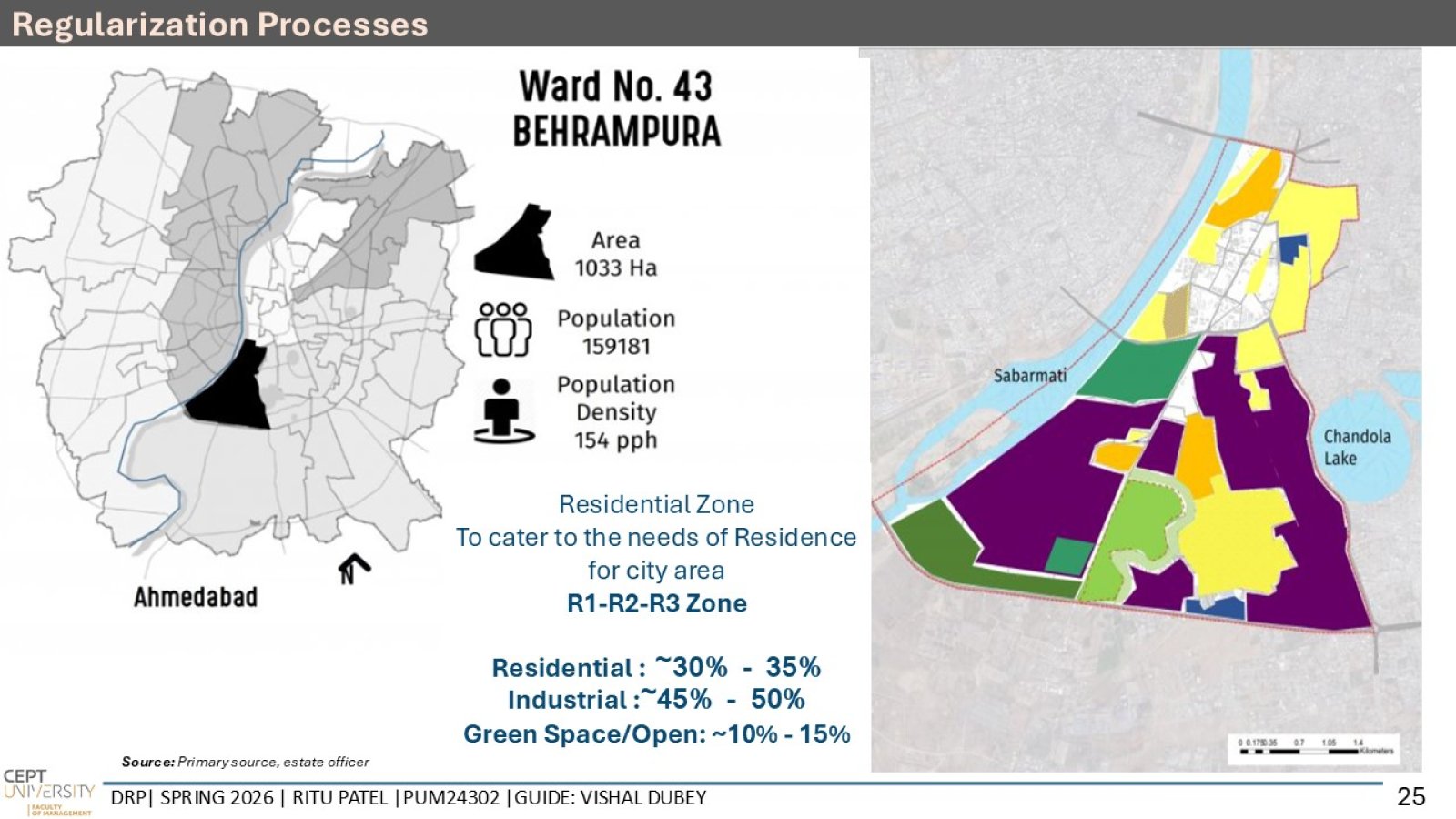
This ward is a high-density residential and industrial hub with over 150,000 residents packed into roughly 1,000 hectares. The land use is dominated by industrial (45-50%) and residential (30-35%) zones, leaving very little room for green or open spaces.

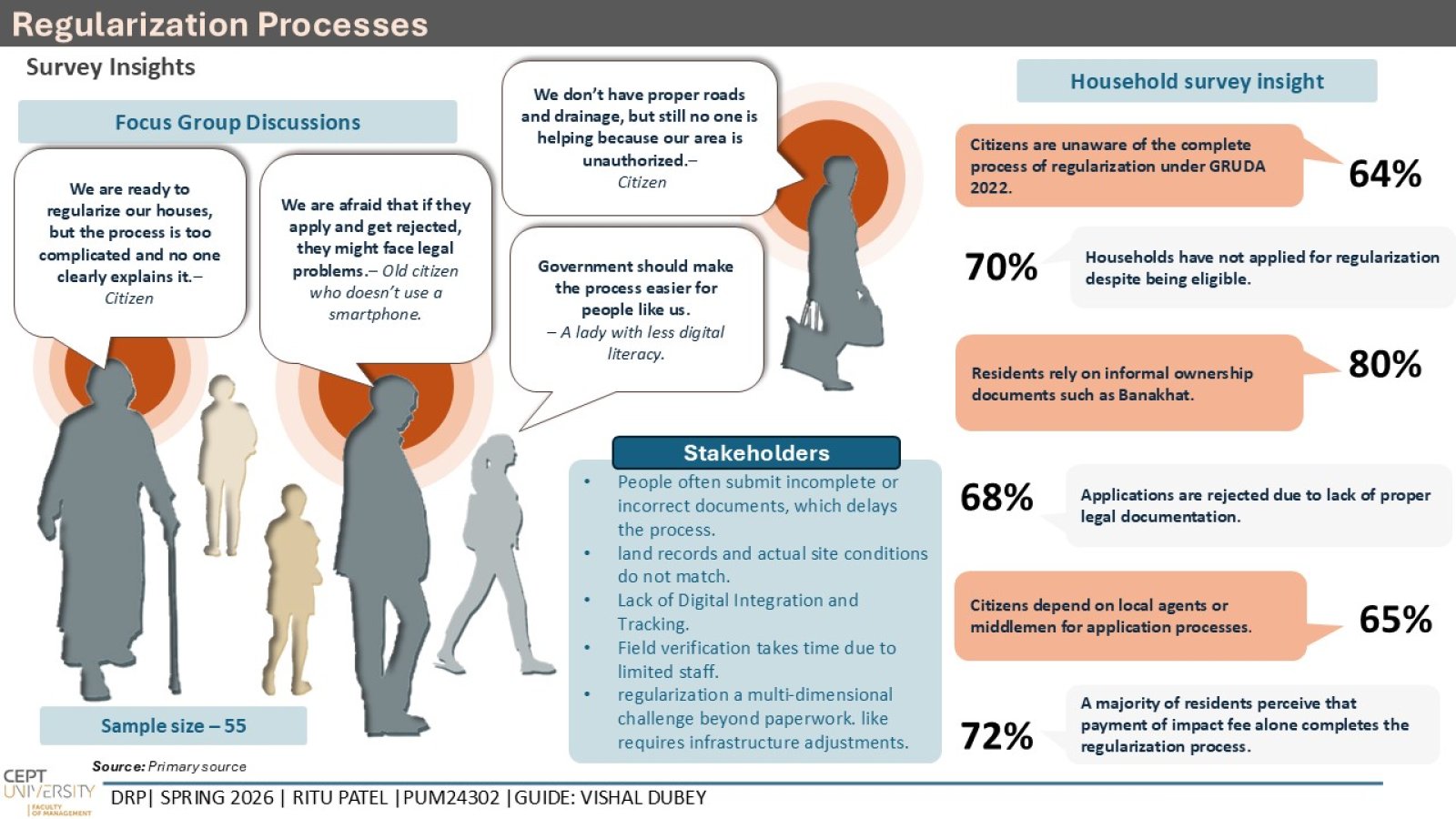
Field surveys indicate that while 70% of eligible households have not applied for regularization, the barrier is often a lack of awareness or fear of the complex legal process. A majority of residents mistakenly believe that paying an impact fee alone is sufficient to legalize their property.

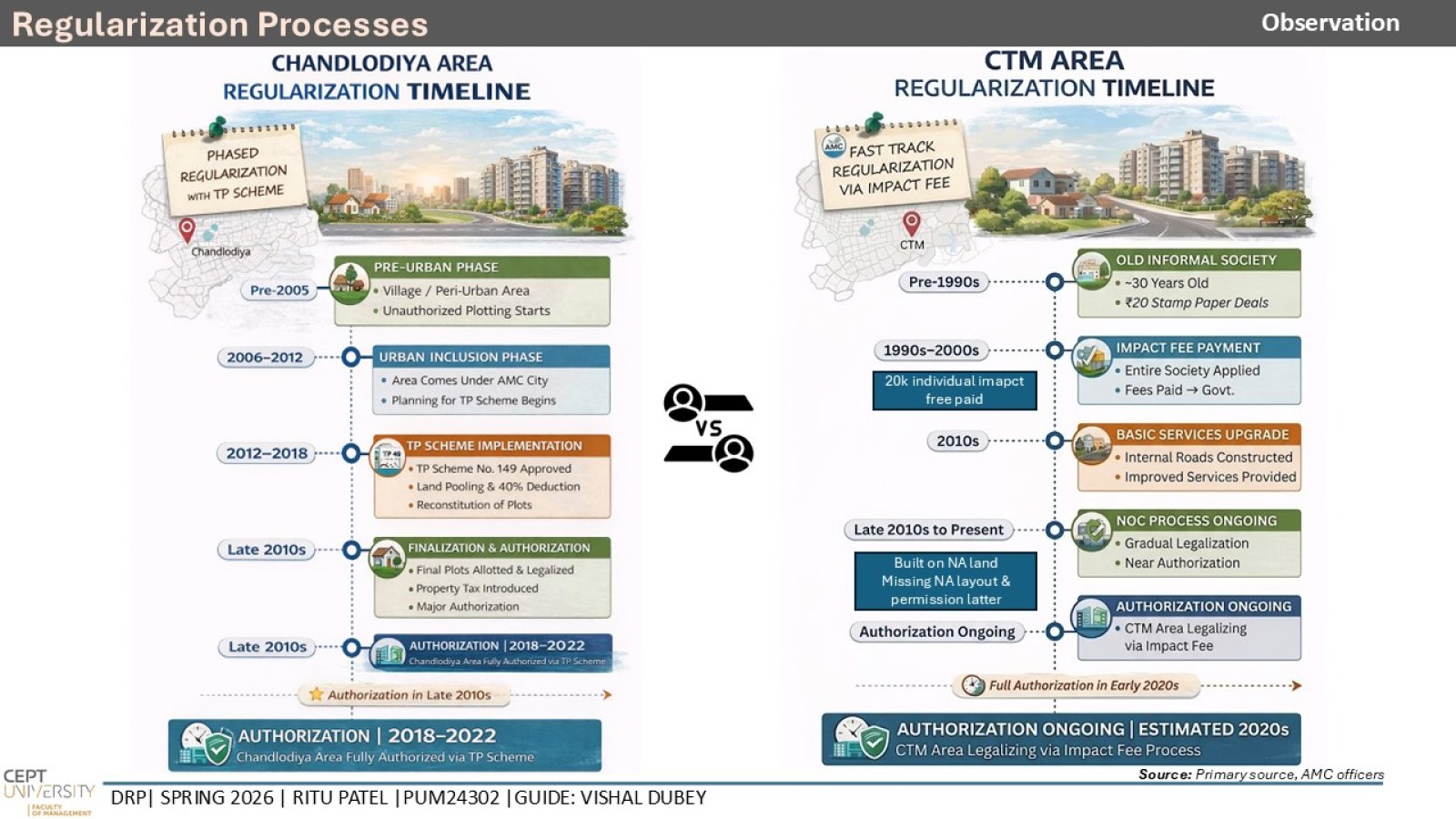
A comparison shows that while Chandlodiya achieved full authorization through phased Town Planning (TP) schemes, the CTM area remains in a state of ongoing legalization. The timeline highlights how different administrative paths—TP schemes vs. Impact Fees—drastically affect the speed of regularization.

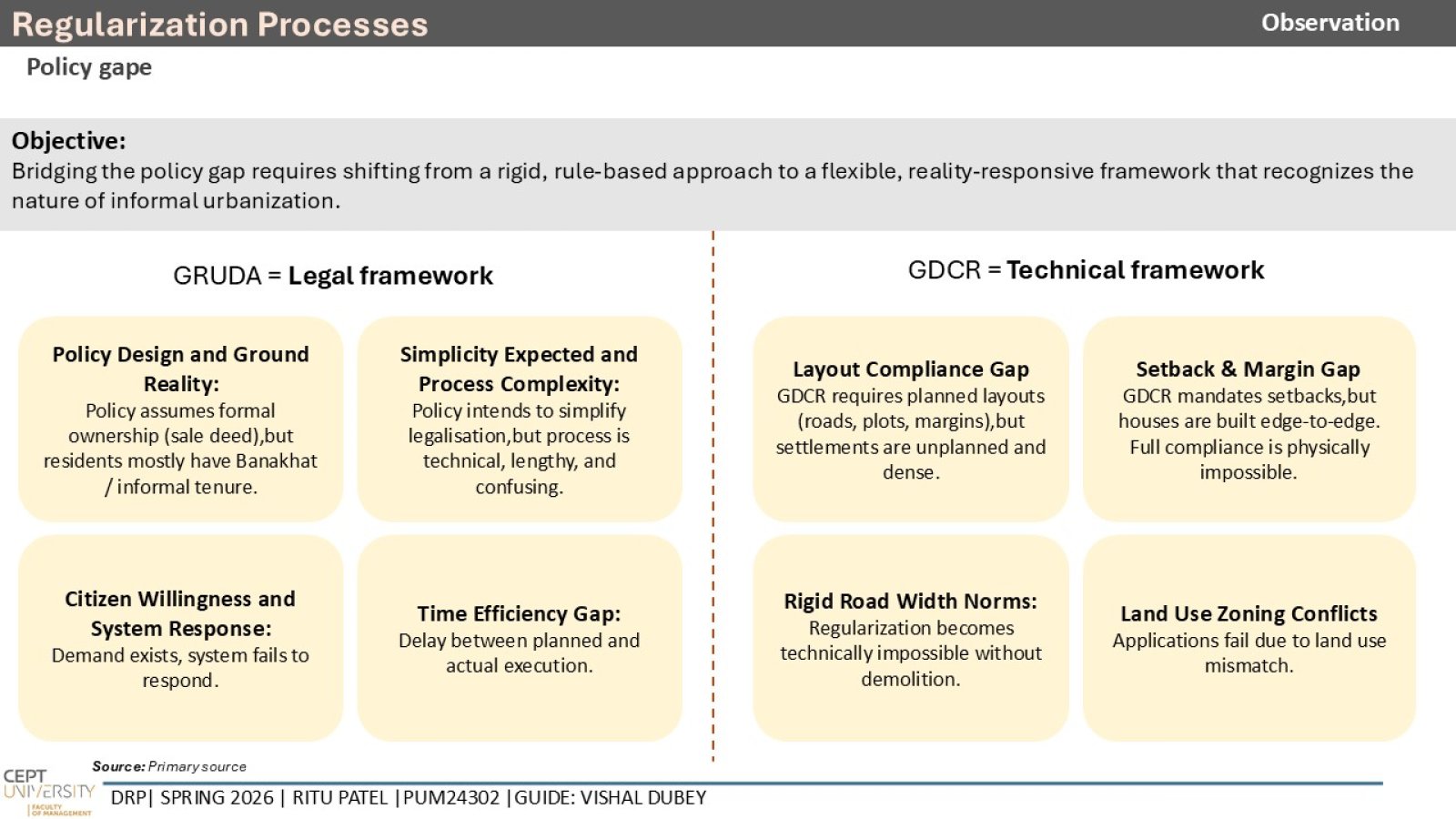
There is a fundamental mismatch between legal frameworks (GRUDA) and technical requirements (GDCR). Policies assume formal sale deeds that residents don't have, while technical norms for road widths and setbacks are physically impossible to meet in dense, existing settlements.

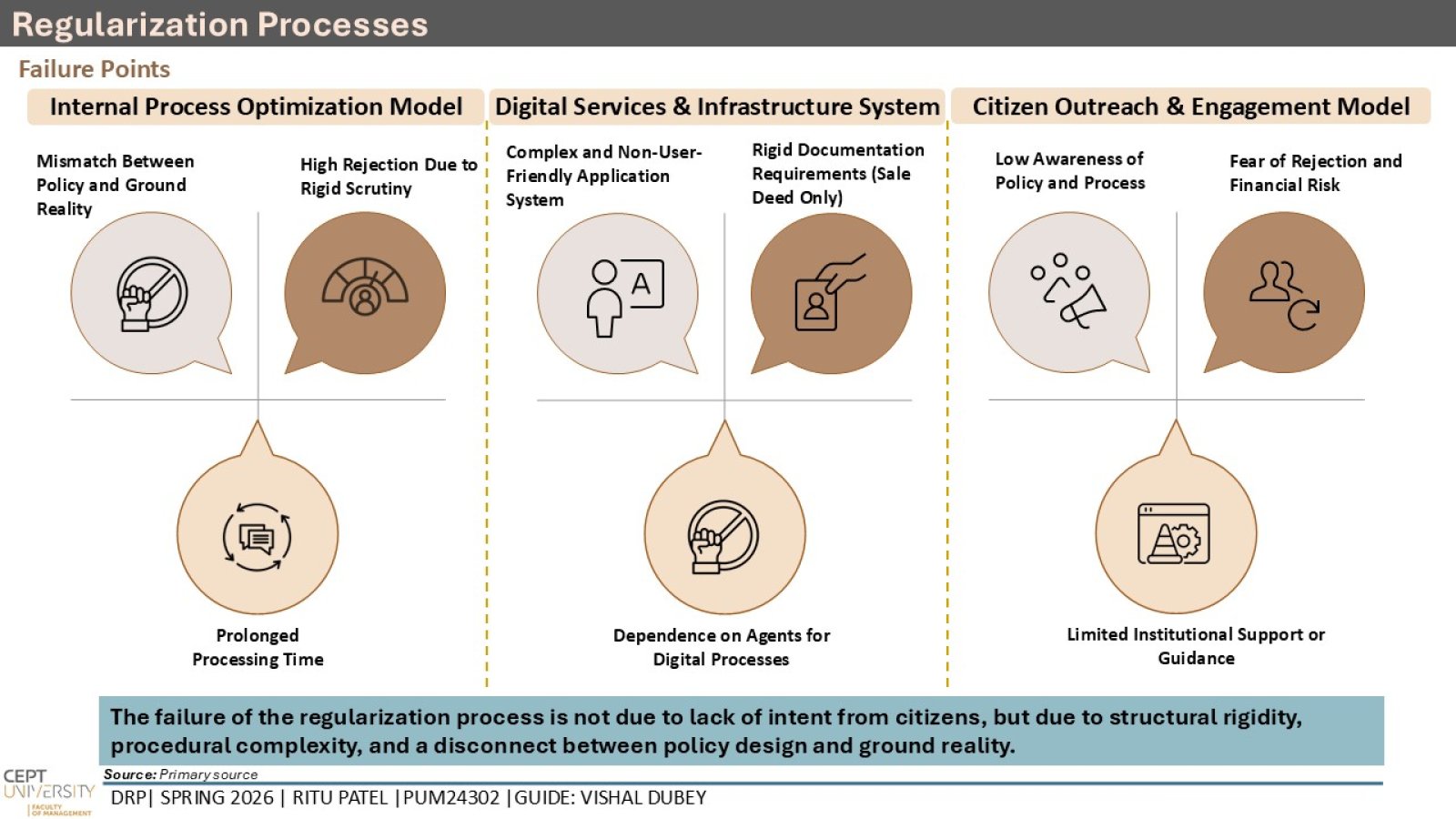
The failure of regularization stems from structural rigidity, high rejection rates during scrutiny, and a heavy dependence on middlemen for digital processes. Ultimately, the system fails not due to a lack of citizen intent, but because of a massive disconnect between policy design and ground reality.

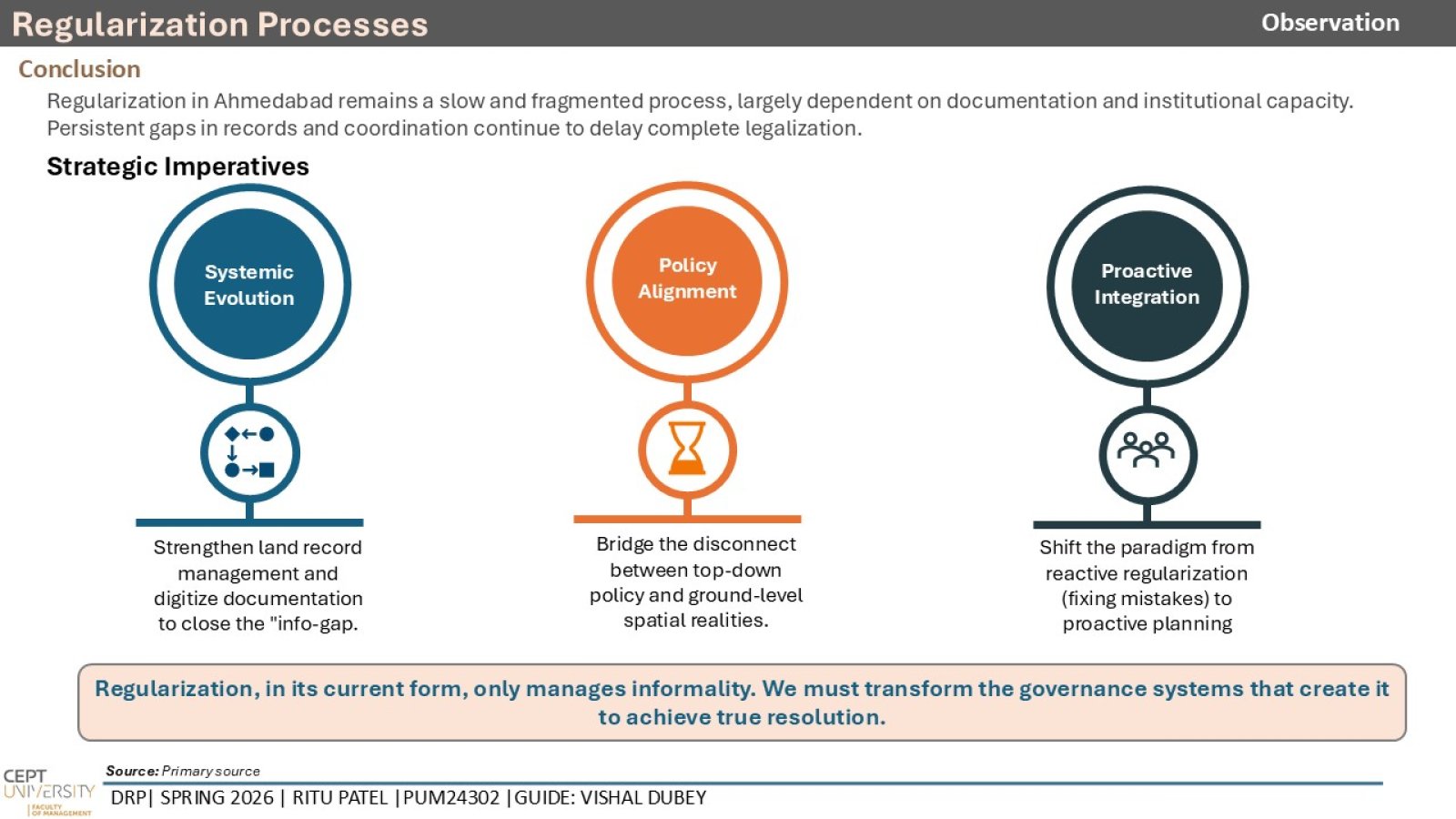
o achieve true urban resolution, the governance system must evolve from reactive "mistake-fixing" to proactive, digitized planning. We must bridge the info-gap and align top-down policies with the actual spatial realities of informal urbanization.