Uttaran Bhunia

UI4005

Unlocking Green Lungs of Ahmedabad

Ahmedabad faces intensifying heat stress, urban flooding, and declining ecological resilience despite possessing significant but fragmented green assets. Unlocking Green Lungs of Ahmedabad proposes transforming the city’s central institutional precinct in Navrangpura into a connected blue-green urban commons through a Green Local Area Plan. By linking gated campuses, introducing sponge infrastructure, permeable green edges, shaded non-motorised mobility, and shared public amenities, the project reimagines underutilized landscapes as climate-performing public infrastructure and vibrant public realm. Beyond ecological resilience, it fosters social inclusion, healthier public life, cultural activation, safer walkability, and equitable access to recreation, creating a scalable model for a cooler, more resilient, and inclusive Ahmedabad.

View Additional Work
Report Content

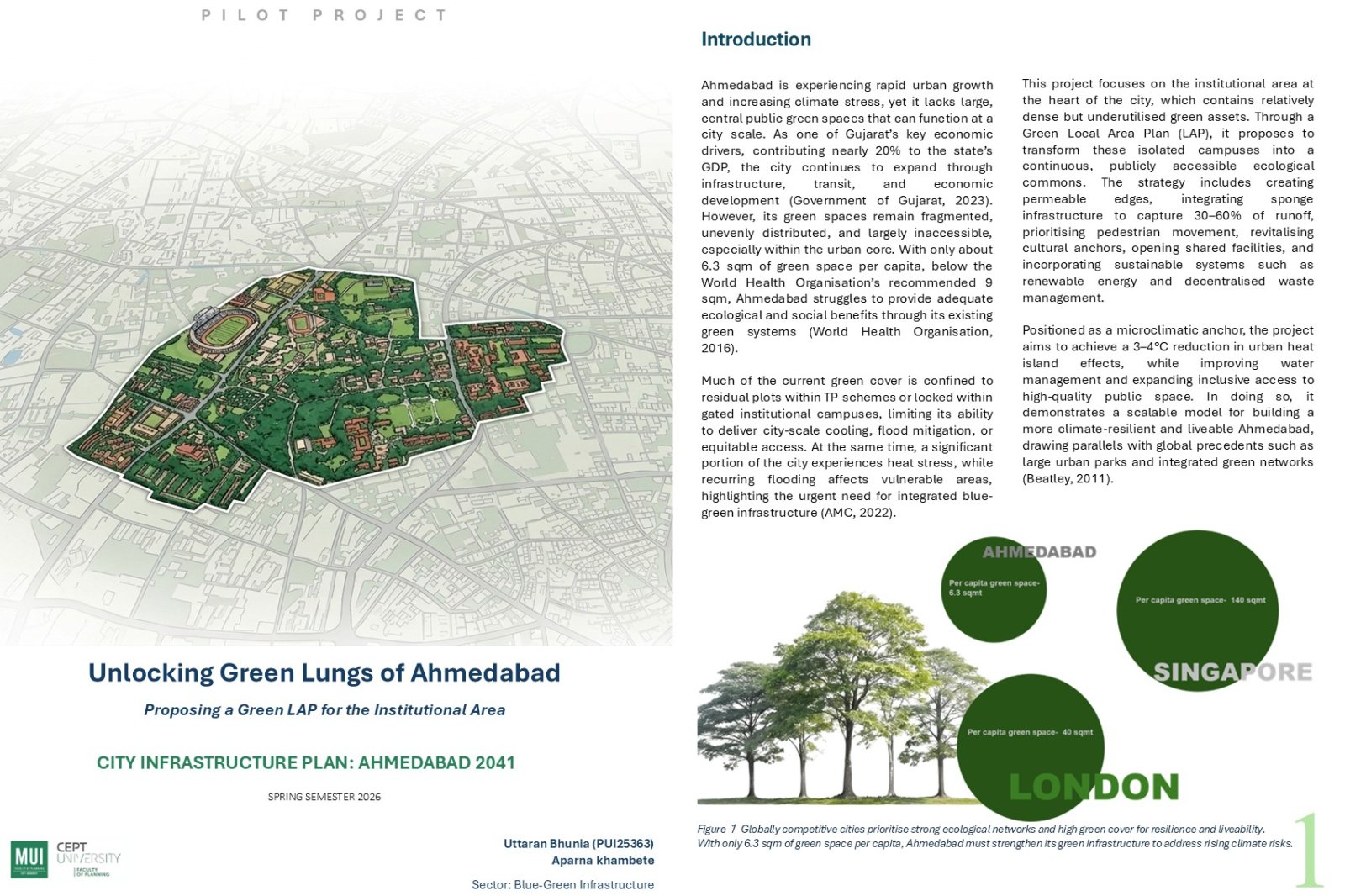
Introduction: Ahmedabad is growing rapidly but its green space — at just 6.3 sqm per capita — falls well below the WHO's recommended 9 sqm. Fragmented, inaccessible, and climatically underperforming, the city's greens fail to deliver city-scale cooling or flood resilience. A Green LAP for the institutional core proposes a connected, climate-resilient solution.

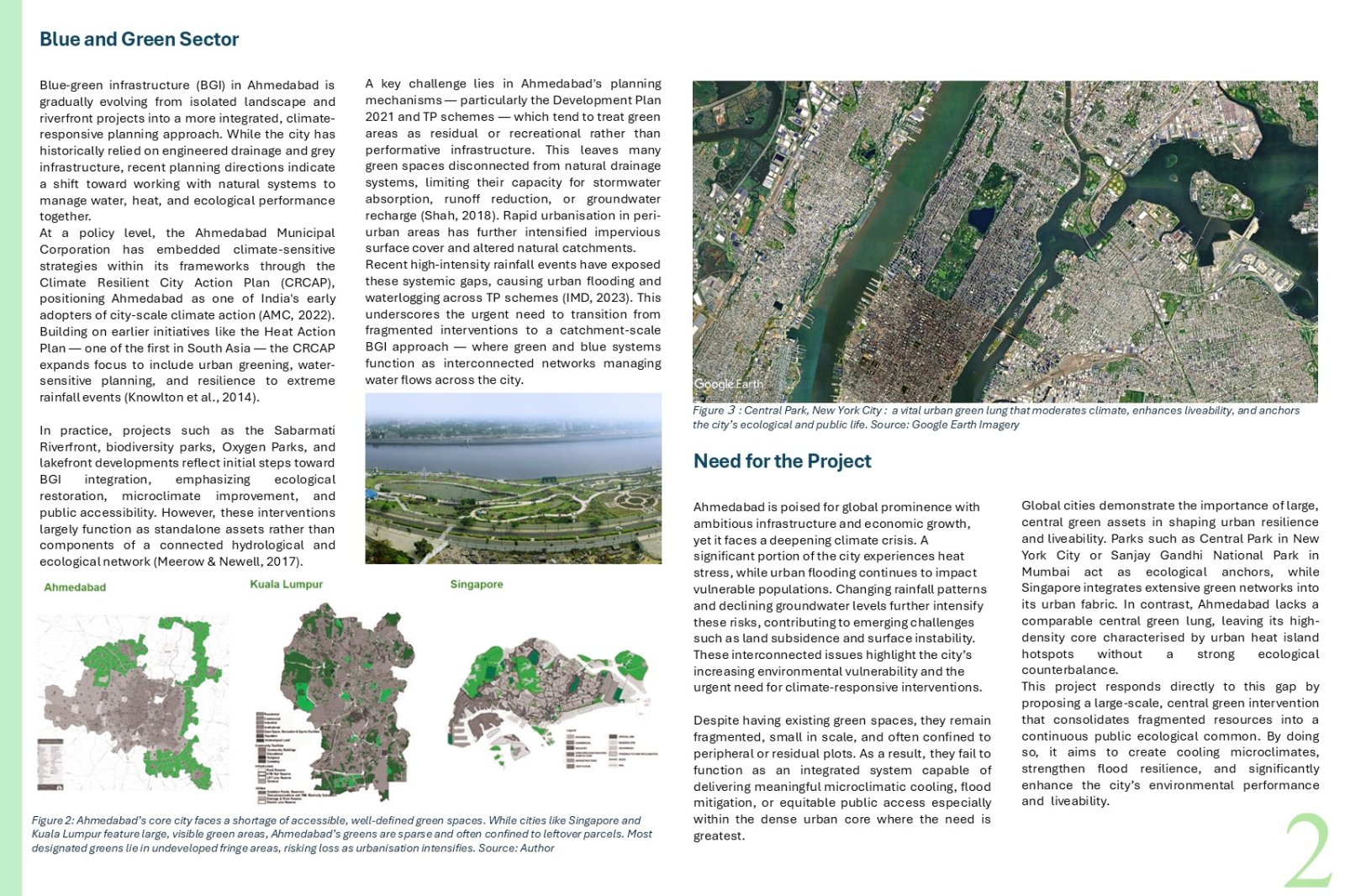
Blue and Green Sector: While Ahmedabad has made early strides through initiatives like the CRCAP and Sabarmati Riverfront, its blue-green infrastructure remains a collection of standalone projects rather than an integrated network. Policy frameworks exist but lack enforceability. A shift toward catchment-scale, connected BGI planning is essential to address the city's growing climate vulnerabilities.

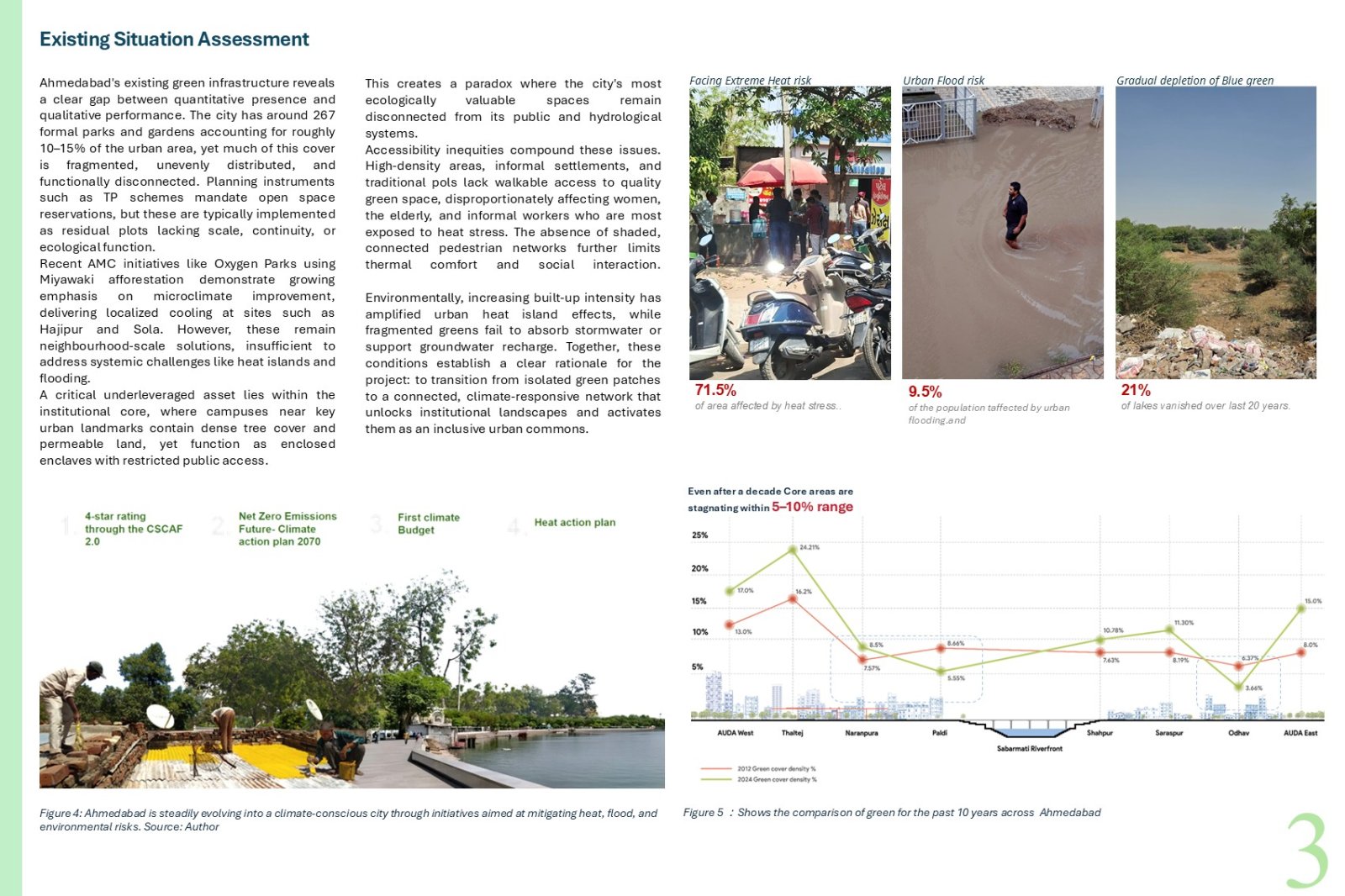
Existing Situation Assessment: The numbers tell a stark story — 71.5% of the city faces heat stress, 9.5% of the population is affected by urban flooding, and 21% of lakes have vanished over two decades. Despite having green assets, they remain gated and fragmented, unable to deliver meaningful ecological or social benefits at scale.

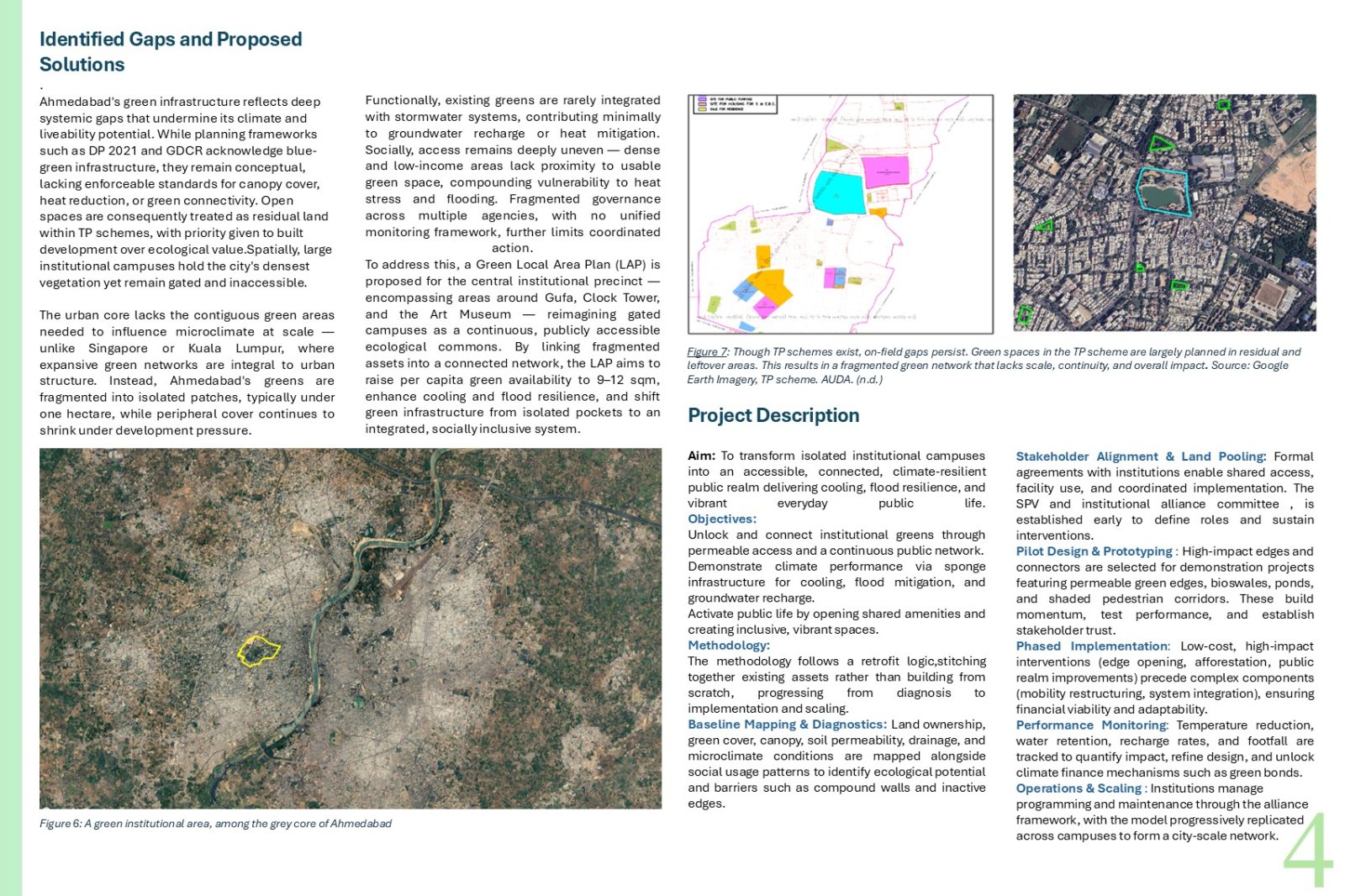
Identified Gaps & Project Description: current Planning frameworks treat green space as residual land, governance is fragmented across agencies, and the city's densest vegetation sits locked within inaccessible institutional campuses. A Green LAP for the Gufa–Clock Tower–Art Museum precinct addresses these gaps by retrofitting and connecting existing assets into an integrated, socially inclusive ecological commons.

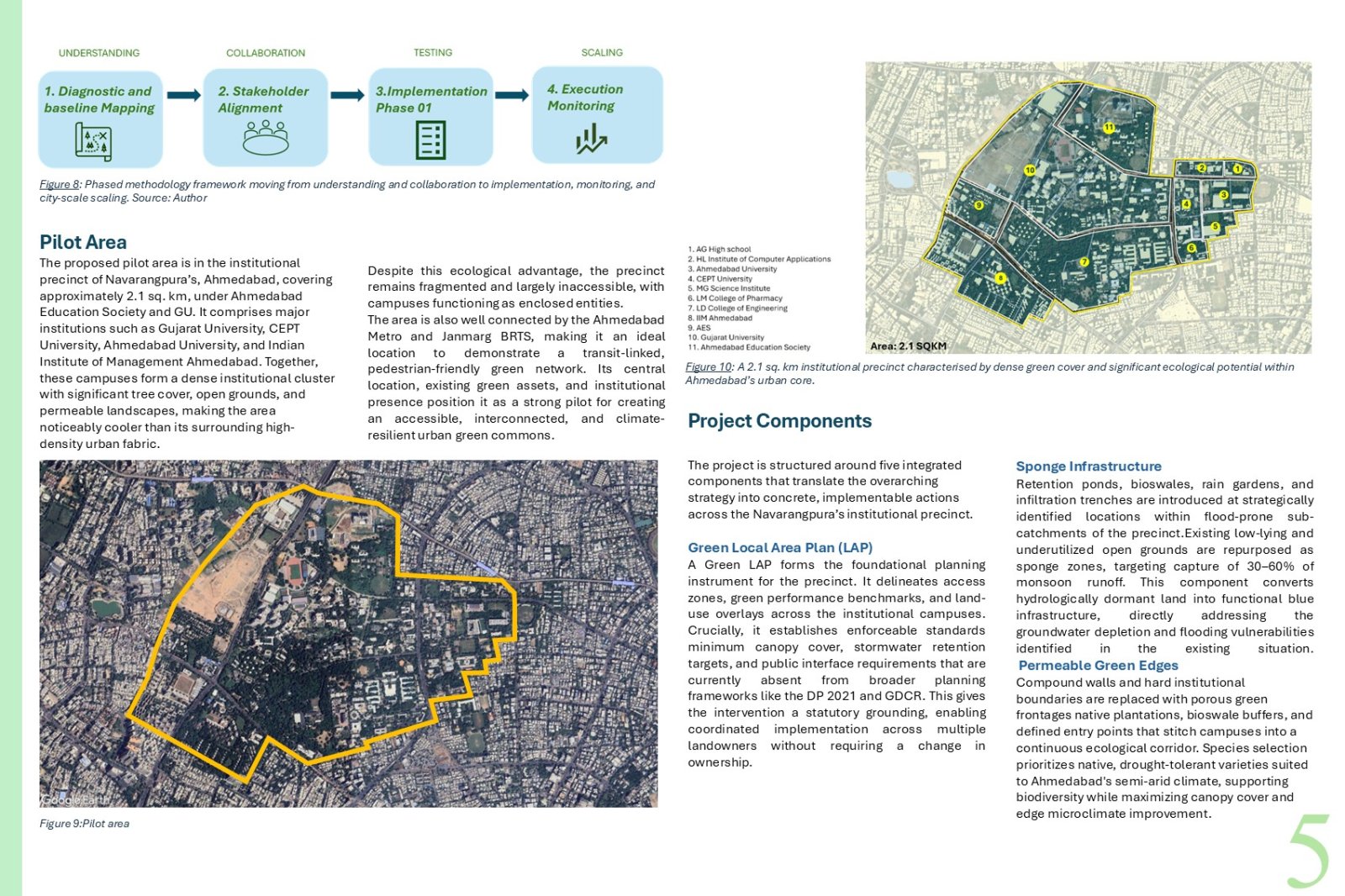
Pilot Area & Project Components: The 2.1 sq.km Navarangpura institutional precinct — home to Gujarat University, CEPT, IIM, and others — offers dense tree cover, permeable land, and strong transit connectivity via Metro and BRTS. Though ecologically rich, campuses function as enclosed enclaves. Five integrated components — Green LAP, sponge infrastructure, permeable edges, mobility, and shared amenities — unlock their potential.

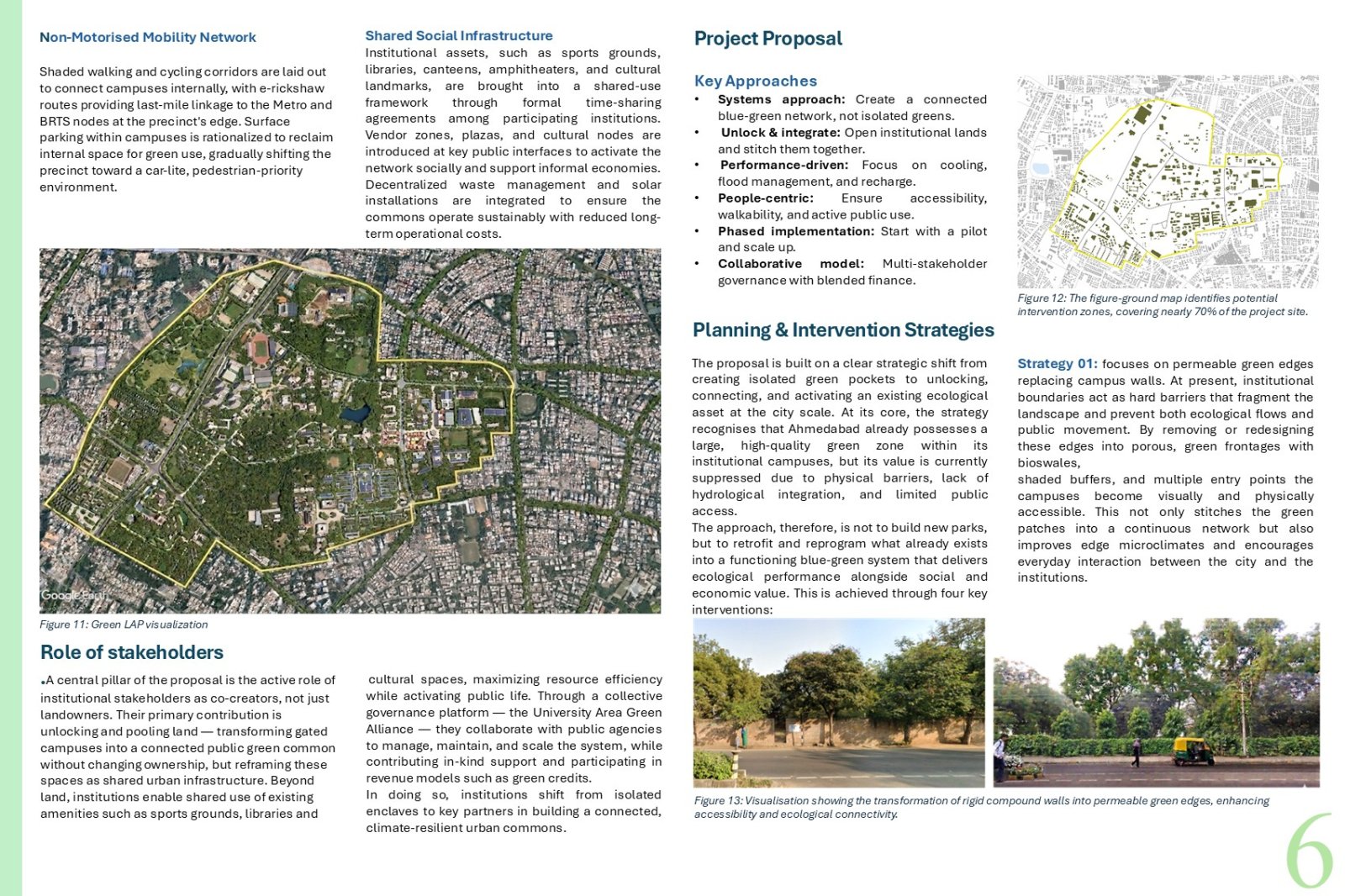
Stakeholders & Planning Strategies: The proposal's core logic is retrofit, not rebuild — unlocking and reprogramming what already exists rather than creating new parks from scratch. Institutions shift from isolated landowners to active co-creators, pooling land and sharing facilities under a collective governance platform. Four intervention strategies then stitch these assets into a functioning, publicly accessible blue-green system.

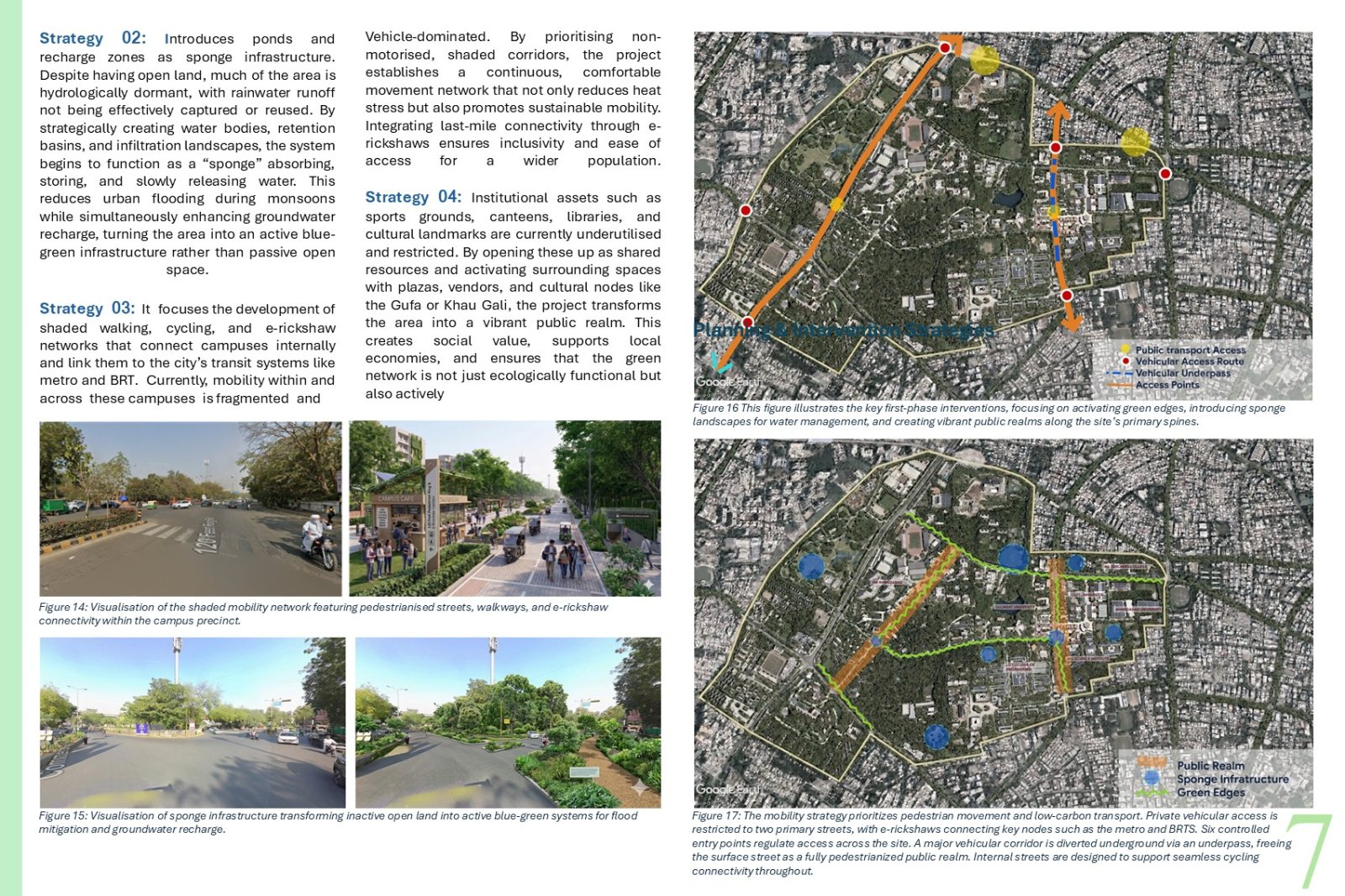
Intervention Strategies & Mobility: Four strategies work in tandem: permeable green edges dissolve hard campus boundaries; sponge infrastructure captures 30–60% of monsoon runoff; a shaded mobility network of walking, cycling, and e-rickshaw routes connects campuses to metro and BRTS; and shared social infrastructure — sports grounds, cultural nodes, vendor plazas — activates the precinct as a vibrant public realm.

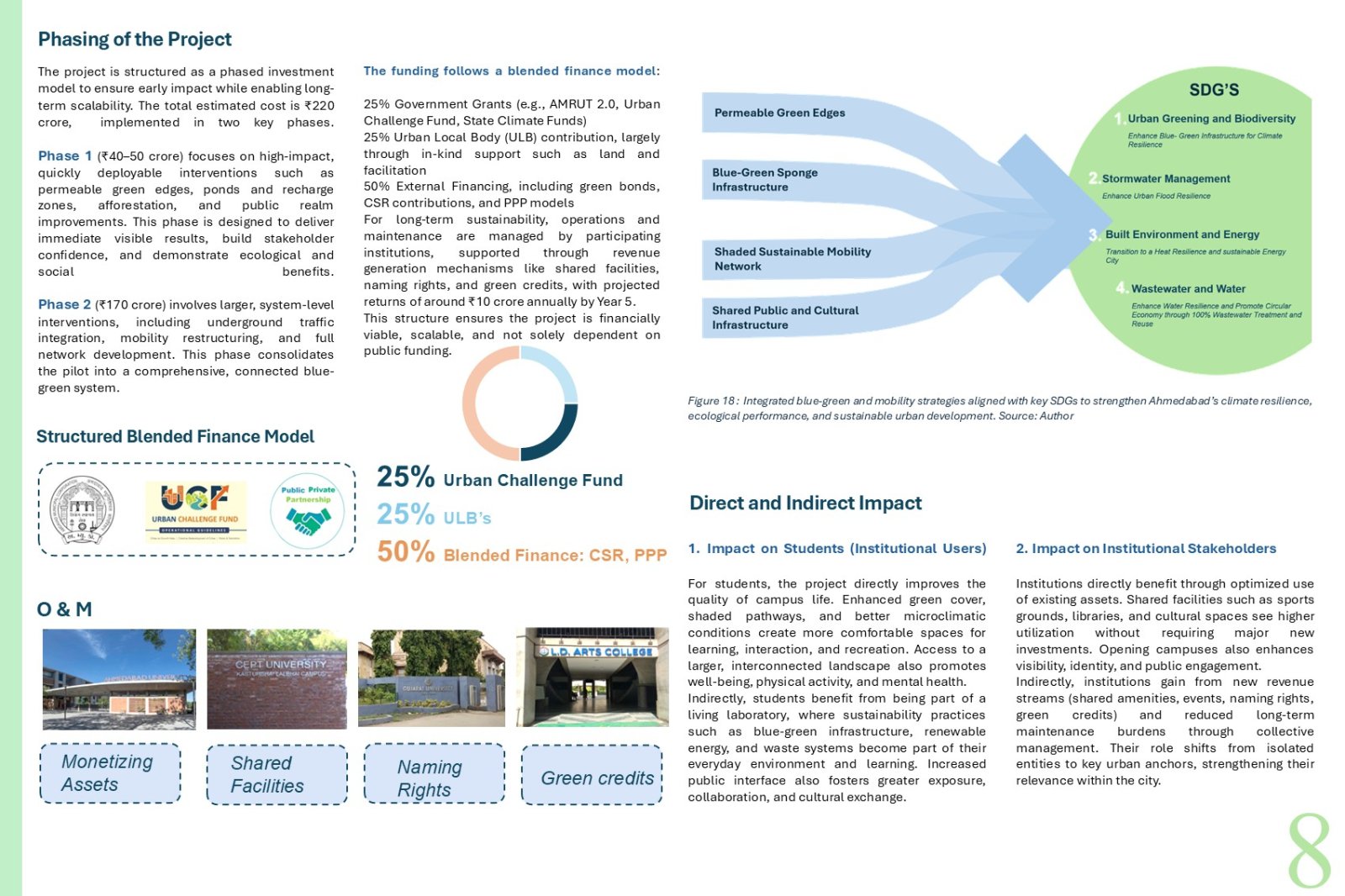
Phasing & Finance: The Rs 220 crore project is delivered in two phases — Phase 1 (Rs 40–50 crore) focuses on quick, high-impact interventions to build momentum and demonstrate performance, while Phase 2 (Rs 170 crore) scales to full system integration. A blended finance model combining government grants, ULB contributions, green bonds, CSR, and PPP ensures long-term financial viability and reduced dependence on public funding.

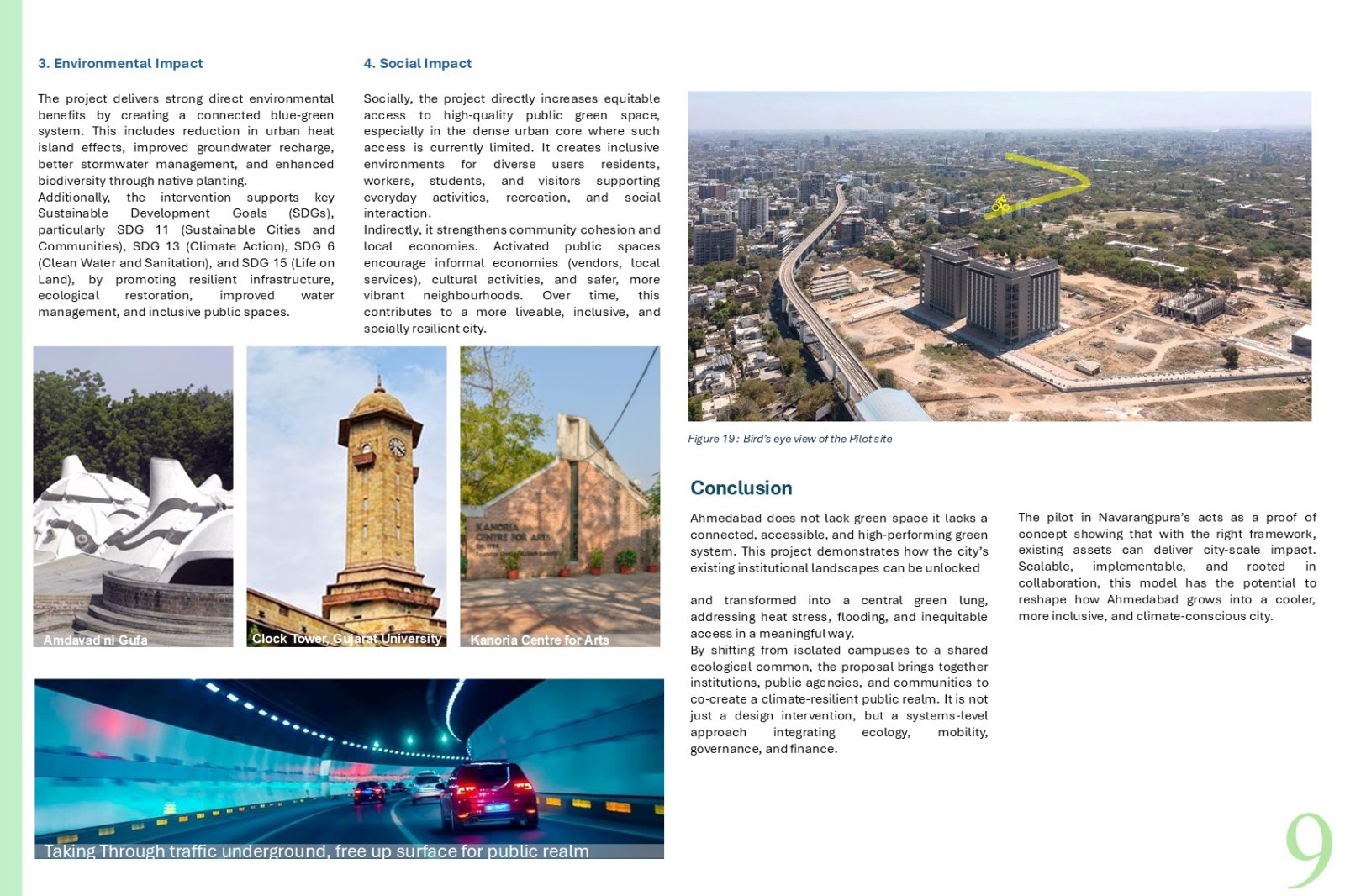
Impact & Conclusion: Ahmedabad doesn't lack green space — it lacks a connected, accessible, high-performing green system. This pilot in Navarangpura demonstrates that unlocking existing institutional landscapes can deliver city-scale impact: reducing heat stress, improving flood resilience, and expanding equitable access. Scalable and rooted in collaboration, it offers a replicable model for a cooler, more inclusive Ahmedabad.

Project Video