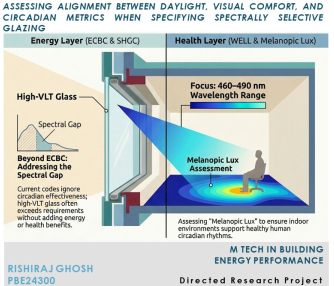
Assessing alignment between daylight, visual comfort, and circadian metrics when specifying spectrally selective glazing
This DRP aims to evaluate high-performance glazing systems not
only for their energy efficiency but also for their impact on circadian health in the Indian built
environment. Current ECBC guidelines prioritize daylight factor, U-value, and SHGC; however, they
do not address the spectral quality of daylight that regulates human circadian rhythms. As a result,
many glazing products deliver excessive visible light (high VLT) to comply with code requirements—
often without proportional energy savings or biological benefits.
This study will assess commercially available glazing types through simulation and on-site
measurements, focusing on melanopic lux, spectral transmittance (460–490 nm), daylight autonomy,
UDI, SHGC, and annual energy performance. Standards like the WELL Building Standard (Feature L03 – Circadian Lighting Design) will be used as benchmarks for circadian compliance.
By comparing high-VLT and moderate-VLT glazing options, the research seeks to determine whether
glazing that only meets, rather than exceeds, ECBC daylight requirements can deliver a more
optimal balance of energy efficiency, thermal comfort, cost, and circadian effectiveness.