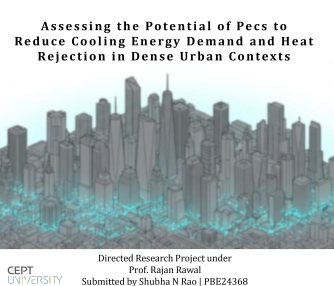
Assessing the Potential of Personalized Environmental Comfort Systems (PECS) to Reduce Cooling Energy Demand and Heat Rejection in Dense Urban Context
This Directed Research Project investigates the potential of integrating Personalized
Environmental Control Systems (PECS) within buildings to reduce energy consumption and
heat rejection from HVAC systems, thereby mitigating the Urban Heat Island (UHI) effect.
The study examines a medium-rise building surrounded by high-rise structures, where heat
entrapment and altered microclimates are particularly prominent. Urban temperature
escalation is driven not only by solar absorption and reduced vegetation but also by
anthropogenic heat emissions, primarily from cooling systems. Existing research indicates
that PECS—through devices such as desk fans, heated chairs, or personal diffusers—can
maintain thermal comfort while lowering central cooling loads by up to 30%. This project
employs DesignBuilder-based simulations, supported by literature on UHI behavior, to
quantify reductions in cooling demand and subsequent HVAC heat rejection. The ultimate
objective is to assess whether PECS can function as a practical approach to disrupt the
energy–heat feedback loop and enhance thermal resilience in dense urban environments.