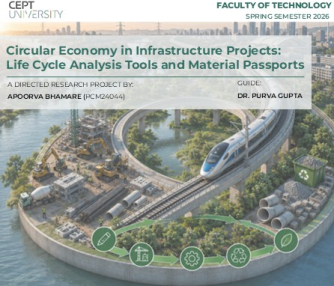
Circular Economy in Infrastructure Projects – Life Cycle Analysis Tools and Material Passports
Infrastructure development has long followed a linear “take–make–dispose” model, resulting in substantial
resource depletion, waste generation, and carbon emissions. Circular economy (CE) approaches aim to move
away from this resource-hungry paradigm where materials are extracted, used, and discarded, to one that
emphasizes material reduction, retention, and reuse. At the core of circular approaches in construction lies
material efficiency, achieved through designing for adaptability, disassembly, and value preservation
beyond initial use.
A key conceptual shift is to perceive buildings and infrastructure assets not merely as static entities but as
material banks, repositories of valuable components that can be recovered, traded, and reused at the end of
their service life. Material Passports (MPs) are digital tools that document material characteristics, provenance,
and potential for reuse throughout the life cycle.
To operationalize this vision, Life Cycle Analysis (LCA) offers a quantitative method for evaluating
environmental impacts, resource flows, and circularity performance. This study explores how integrating LCA
tools with Material Passport systems can provide a robust framework for achieving circular economy
objectives in infrastructure projects, enhancing transparency, resource efficiency, and long-term
sustainability.