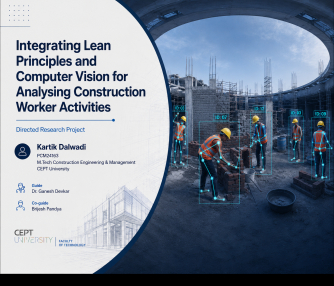
Integrating the lean principles and computer vision for analyzing construction worker activities
The construction productivity at the site comes under intense scrutiny for on time completion
of project. There are many elements of this productivity which includes construction
workers, equipment, information, site conditions and so on. The on-site administration
involving construction managers, supervisors and foreman take keen interest in improving
construction worker productivity. Typically, the activities performed by the workers are
categorized as productive and nonproductive, and on site administration uses different ways
and means to improve productive activities. As in person supervision of construction
workers has its set of challenges like geographically disperse activities, additional
manpower required for supervision and cost constraints. Under these circumstances, the
computer vision would be useful for reducing human involvement in the analysis of
construction worker activities. Further to this, the lean principles provide a lens to analyze
the activities performed by the construction workers under three categories: value adding
(VA), non value adding but necessary (NVAN) and non value adding activities (NVA).
Typically, the lean tools like work sampling and foreman delay survey includes the in-
person (by construction supervisors) observations of construction activities performed by
2
the workers and perform analysis in terms of percentage VAs, NVAs and NVANs. The
rationale behind this analysis is to reduce percentage of NVA and NVAN activities by
formulating various improvement strategies. With the advent of computer vision and
construction automation, there is a call for reducing human involvement in the analysis of
construction worker activities. This is in line with the growing interests among the
researchers and academicians to create synergies between lean construction and
construction automation. This research study aims to analyze different construction activities
like plastering, brickwork and concreting with computer vision and lean principles. Further
to this, the analysis would involve investigating application of computer vision under
different lighting conditions and site conditions.