Your browser is out-of-date!
For a richer surfing experience on our website, please update your browser. Update my browser now!
You open an app, add a few items to a cart, and confirm the order. Within minutes, sometimes less, a brown paper bag appears at your door. The transaction is seamless. At no point did you need to know where the products came from, who picked them, or what kind of space made it possible. That invisibility is not incidental. It is the product.
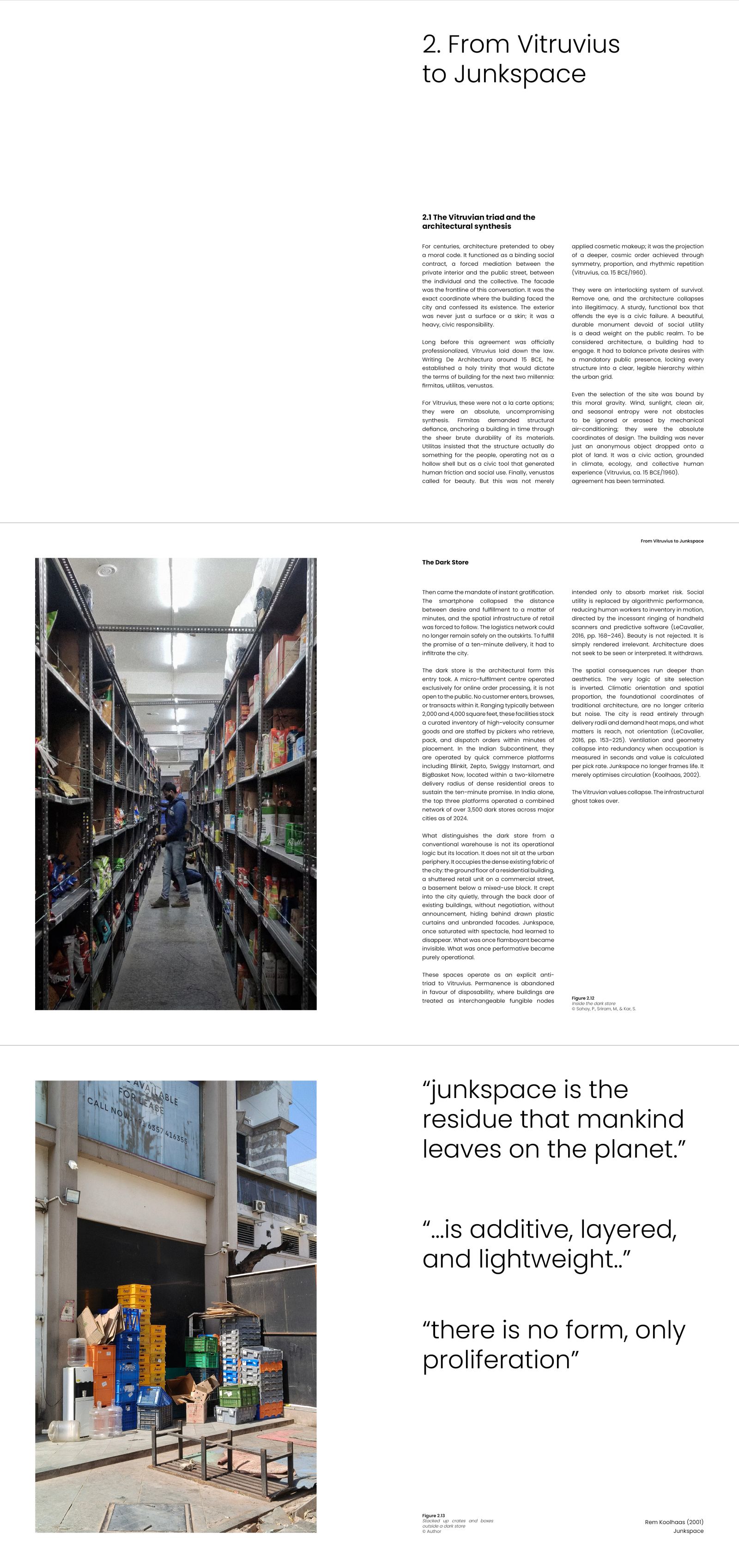
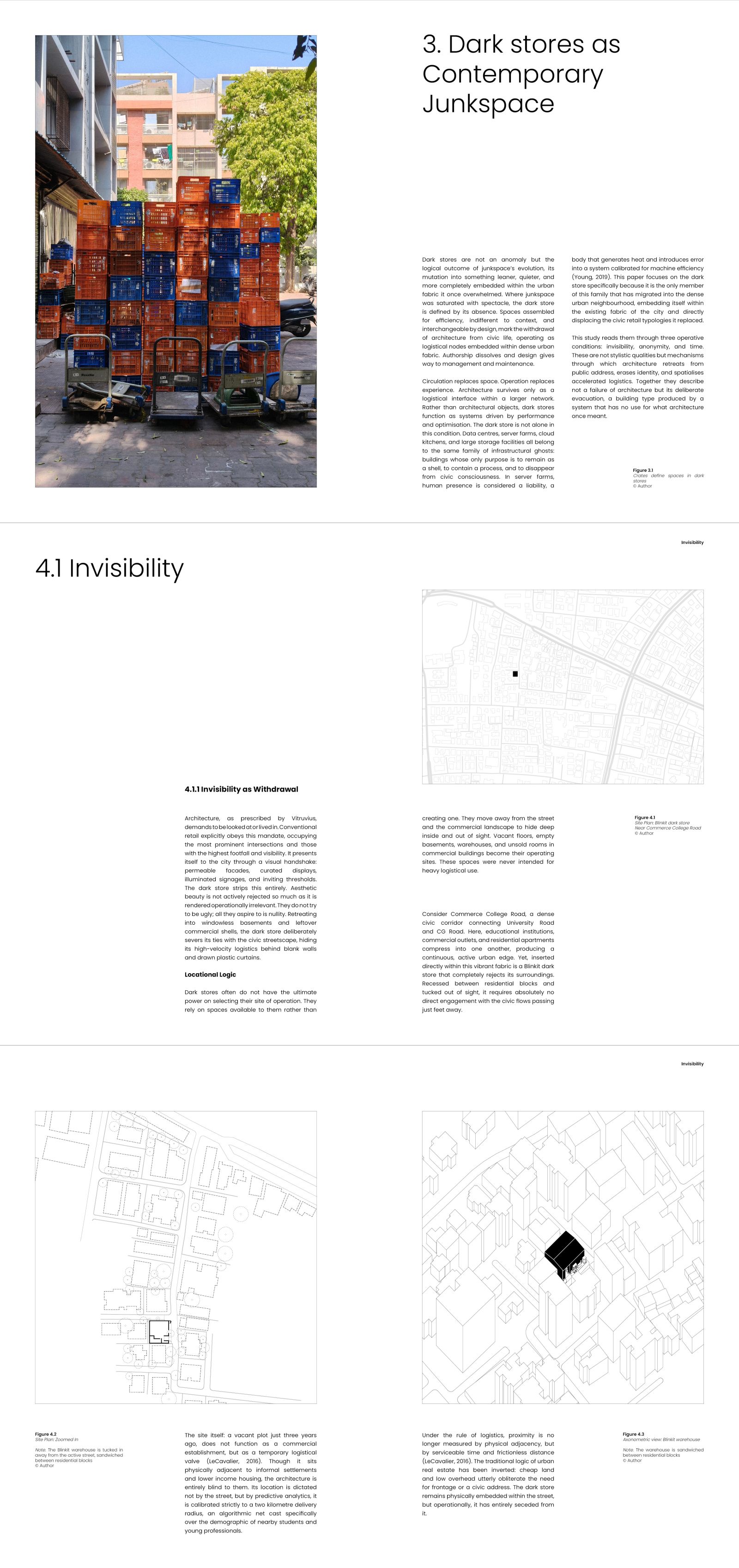
Every day, across the dense neighbourhoods of Indian cities, a new kind of building is quietly embedding itself into the urban fabric. It occupies the ground floor of a residential block, a shuttered retail unit, a forgotten basement. It has no signage worth reading and no threshold worth crossing. It arrives without announcement and leaves without trace. You have never been inside one, but chances are you live within two kilometres of one right now. It is called a dark store, and it is the spatial infrastructure behind every ten-minute delivery promise you have ever accepted without thinking twice.
This research is about what that building is, what it does to the street it occupies, and what it reveals about the city we are becoming. It reads the dark store as an architectural symptom of logistical capitalism and the collapse of civic space. A new kind of junkspace that has learned to disappear. Where the shopping mall was saturated with spectacle, the dark store is defined by its absence. It does not perform. It simply operates, invisibly, at speed, embedded within neighbourhoods it has no interest in addressing.
Drawing on the theories of Rem Koolhaas, Keller Easterling, Marshall McLuhan, and Marc Augé, and grounded in the streets of Ahmedabad, the research argues that the dark store is not simply a warehouse in the wrong location. It is the built expression of a system that has no use for architecture as a civic act. The Vitruvian values have not been abandoned. They have been absorbed into the logistical system and returned to the city in a form their author would not recognise.
The brown paper bag piling up in your kitchen is the only thing it leaves behind.