Anushka Parag Chaudhari

BD3596

UBD22032

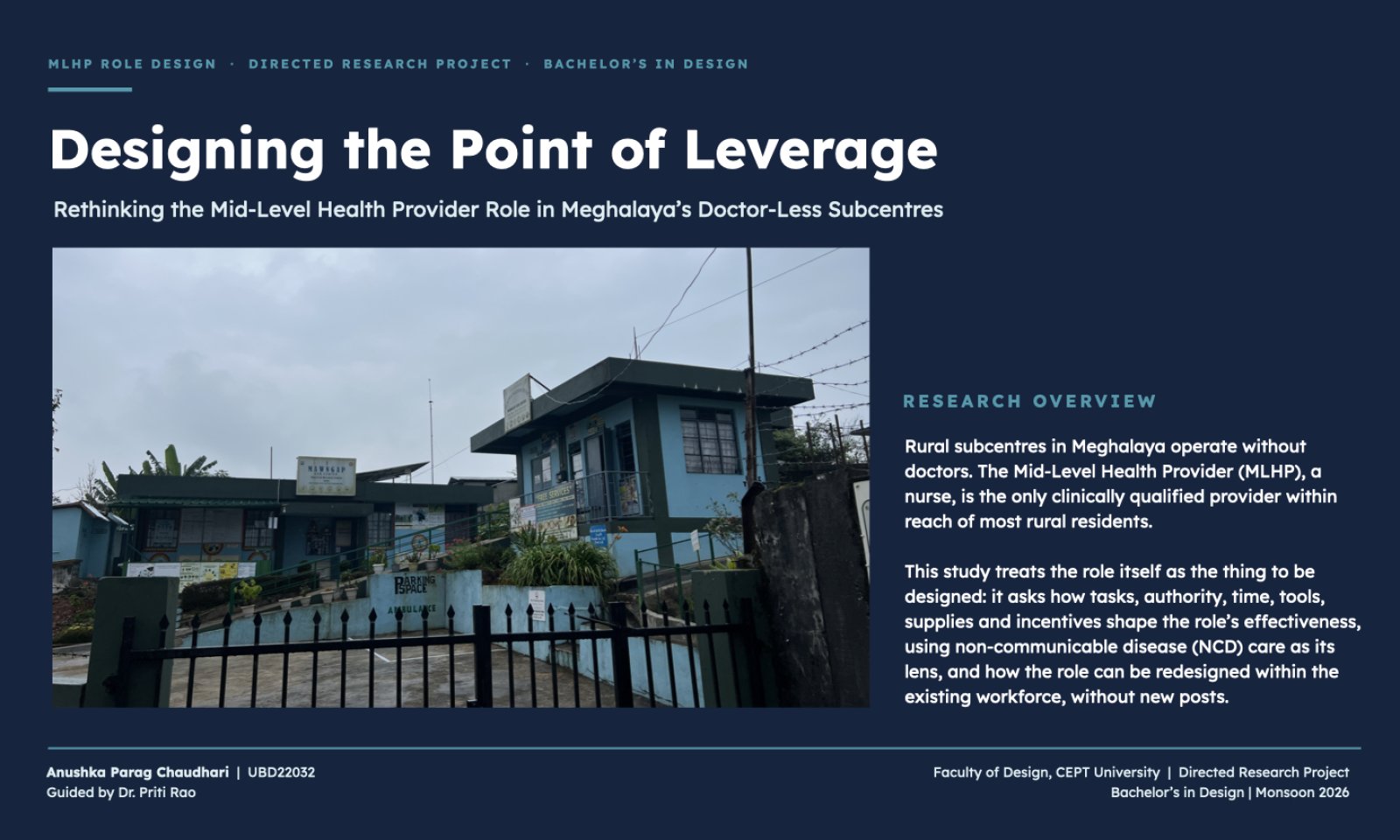
Designing the Point of Leverage: Rethinking the Mid-Level Health Provider Role in Meghalaya's Doctor-Less Subcentres 

This Directed Research Project treats the role of MLHPs, the subcentres' only clinicians, as a design problem. Through chronic disease care, it examines workload, authority, time, tools and rewards together.
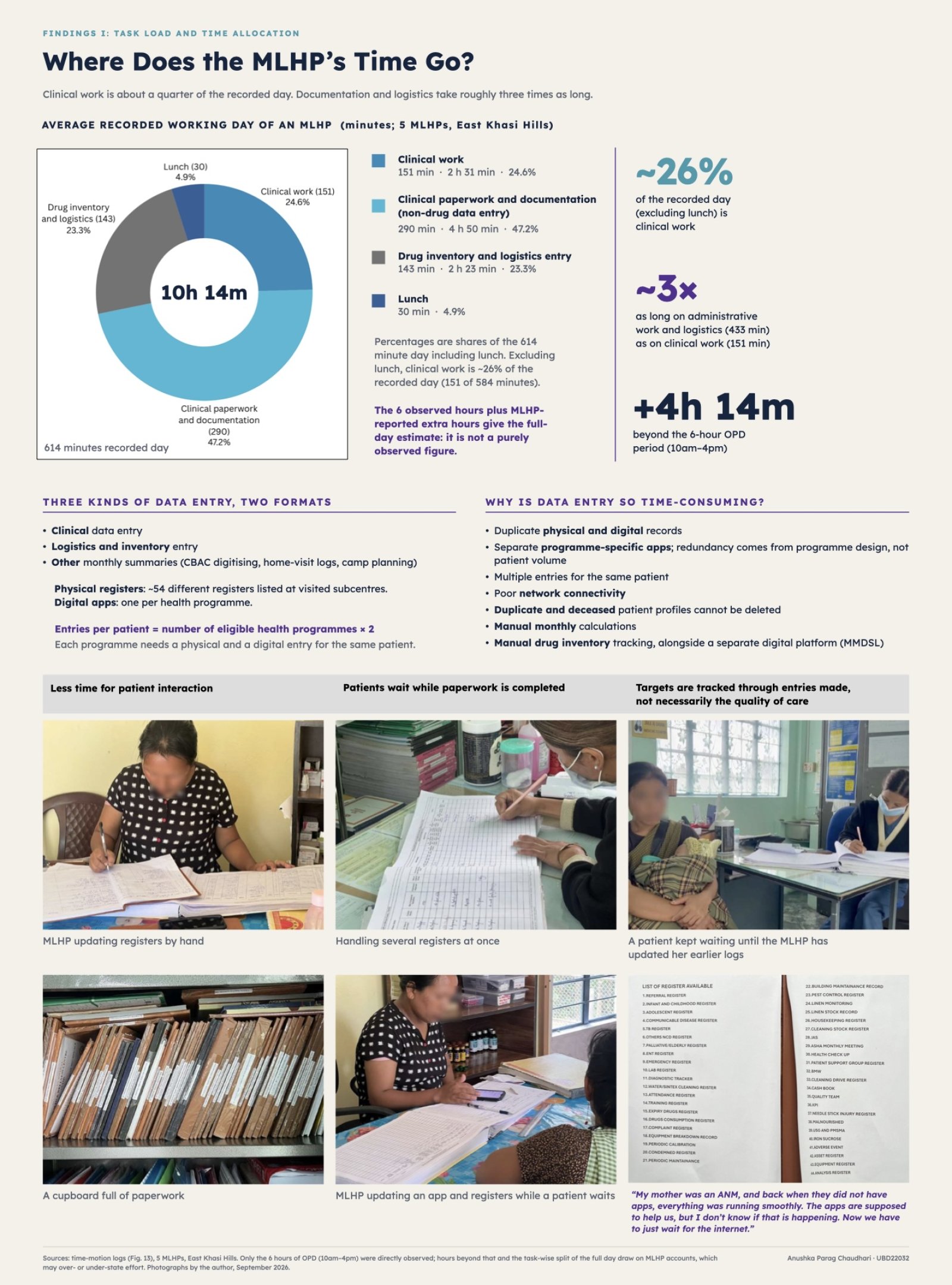
Fieldwork in East Khasi Hills used interviews, shadowing, time tracking and surveys. MLHPs work over 10 hours daily, mostly on repeated data entry and manual stock-keeping; only a quarter is clinical. Motivation is high, but medicine shortages, limited authority and weak rewards add strain. It produced a field-tested data-entry tool and an untested workload simulator.
View Additional Work

Report Content

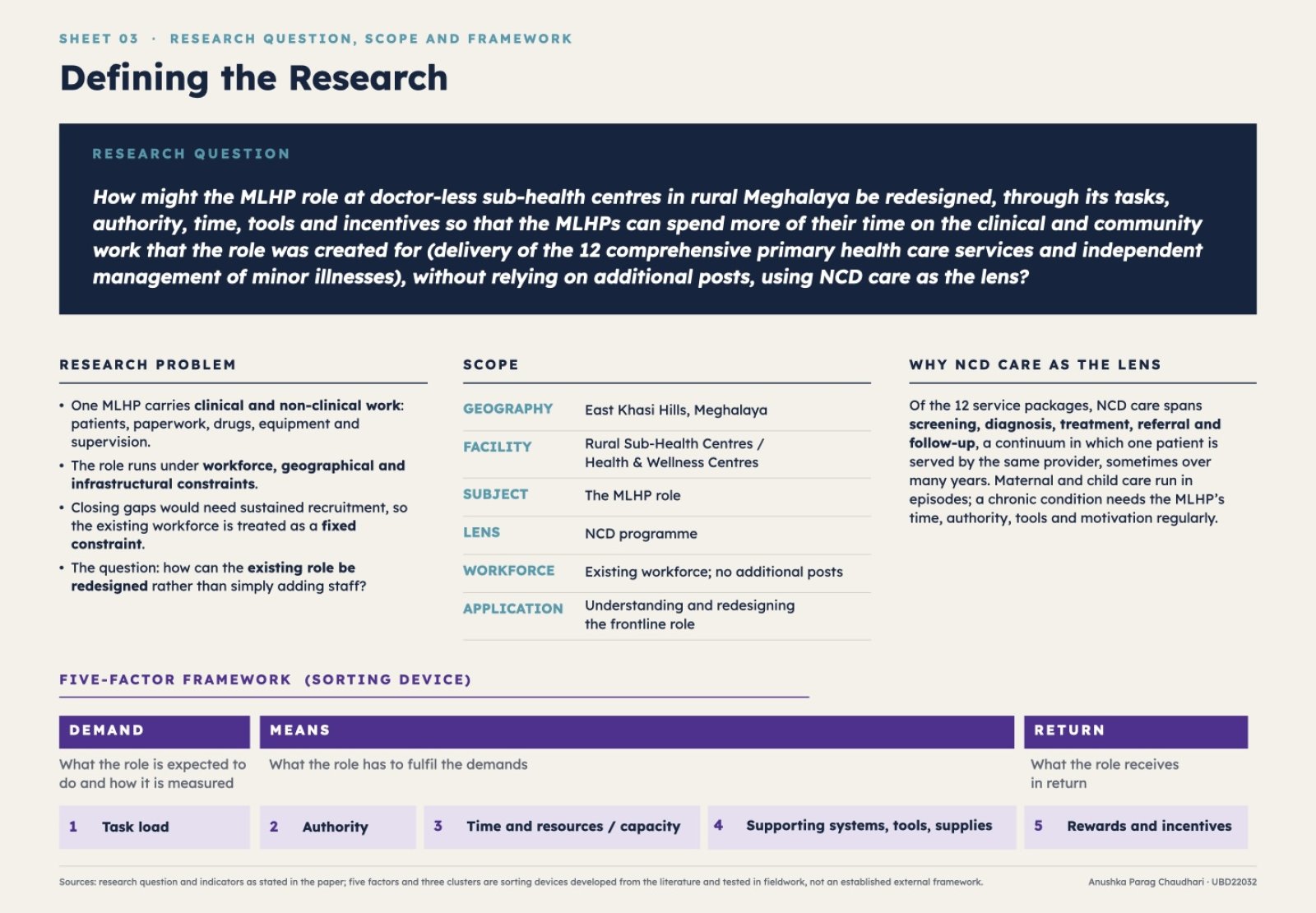
Introduction. The study treats the Mid-Level Health Provider, the only clinically qualified provider at Meghalaya’s doctor-less rural subcentres, as a role to be designed. It uses non-communicable disease care as its lens and asks how the role can be redesigned within the existing workforce, without adding posts.

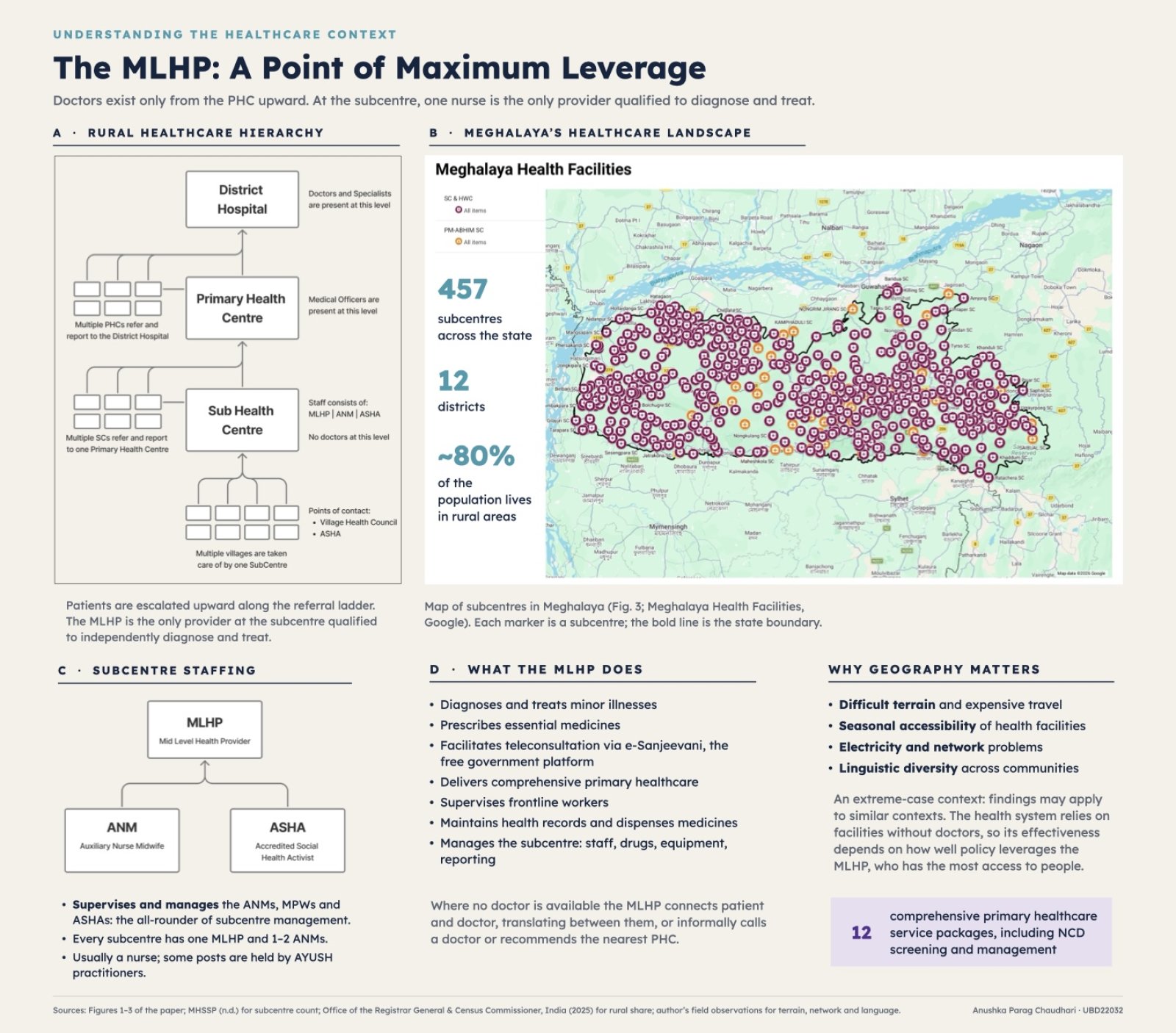
Healthcare context. Maps the rural referral ladder, the subcentre team and Meghalaya’s 457 subcentres across 12 districts, where nearly 80% of people live in rural areas. It shows why one nurse who supervises ANMs and ASHAs and delivers 12 service packages is the system’s point of maximum leverage.

Research design. Sets out the research question, its scope (East Khasi Hills, existing workforce, NCD lens) and the five-factor framework grouped as Demand, Means and Return. It separates the one directly observed indicator, time allocation, from those drawn from interviews and reports.

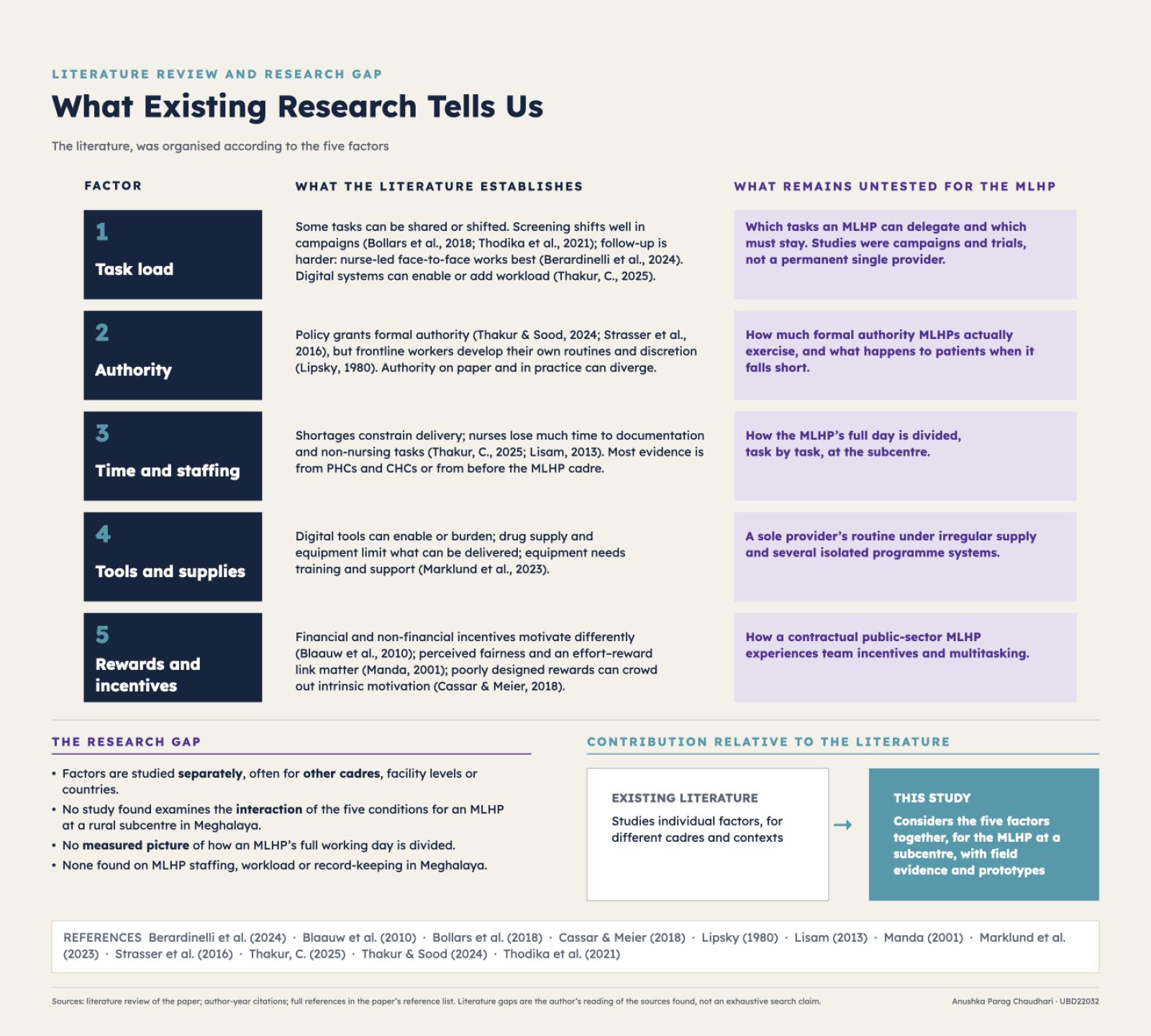
Literature and gap. Reviews literature on task load, authority, time and staffing, tools and supplies, and incentives. It shows these were studied separately, for other cadres and settings, and positions this study as the first found to examine all five together for the MLHP, with a measured working day.

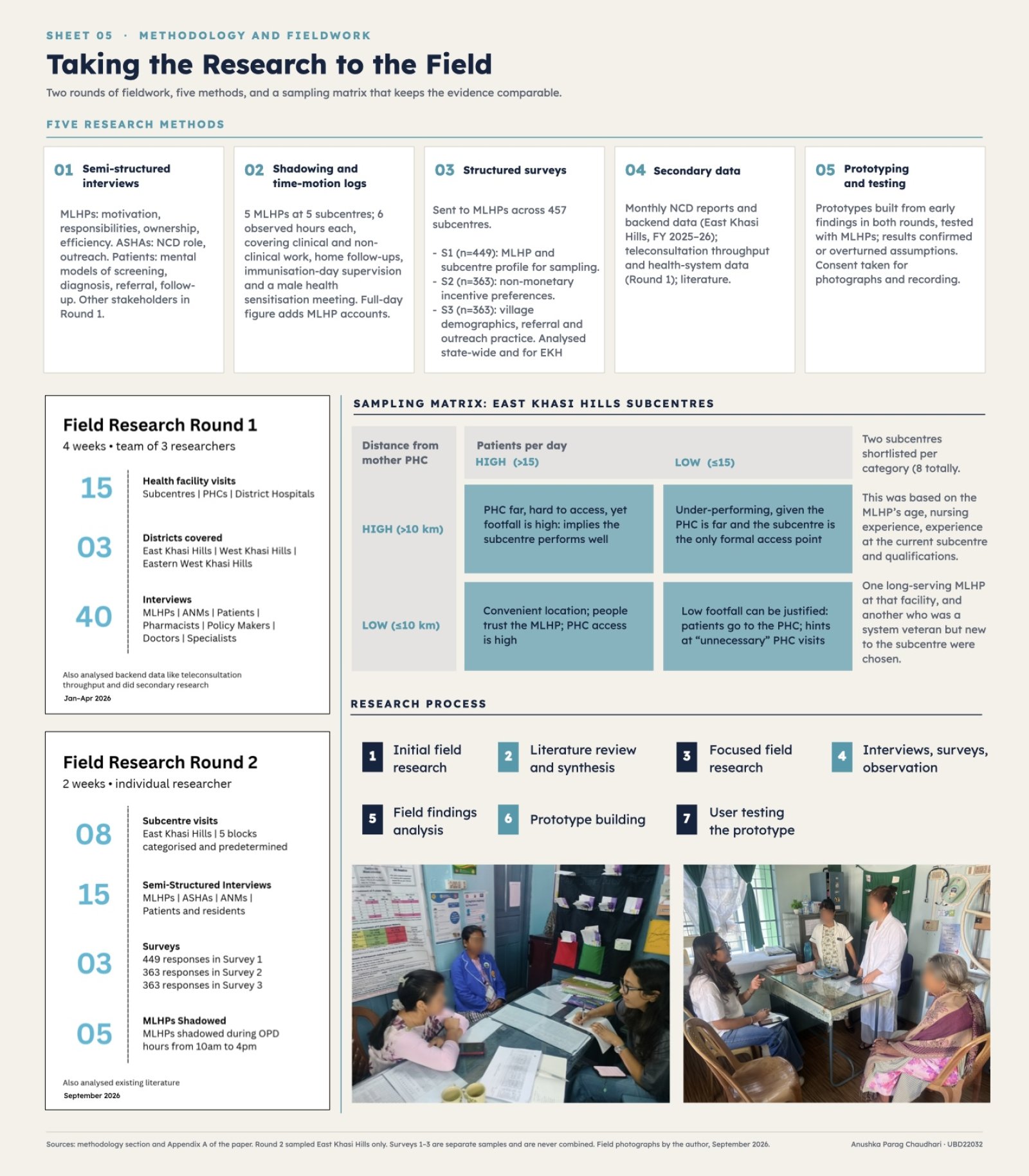
Methodology. Documents two rounds of fieldwork across 15 facilities and 8 subcentres, five methods including shadowing, time-motion logs and three surveys, and a four-category subcentre sampling matrix. Evidence types are kept distinct so each finding can be traced to how it was gathered.

Time findings. An MLHP’s recorded day averages 10 hours 14 minutes, with about a quarter spent on clinical work. Duplicate physical and digital records across roughly 54 registers explain why documentation and logistics take about three times as long. Only six hours were directly observed.

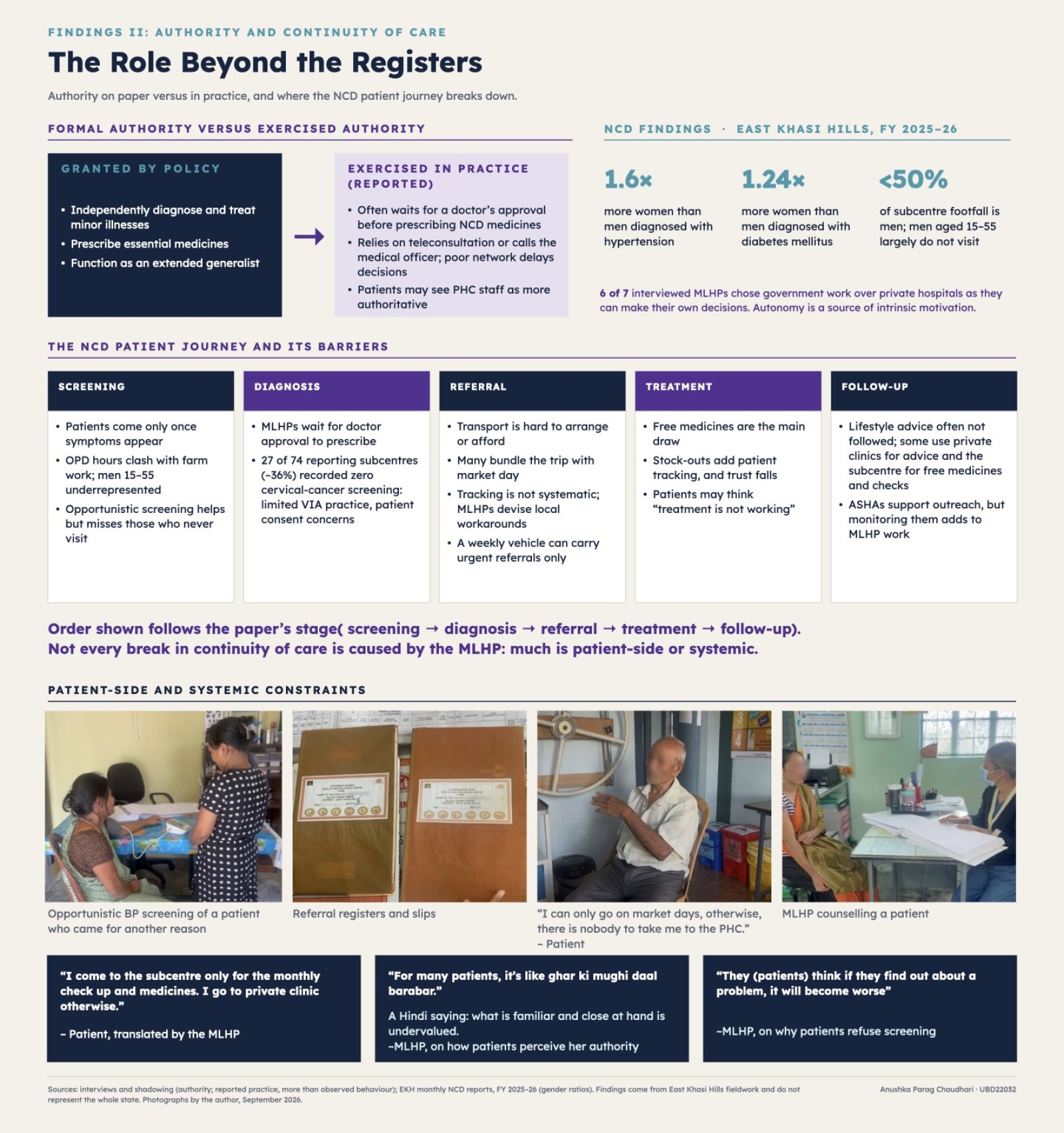
Authority and continuity. Compares the authority policy grants with what MLHPs report exercising, and follows the NCD patient journey from screening to follow-up. East Khasi Hills data show who is missed, where referrals stall, and why not every break in care is the MLHP’s doing.

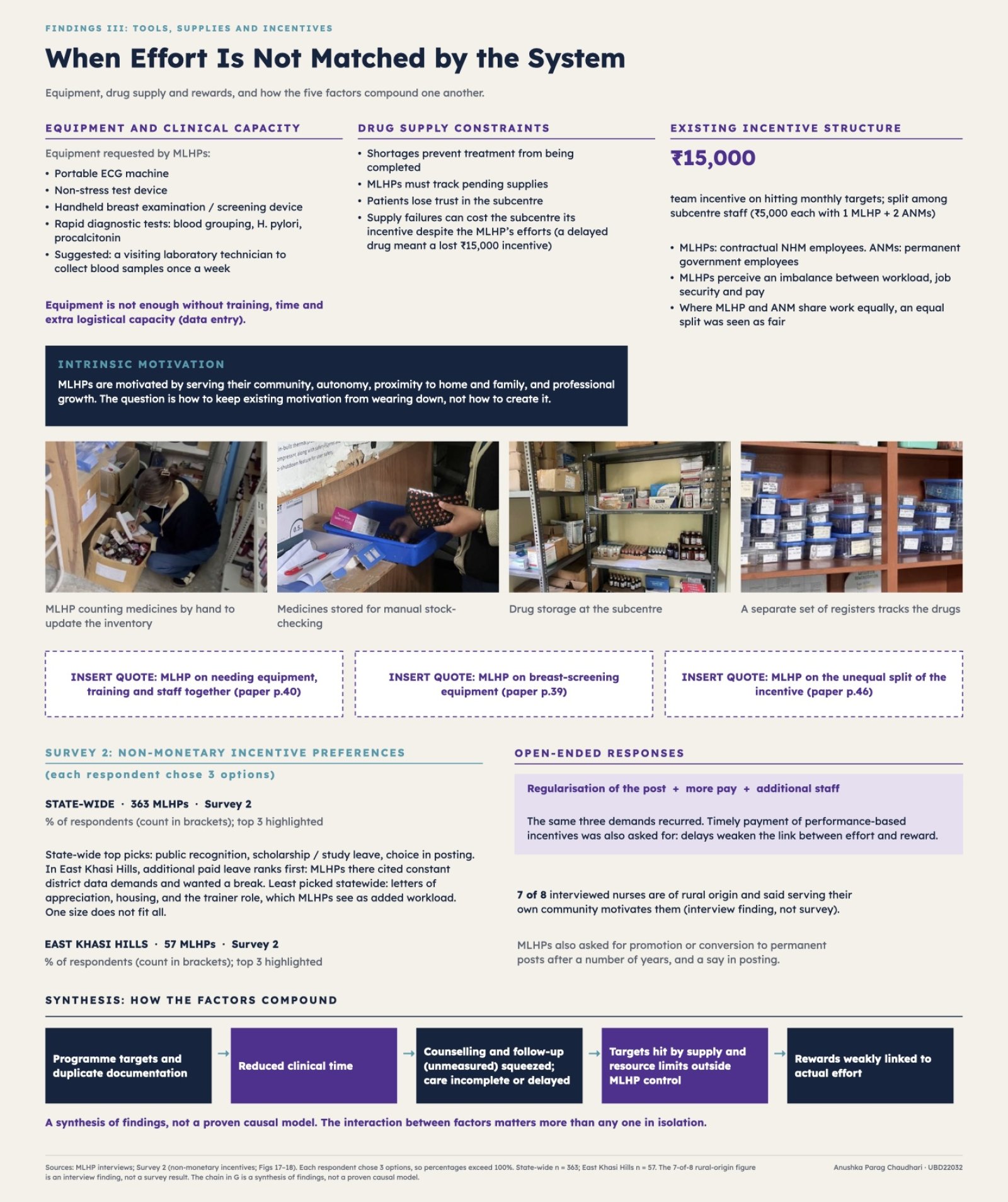
Tools, supplies, incentives. Examines requested equipment, drug stock-outs and a team incentive weakly tied to effort, with Survey 2 preferences for non-monetary rewards. It ends with a synthesis showing how the five conditions compound, presented as a synthesis of findings rather than a causal model.

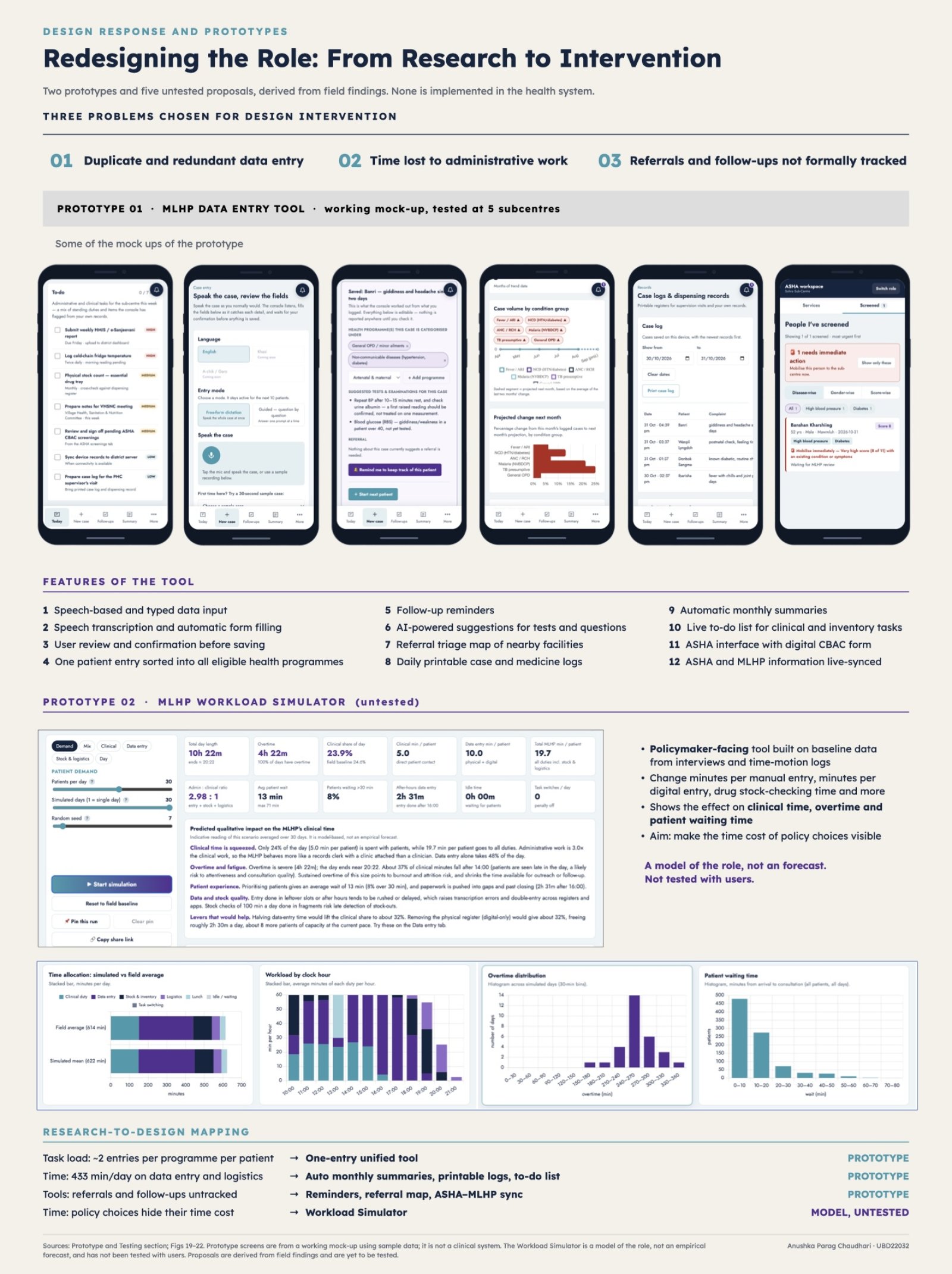
Design response. Translates findings into a data entry tool that captures each patient once, and a workload simulator for policymakers, alongside five untested proposals. A mapping links each intervention to the finding behind it and marks which remain prototypes, models or proposals.

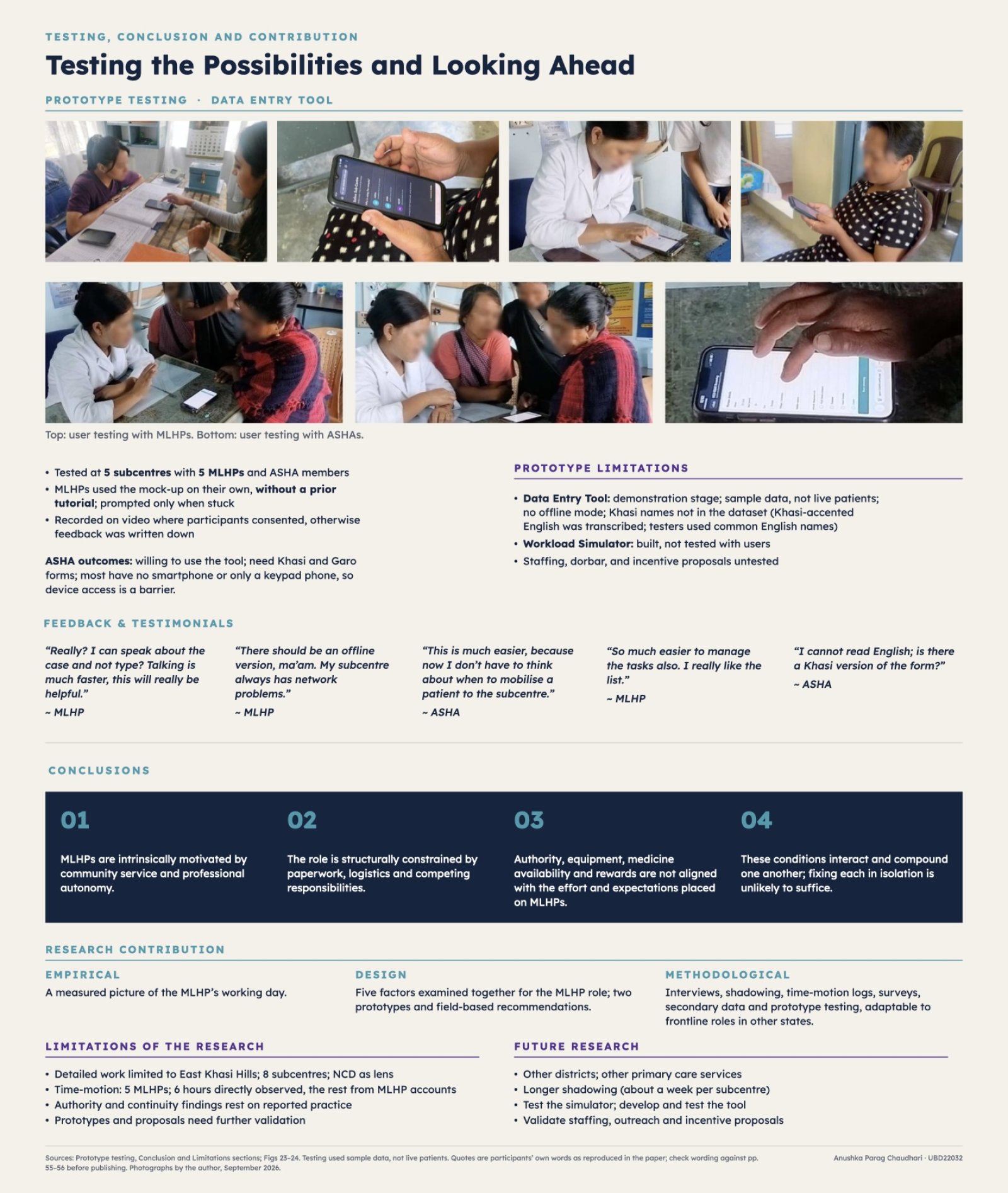
Testing and conclusion. Reports usability testing of the mock-up with MLHPs and ASHAs, its limitations, the four conclusions and three contributions. Limits of scope and evidence are stated plainly, along with future research needed to validate the prototypes and proposals.