Barot Deep Vimalbhai

UT4051

PUT24082

India has invested heavily in metro rail, yet Ahmedabad operates at just 14.4% of projected ridership and Pune at 30%. Surveying 918 riders across both cities, this study finds that official DPR planning models are fundamentally flawed — they measure only in-vehicle time and assume car diversion, while real riders are two-wheeler and shared-auto users. Different groups switch for different reasons: price drives working males, time and safety drive working females, and students face structural barriers. Once fares are acceptable, service quality — punctuality, safety, cleanliness — retains riders, not cost. Behavioral drivers differ sharply between cities, making a single national demand model impossible.
Report Content

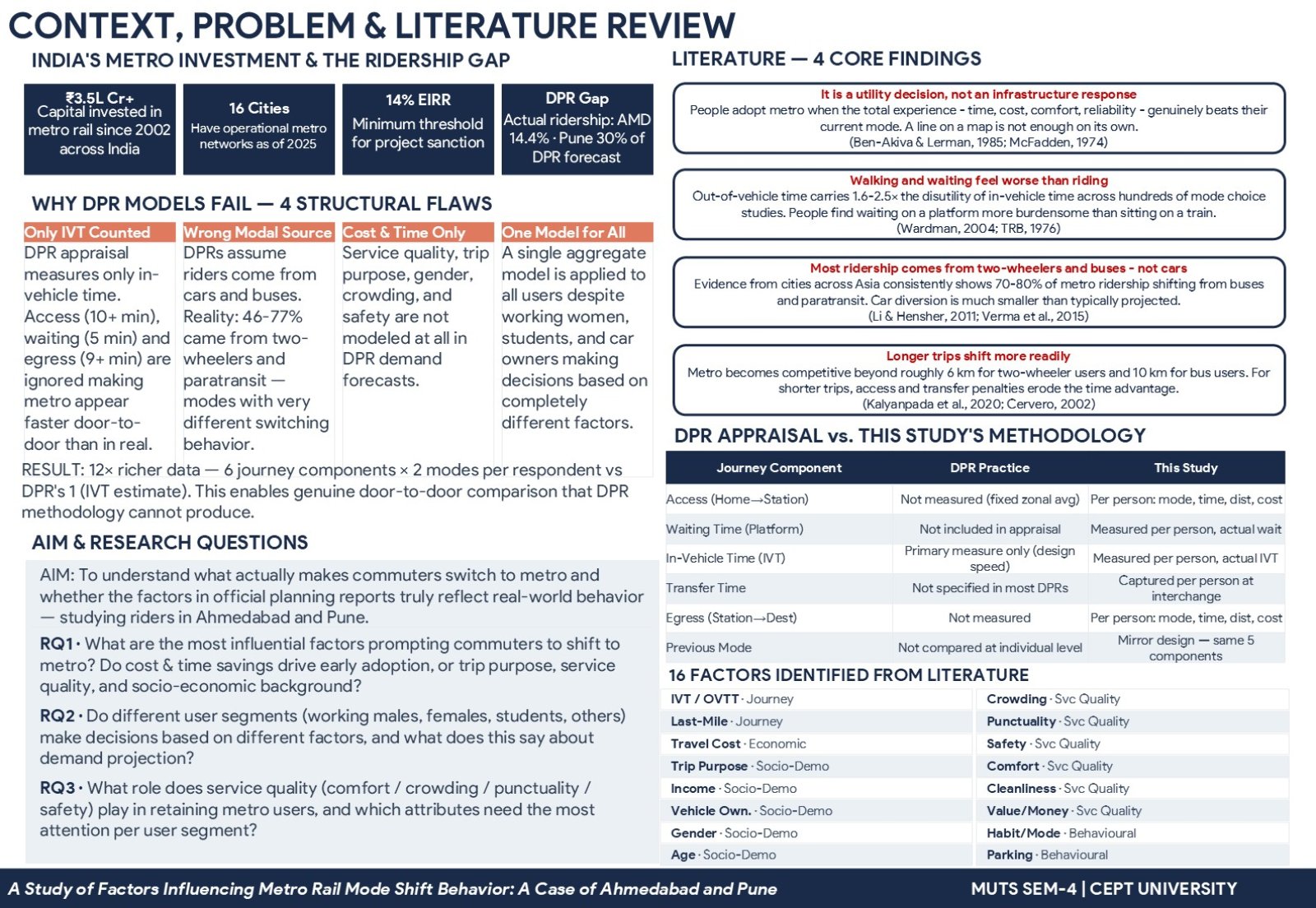
Context & Literature Review — India has invested ?3.5 Cr+ in metro rail across 16 cities, yet Ahmedabad achieves only 14.4% and Pune only 30% of their DPR ridership forecasts; four structural flaws in DPR methodology (ignoring out-of-vehicle time, wrong modal source assumptions, cost-time-only modeling, and a one-size-fits-all approach) are identified, and 16 behavioral factors from literature frame the study's research questions.

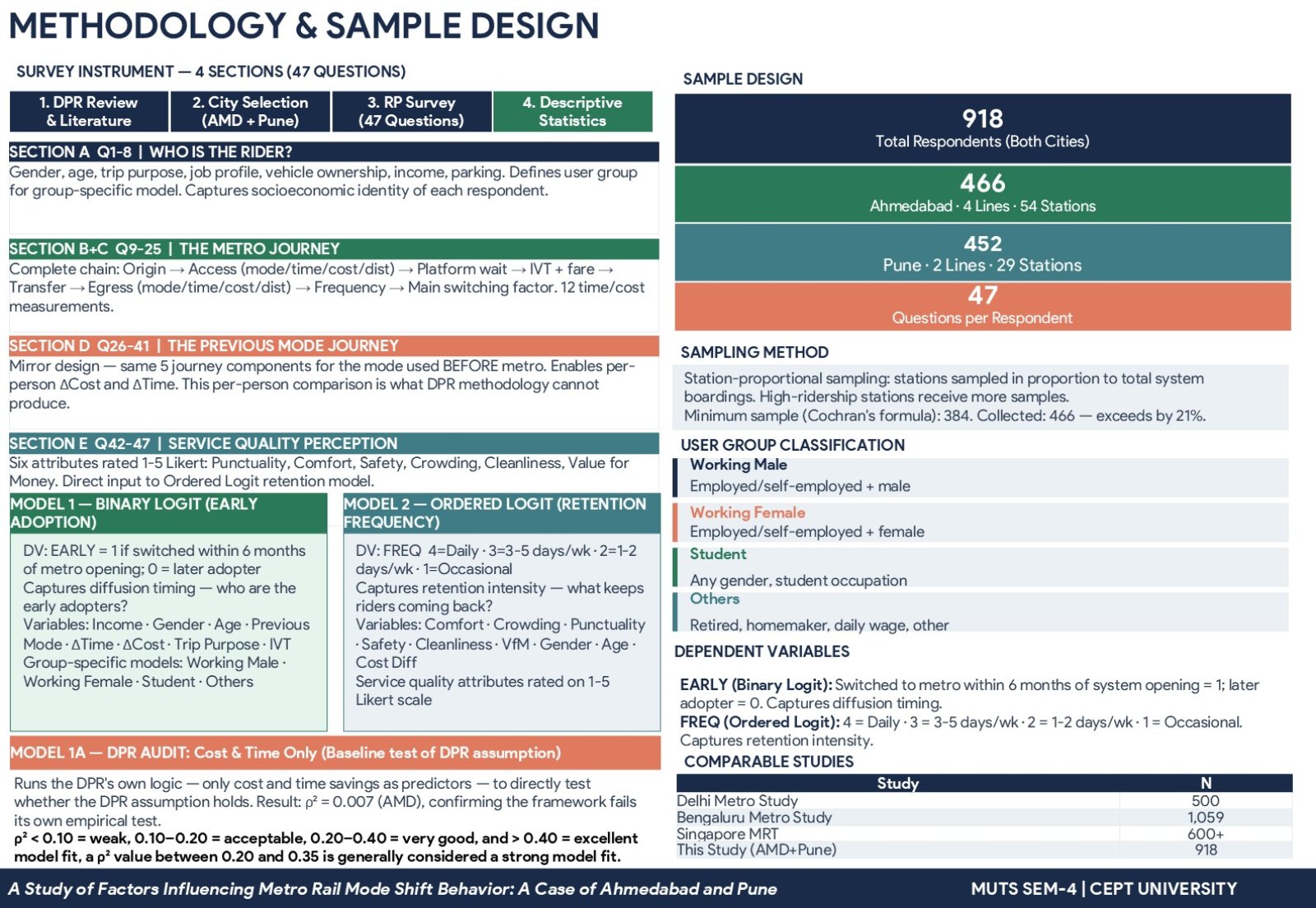
Methodology & Sample Design — A 47-question survey across 918 riders (466 Ahmedabad, 452 Pune) uses station-proportional sampling and three model types — Binary Logit for early adoption, Ordered Logit for retention frequency, and a baseline DPR audit model — to capture the full door-to-door journey chain across four user groups: working males, working females, students, and others.

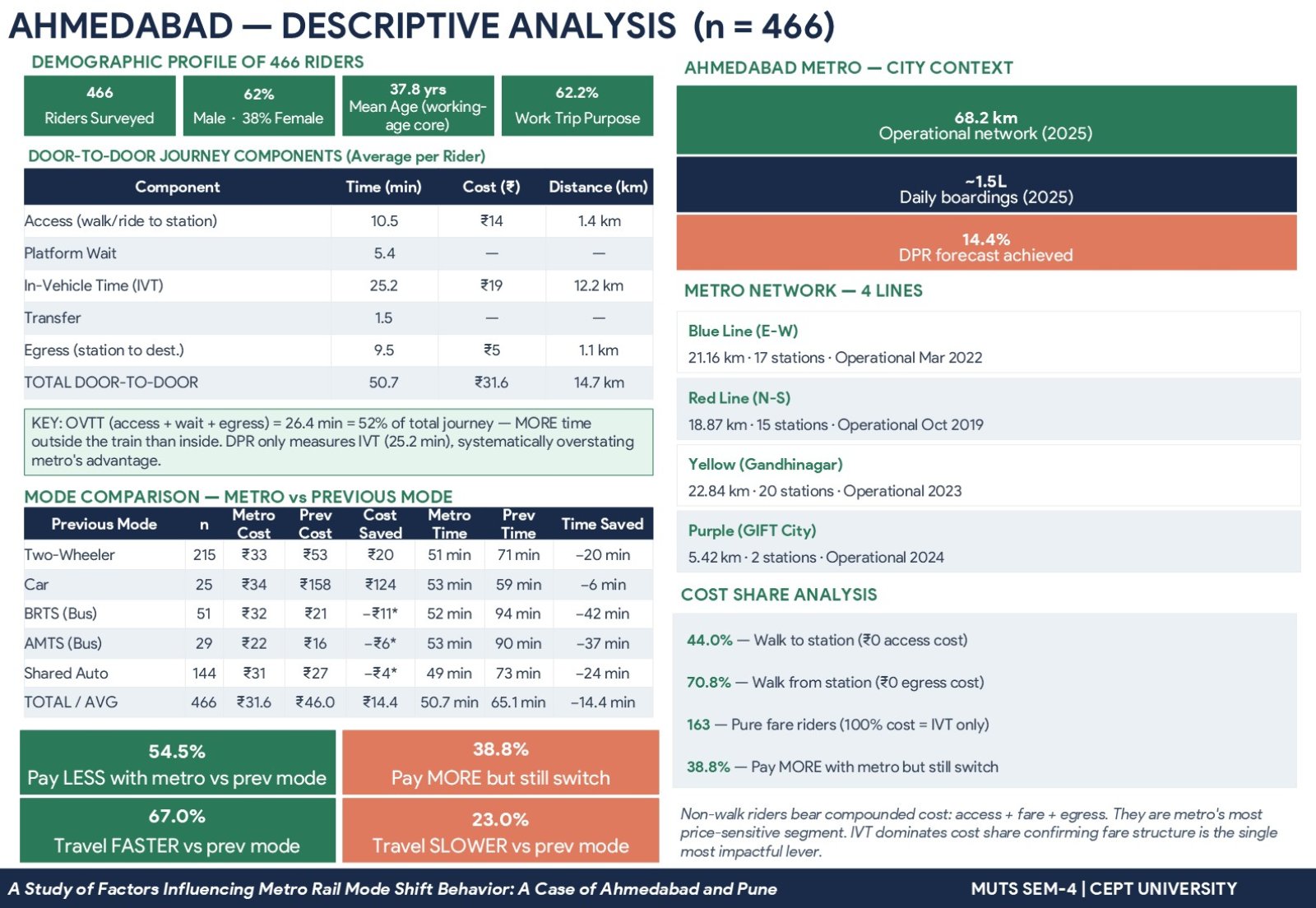
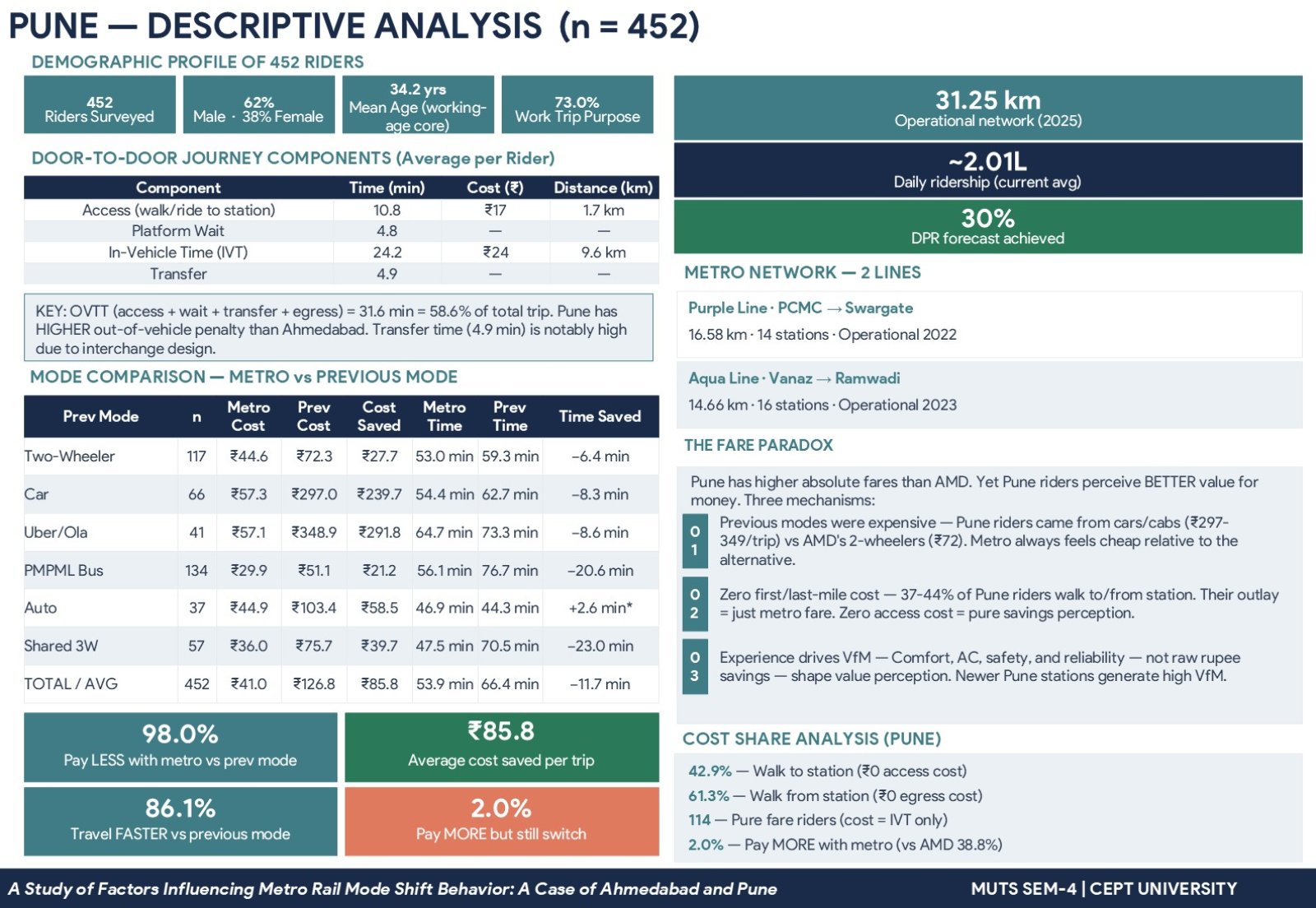
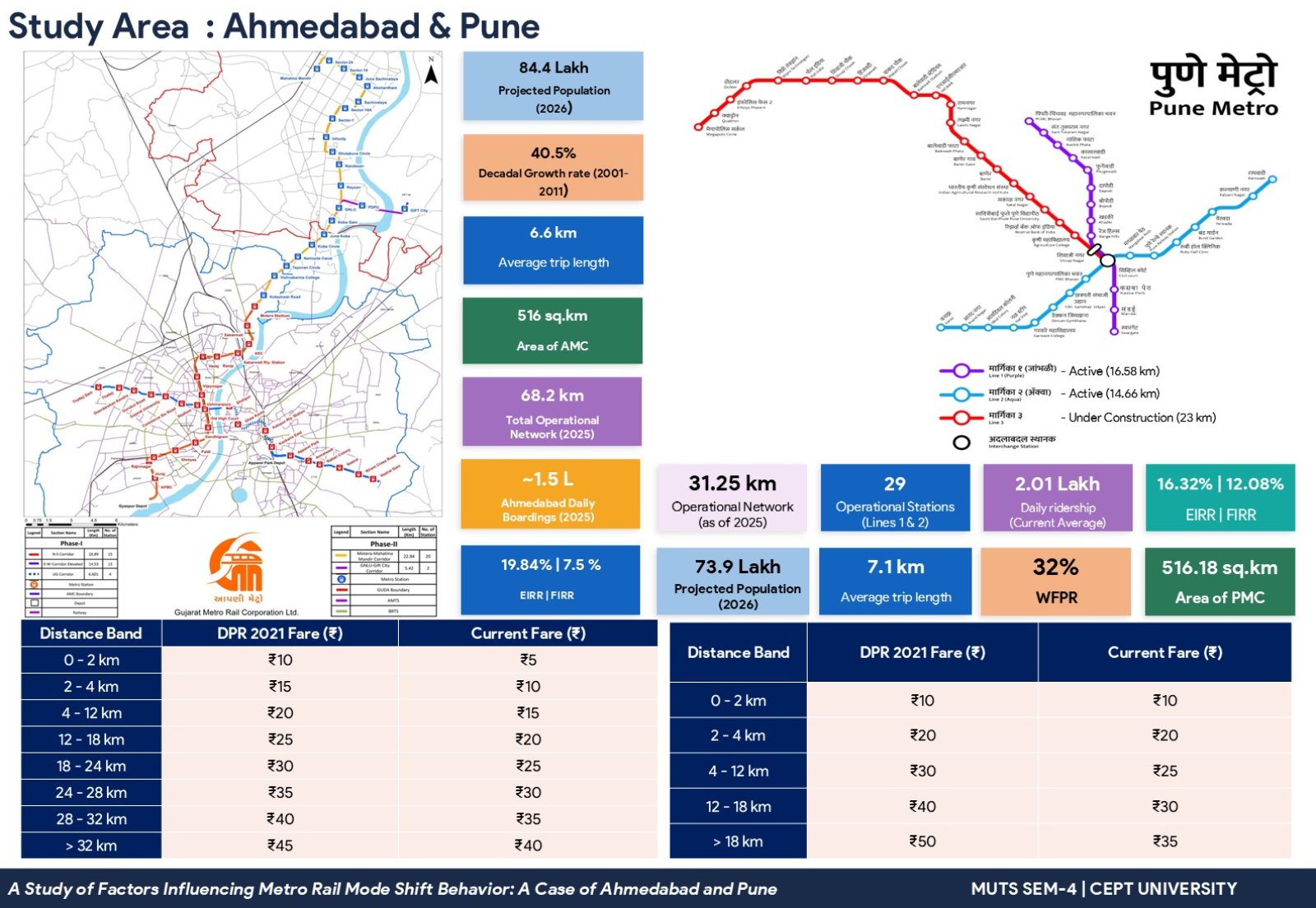
Study Area — Ahmedabad's mature 68.2 km four-line network boards ~1.5 lakh daily riders against a much larger DPR projection, while Pune's compact 31.25 km two-line system achieves ~2.01 lakh daily boardings and 30% of forecast; both cities have progressively reduced fares below DPR projections to stimulate demand.

Ahmedabad Descriptive Analysis — The average door-to-door trip is 50.7 minutes, of which 26.4 minutes (52%) is out-of-vehicle time that DPR ignores; two-wheelers and shared autos are the dominant previous modes, car diversion is just 5.4% against DPR's 20–40% projection, and 38.8% of riders switch to metro despite paying more — confirming metro adoption is a multi-dimensional utility decision.

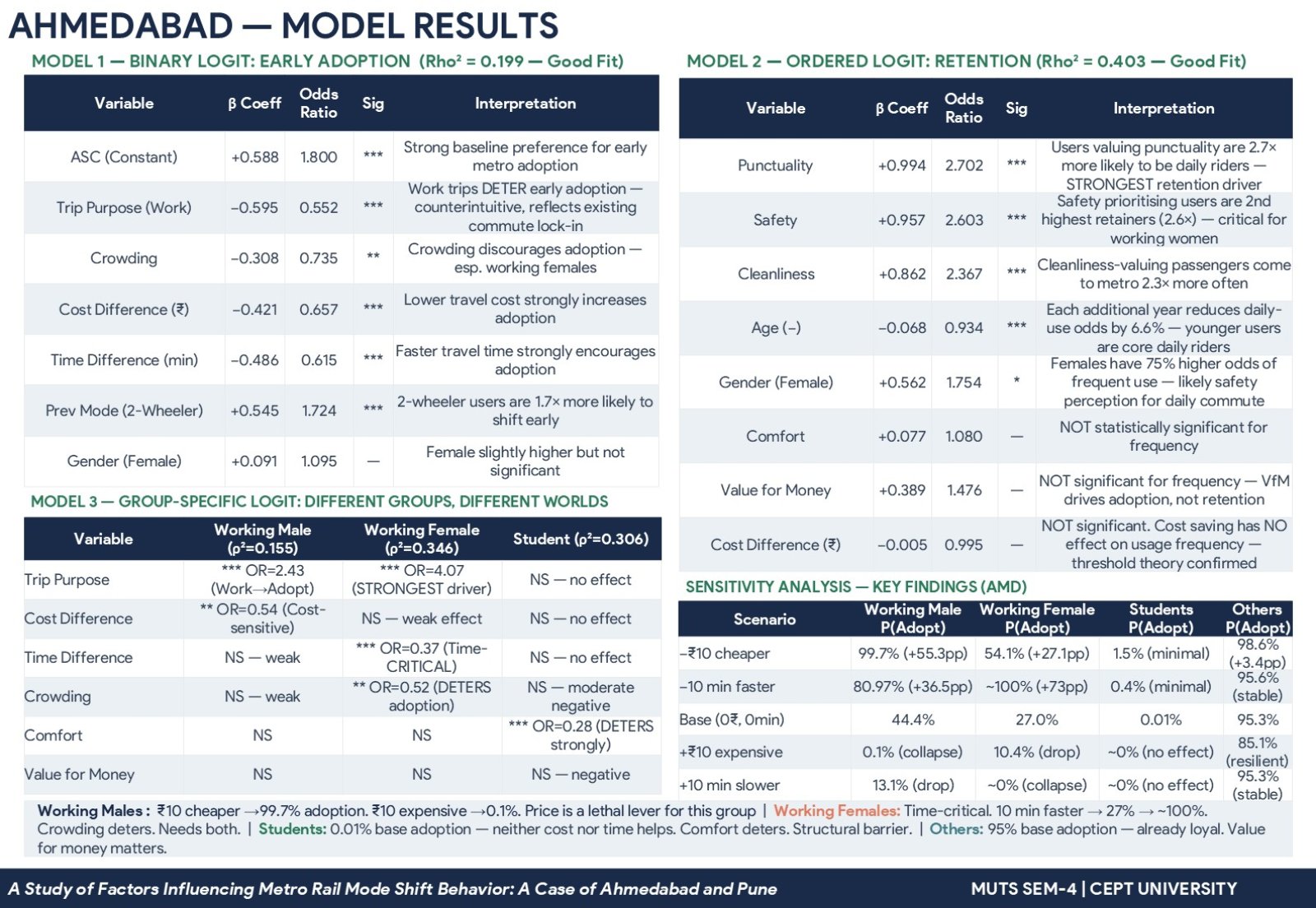
Ahmedabad Model Results — Working males are almost entirely price-driven (?10 cheaper ? 99.7% adoption); working females are time-and-safety critical (10 min faster ? ~100% adoption, crowding deters strongly); students face a structural comfort barrier with near-zero base adoption; and in the retention model, punctuality (OR=2.7), safety (OR=2.6), and cleanliness (OR=2.4) dominate — cost is statistically irrelevant for daily use.

Pune Descriptive Analysis — Pune riders save an average ?85.8 per trip compared to previous modes (primarily cars and cabs at ?297–349/trip), 98% pay less with metro, and 86.1% travel faster; yet Pune's higher transfer penalty (4.9 min) and out-of-vehicle share (58.6%) reveal interchange design as a key friction point, while a "fare paradox" shows riders perceive better value despite higher absolute fares.

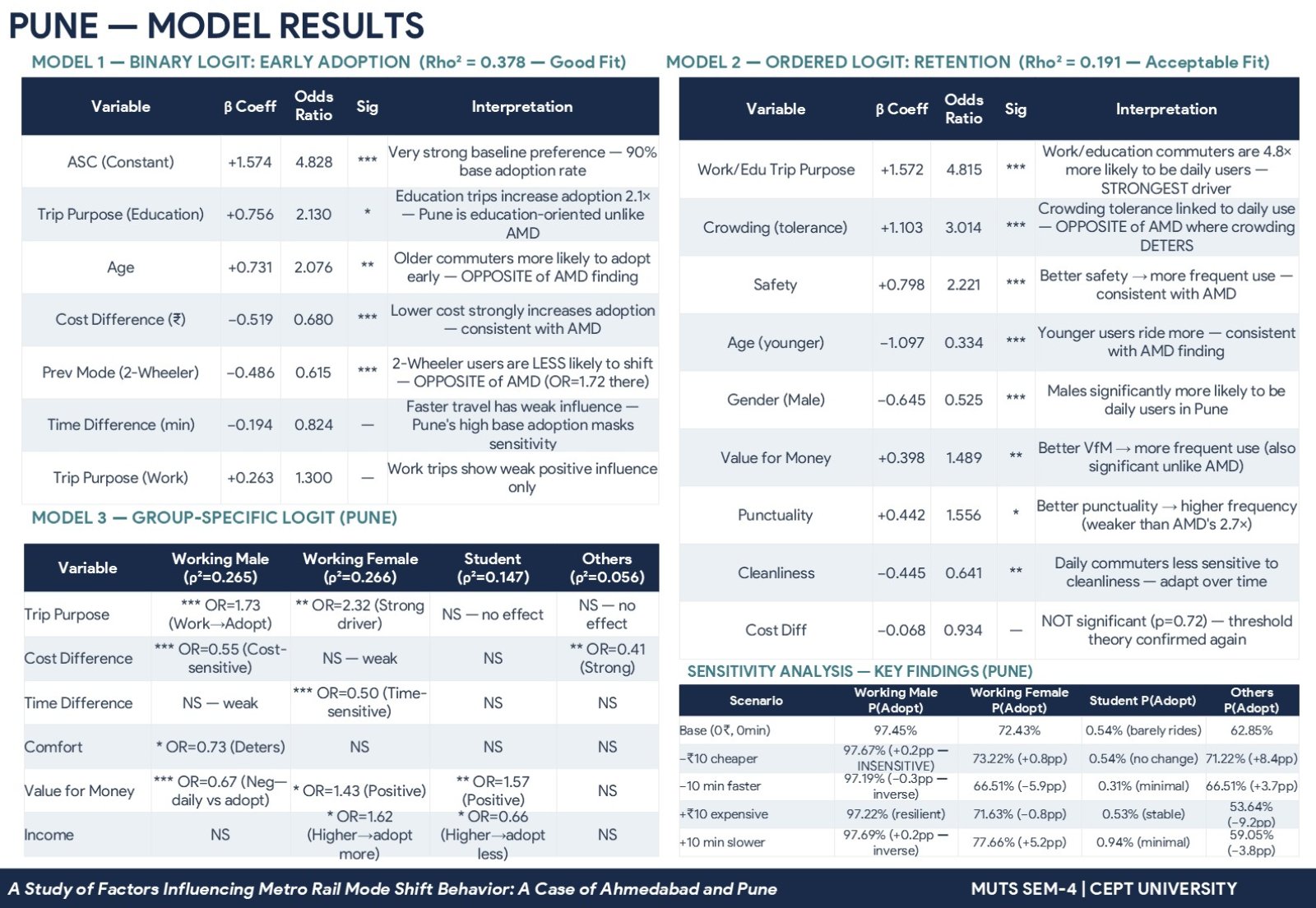
Pune Model Results — Education trip purpose and older commuter age drive early adoption (opposite to Ahmedabad's younger-adopter pattern); two-wheeler users resist switching (OR=0.62, opposite of AMD); trip purpose is the single strongest retention driver (OR=4.82); crowding tolerance links positively to daily use; and cost is again statistically insignificant for retention, confirming threshold theory across both cities.

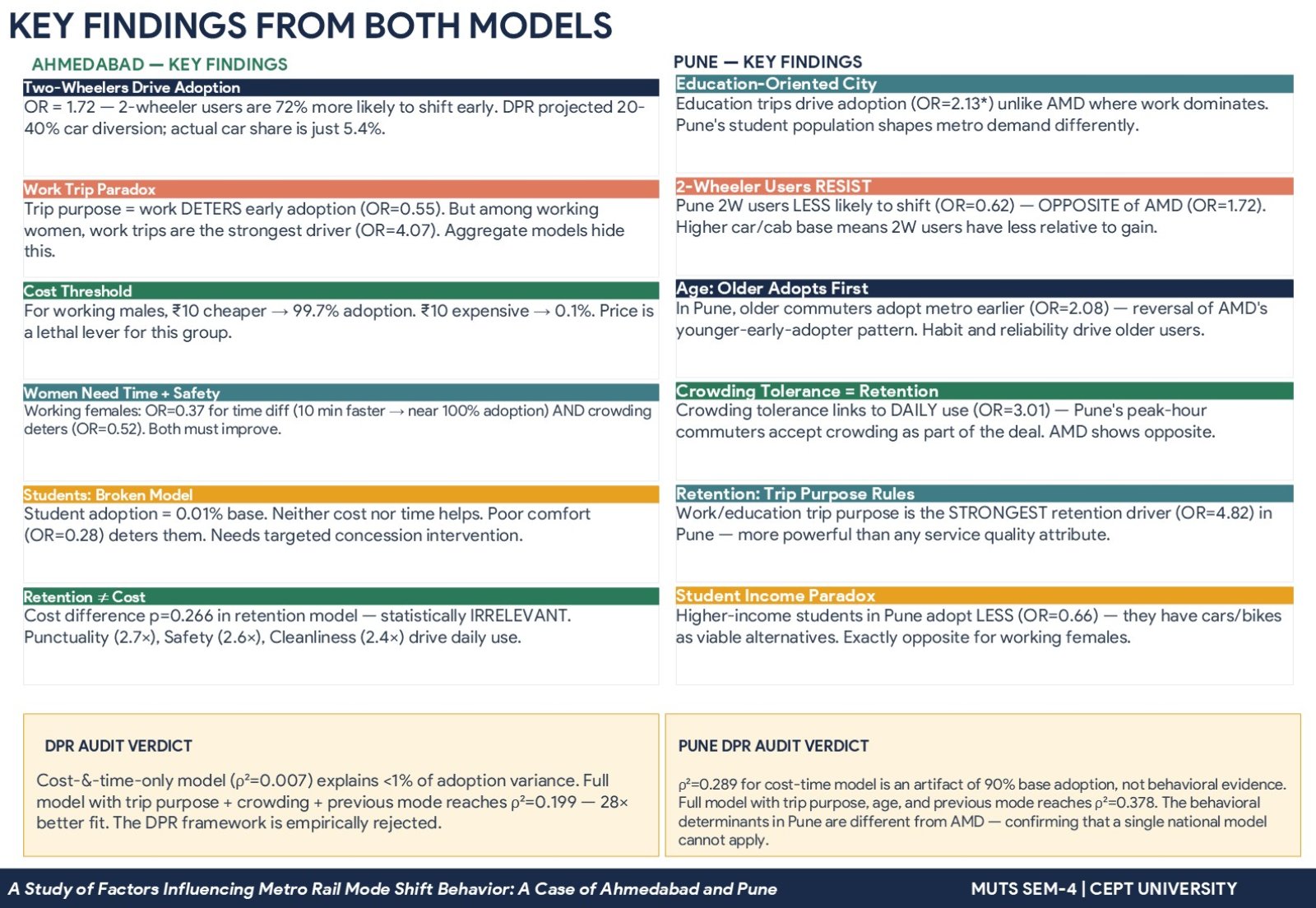
Key Findings from Both Models — The two cities diverge fundamentally: AMD is work- and two-wheeler-dominated with younger daily riders, while Pune is education-oriented with older early adopters and crowding-tolerant daily commuters; the DPR framework is empirically rejected in both cities, and the finding that behavioral determinants differ city-by-city confirms a single national demand model cannot apply.

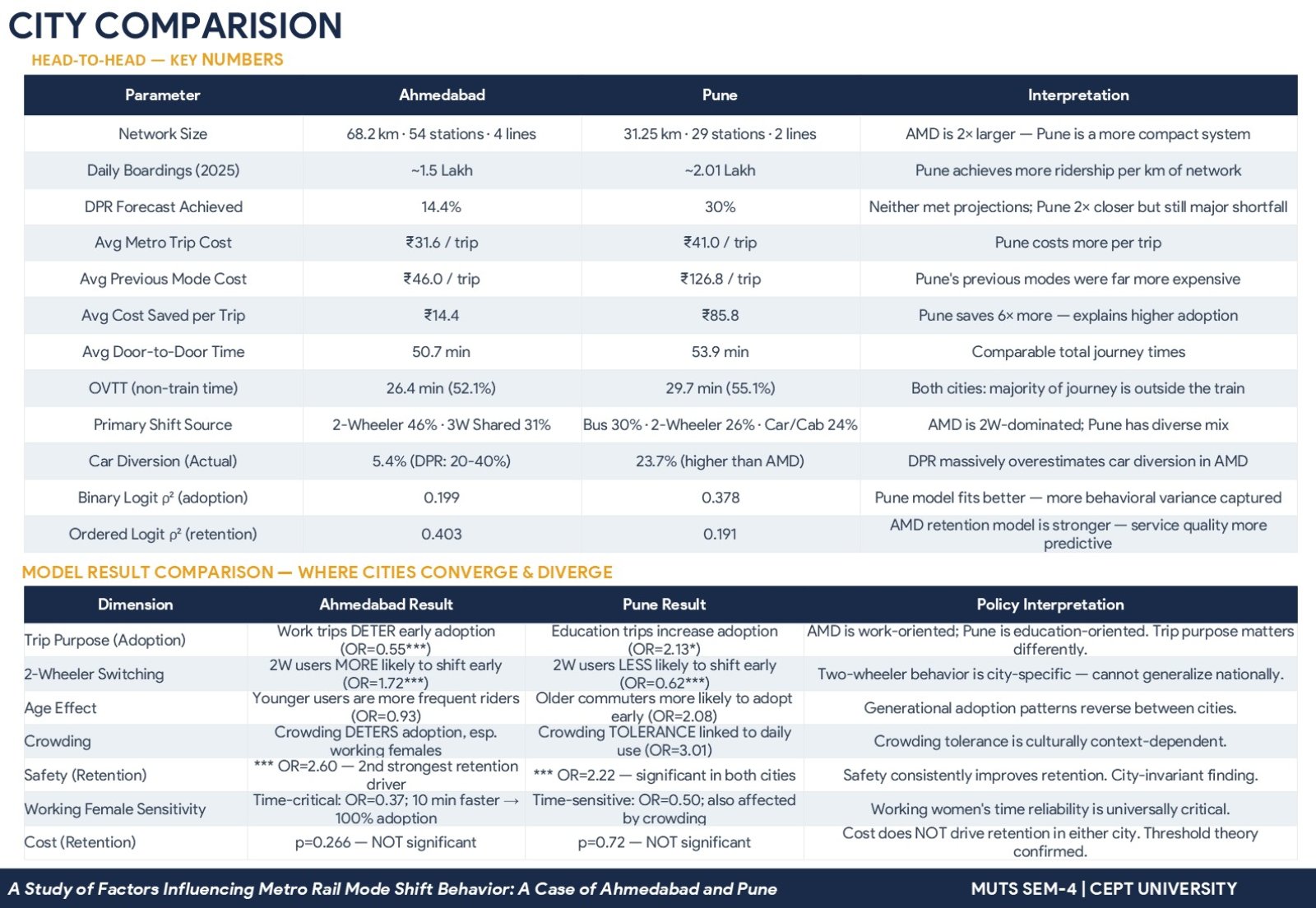
City Comparison — Head-to-head, Pune achieves more ridership per km but both cities fall far short of projections; safety consistently improves retention in both cities (the only city-invariant finding), while two-wheeler behavior, age effects, crowding response, and working female sensitivity all reverse direction between cities — making national generalization impossible.

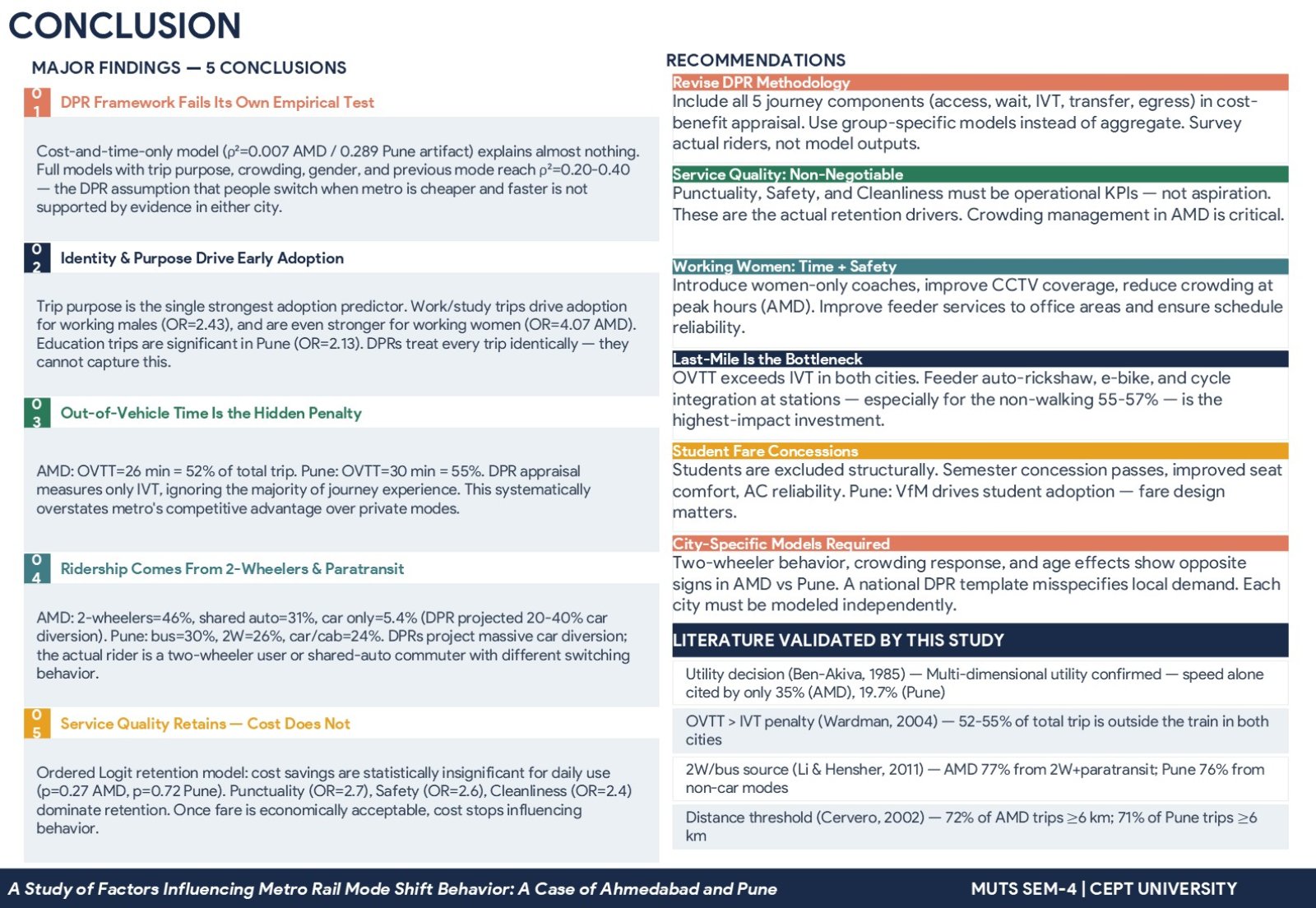
Conclusion & Recommendations — Five conclusions emerge: DPR fails its own empirical test; identity and trip purpose drive adoption; out-of-vehicle time is the hidden penalty; ridership comes from two-wheelers and paratransit, not cars; and service quality — not cost — retains riders. Recommendations cover DPR methodology reform, service quality KPIs, women-only coaches, last-mile feeder investment, student fare concessions, and mandatory city-specific modeling.