Your browser is out-of-date!
For a richer surfing experience on our website, please update your browser. Update my browser now!
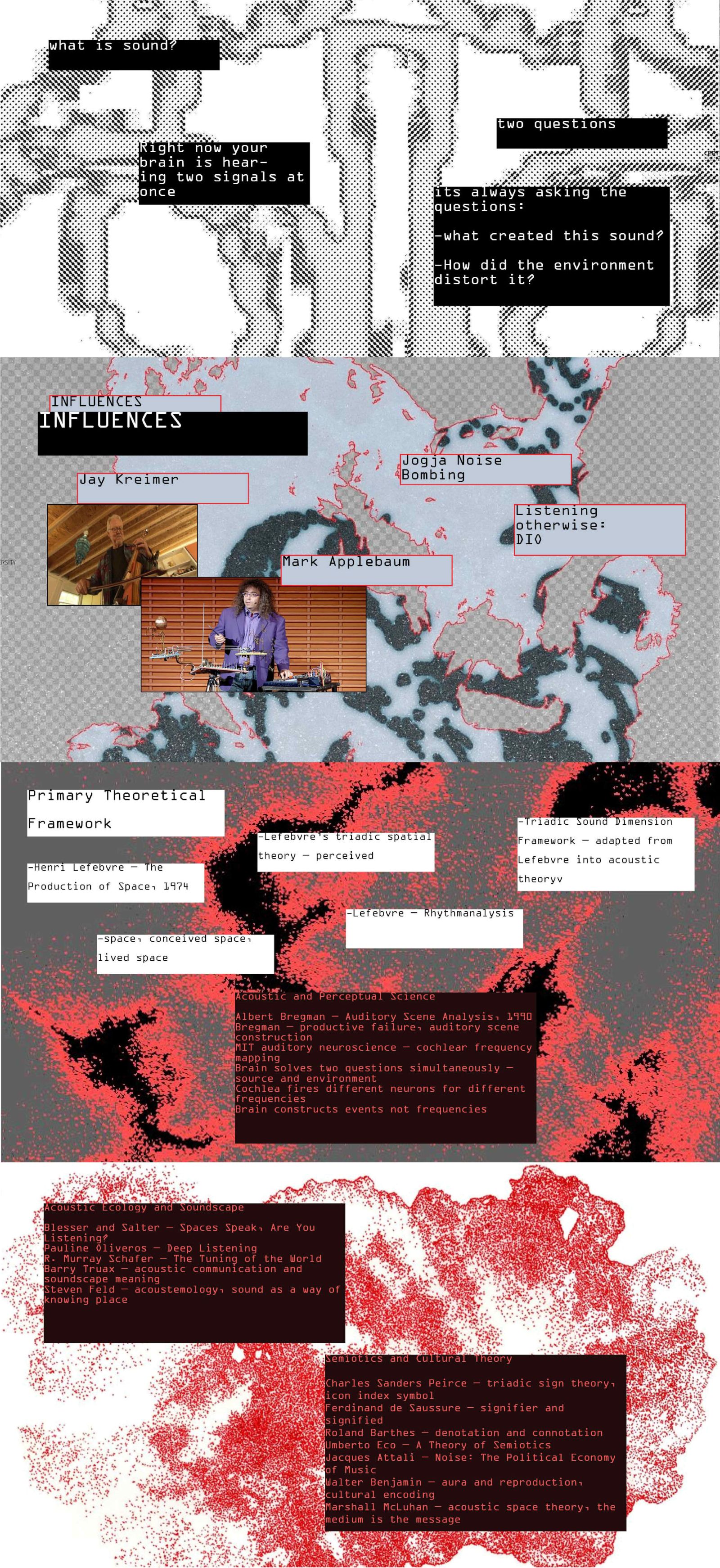
This project explores the Triadic Sound Dimension: a framework that understands sound as simultaneously physical, perceptual, and spatially produced through experimental sound and live electronics. Drawing from Henri Lefebvre’s Production of Space and his triadic spatial theory, the work approaches sound not as an isolated acoustic object, but as something inseparable from the environment, material conditions, and spatial relationships through which it emerges. The project also engages Albert Bregman’s theory of Auditory Scene Analysis, which proposes that listening is an active cognitive process in which the brain continuously organizes, separates, and interprets sonic information to construct perceptual reality
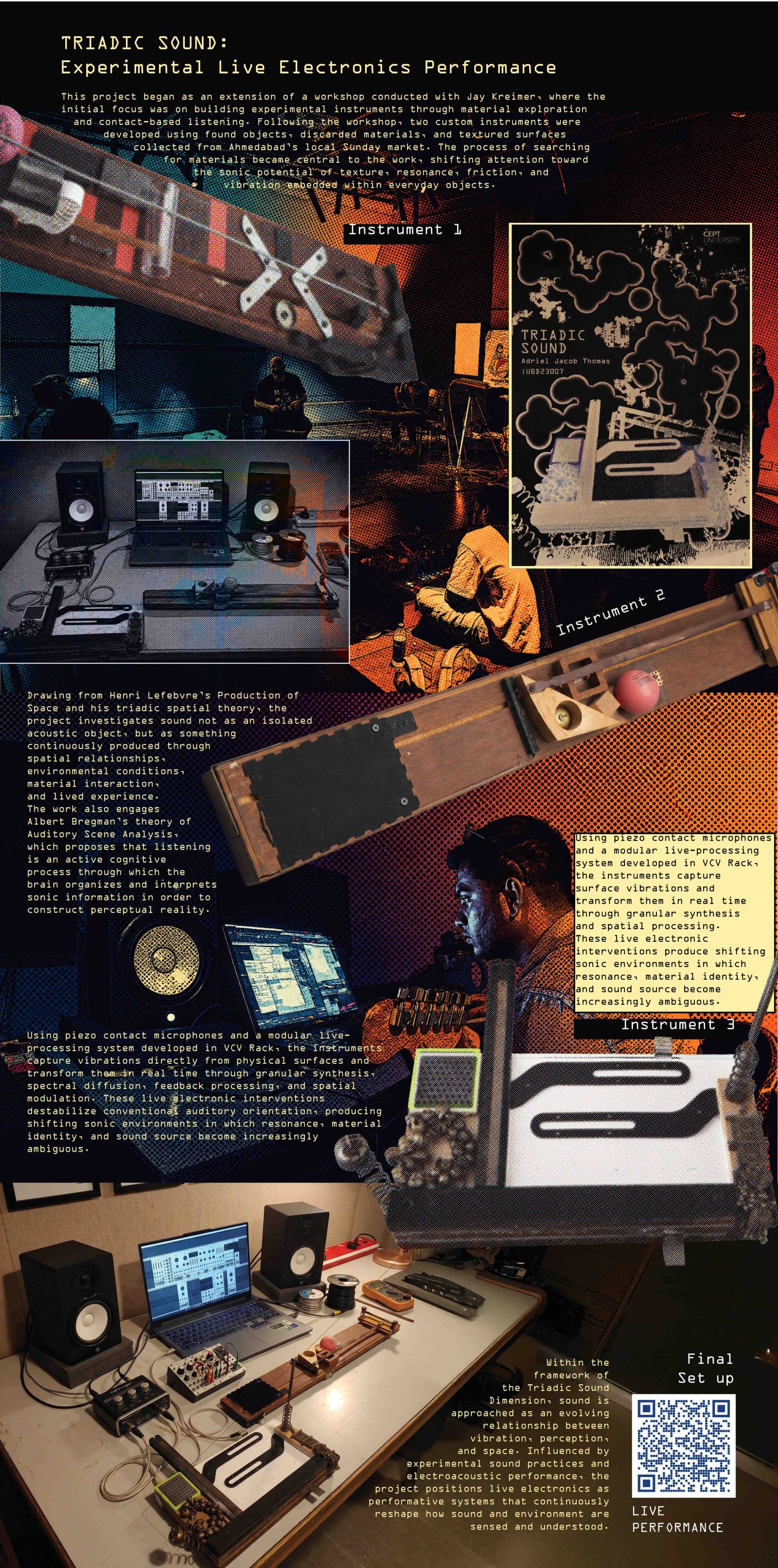
Using a piezo contact microphone and a modular live-processing system built in VCV Rack, the instrument captures material vibrations directly from physical surfaces and transforms them in real time through granular synthesis, spectral diffusion, and spatial modulation. These live electronic processes disrupt conventional auditory orientation, producing shifting sonic environments in which source, space, and resonance become increasingly ambiguous.
Within the Triadic Sound Dimension, sound is treated not as a singular acoustic object, but as a continuously evolving relationship between vibration, perception, and spatial experience. Influenced by experimental sound practices and theories such as auditory scene analysis and acoustic space, the project positions live electronics as an active performative system that reshapes how sound is sensed, located, and understood.