Your browser is out-of-date!
For a richer surfing experience on our website, please update your browser. Update my browser now!
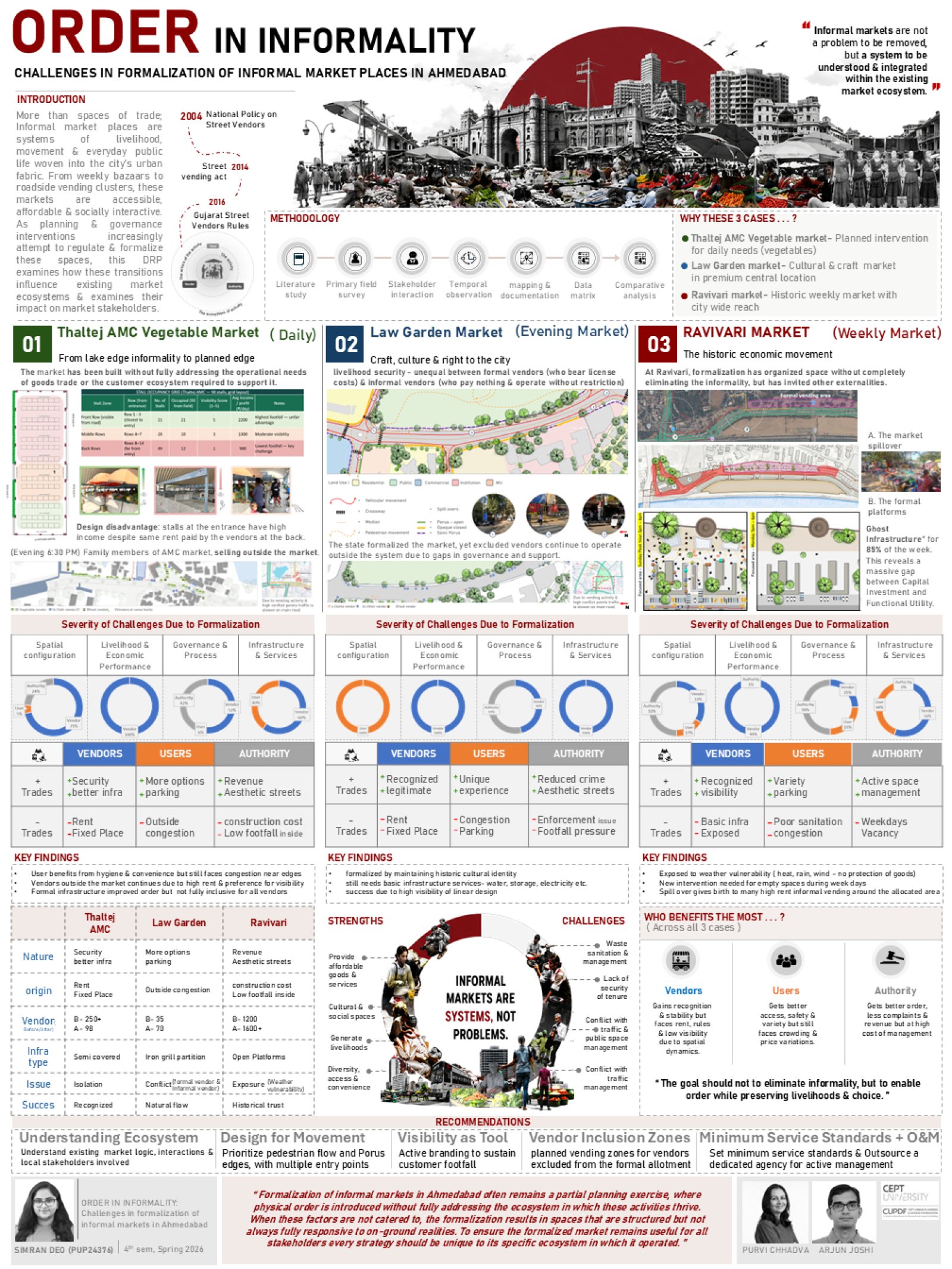
This research investigates the processes through which urban planning and governance interventions attempt to formalize historically informal markets in Ahmedabad. Street vending is examined not as an unregulated activity, but as a structured spatial-economic system that is integral to Indian urban life. Through a comparative study of three distinct sites: the Thaltej AMC Vegetable Market, the Ravivari (Sunday) Market, and Law Garden. This study analyzes how formalization strategies transition these spaces from organic entities into managed urban environments. The methodology is grounded in primary data collection, including extensive field surveys, stakeholder interactions, and temporal observations conducted across different times of the day to capture the dynamic nature of these markets. To evaluate these transitions, the study utilizes a data-driven matrix that organizes spatial information and numerical data to assess the impact of formalization on 3 key stakeholders involved in this ecosystem of activity: the Vendor, the User, and the Authority. By comparing these case studies, the research aims to identify where the primary challenges lie when static planning frameworks are applied to fluid informal systems. The goal of this work is to determine the specific benefits and drawbacks for each stakeholder, providing a clearer understanding of how formalization affects economic efficiency and spatial organization in the Indian context.