Your browser is out-of-date!
For a richer surfing experience on our website, please update your browser. Update my browser now!
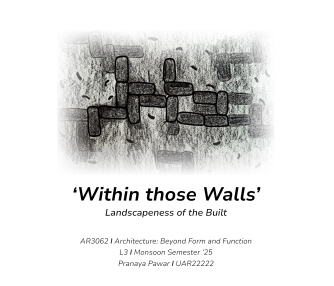
We’re conditioned to think of ‘Architecture’ and ‘Landscape’ as nouns, but not as verbs. Everything built is considered architecture, while the open and/ or the peripheral are seen as landscape. What if we reframe them as verbs instead?
Outside our profession, language already does—Ambedkar is called the architect of India’s Constitution, and shifting global dynamics are described as political landscapes. Here, something orchestrated and curated is architecture, while something fluid and evolving is landscape. By this logic, the Mughal Garden at Taj Mahal, though open, is "architectured". And, the corridors of IIM-Bangalore, though built, are "landscaped".
Felix Guattari in "The Three Ecologies", expands ecology beyond the environmental/ natural to include social and mental dimensions. Our idea of landscape remains constrained to the natural. There is a need to broaden how we perceive and represent landscape (and architecture).
The studio urges students to see architecture and landscape as verbs—unlocking multiplicity in spatial expression. It explores the built environment as landscape, transcending form and function to craft spaces shaped by movement, experience, time, and memory.
Students will design a public building or a campus with enough complexity to engage with mental, social, and environmental landscapes—revealing architecture as a living and ever-evolving entity.