Your browser is out-of-date!
For a richer surfing experience on our website, please update your browser. Update my browser now!
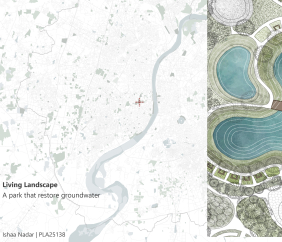
The health of a city’s green infrastructure directly impacts the health of a city. Of all the UGIs, parks play a vital role in regulating and detoxifying a city’s pollution. This studio investigates the interdependencies between ecological performance and human well-being, positioning parks as infrastructures of health.
This studio process commences with study of two high performing parks in the city of Ahmedabad, through a multi layered framework. The parameters studied under each of these layers are as follows: Firstly, ‘Ecological Health’ addressing biodiversity, reducing urban heat stress, carbon sequestration, ground water recharge and corridor connectivity. Secondly ‘Human health’ addresses the impact of shaded outdoor spaces, air quality, interactions, inclusivity and safety.
From this analysis, students derive a ‘kit of parts’ - adaptable design components that strengthen the resilience and livability of public spaces. Through site visits, QGIS mapping, quadrant studies, and surveys, students investigate underperforming parks with potential for revival. Final student proposals include applying the ‘kit of parts,’ enhancing the degraded or underperforming parks, evaluating the performance based on public health and producing design frameworks that translate health metrics into spatial strategies, envisioning how resilient, people-centered park design can reinforce Ahmedabad’s ecological networks enhancing public health.