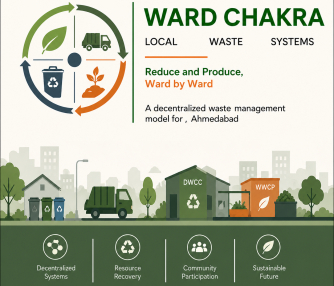
Ahmedabad, one of India’s fastest-growing metropolitan cities, generates nearly 4,500–5,000 tonnes of municipal solid waste per day. Over the past decade, the Ahmedabad Municipal Corporation (AMC) has made significant efforts to improve solid waste management (SWM) through door-to-door collection, mechanised transport, and landfill remediation. However, the system remains highly centralised and heavily dependent on long-haul waste transportation, transfer stations, and the large regional landfill at Pirana.
Centralised waste systems face several challenges:
• High transportation and fuel costs.
• Increased greenhouse gas emissions.
• Inefficient segregation and resource recovery.
• Pressure on landfills and limited lifespan of disposal sites.
• Exclusion or marginalisation of informal waste workers.
In contrast, decentralised SWM models—such as ward-level composting, material recovery facilities (MRFs), decentralised biomethanation plants, and community-level segregation systems—are increasingly recognised as environmentally sustainable, economically viable, and socially inclusive.
While several Indian cities (e.g., Indore, Ambikapur, Varanasi) have adopted decentralised approaches with measurable efficiency gains, Ahmedabad’s decentralisation efforts remain fragmented. There is a critical need to systematically assess the feasibility, effectiveness, and scalability of decentralised SWM systems in the context of Ahmedabad’s socio-economic, infrastructural, and institutional realities.
This research proposes to evaluate current practices, identify gaps, and outline feasible decentralised models tailored to the city’s needs.