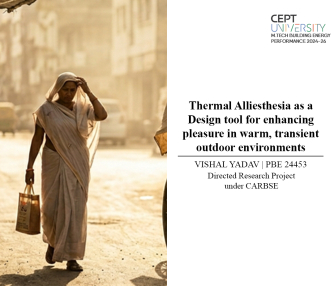
Thermal alliesthesia as a design tool to enhance pleasure in warm, transient outdoor environments.
Thermal comfort research has conventionally focused on achieving thermal neutrality, especially for
indoor steady-state conditions, often overlooking hedonic pleasure in transient outdoor environments.
This study explores thermal alliesthesia as a design-assistance metric to enhance thermal pleasure
under warm outdoor conditions. Thermal alliesthesia describes a state-dependent
psychophysiological phenomenon in which identical thermal conditions may be perceived as pleasant
or unpleasant depending on the human body’s thermoregulatory state. The research aims to identify
optimal contact surface temperatures for different bench components (seat, backrest, handrest, and
legrest) in outdoor seated conditions to induce sufficient thermal pleasure and improve overall
comfort. These temperature ranges are evaluated for their effectiveness in shifting whole-body
Thermal Comfort Vote (TCV) from discomfort toward near-comfortable conditions across varying heat
stress levels defined by the Universal Thermal Climate Index (UTCI). Additionally, the study examines
the duration of thermal pleasure following the application of local cooling stimuli. A simulation
framework integrating the JOS-3 multi-segment thermoregulation model with transient and non
uniform thermal comfort models is implemented in Python.