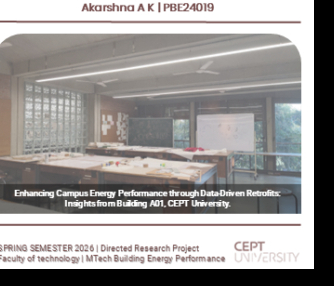
Energy-Efficient HVAC Design for Academic Buildings in Hot-Dry Climates: Case of Building A01, CEPT University
Thermal comfort and indoor air quality (IAQ) play an
essential role in ensuring productivity and wellbeing within institutional environments,
directly influencing learning and work efficiency. However, maintaining these parameters
often increases energy use, highlighting the need for balanced, demand-based HVAC
strategies in educational settings. In an architecture and design campus, the challenge is
particularly complex. Studio spaces operate with variable occupancy, diverse internal loads,
and occasionally 24-hour use during peak academic periods, leading to inconsistent cooling
and ventilation demands. This underscores the need for developing adaptive, climate
responsive, and demand-based HVAC strategies tailored to educational settings. This research focuses on developing a data-driven approach to evaluate and optimize HVAC
systems in hot-dry climates, taking the CEPT University campus in Ahmedabad as a case
context. The first phase involves developing a tool that can process raw electricity
consumption data from different campus buildings to automatically generate insights on
consumption patterns, peak demand, and operational inefficiencies. The second phase
applies these insights to Building A01, exploring retrofit HVAC design strategies that
integrate ASHRAE Standard 62.1 for IAQ and the IMAC adaptive comfort model, along with relevant passive design measures. The study aims to create a scalable framework for
energy-efficient HVAC design in academic buildings.