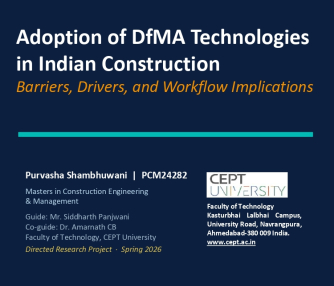
Adoption of DFMA (Design for Manufacture & Assembly) Technologies in Indian Construction: Barriers, Drivers, and Workflow Implications
Design for Manufacture and Assembly (DFMA) represents a major shift from labour-intensive, in-situ construction toward
industrialised, standardised, and digitally coordinated delivery models. Globally, DFMA encompasses a family of
technologies such as precast concrete, 2D panelised and 3D modular systems, light-gauge steel framing (LGSF),
prefabricated bathroom/MEP pods, hybrid precast–in-situ systems, and emerging automated fabrication approaches like 3D
Concrete Printing (3DCP). These methods promise faster execution, improved quality, better cost predictability, and safer
working conditions.
In India, however, DFMA adoption remains limited and inconsistent. Despite successful pilots in housing, industrial buildings,
and public infrastructure, contractors report barriers such as high upfront cost, limited design integration expertise, supply
chain fragmentation, absence of clear regulations, and uncertainty about the business case. Existing adoption studies from
Australia, Singapore, China, and Europe classify such challenges using Technology–Organisation–Environment (TOE)
frameworks, but India-specific empirical evidence remains scarce.
This DRP examines how Indian construction professionals perceive DFMA, what factors influence adoption, and how DFMA
would alter day-to-day site workflows. Using interviews, a short survey, and international case reviews, the study aims to
develop a practical DFMA Adoption Readiness Framework for contractors.